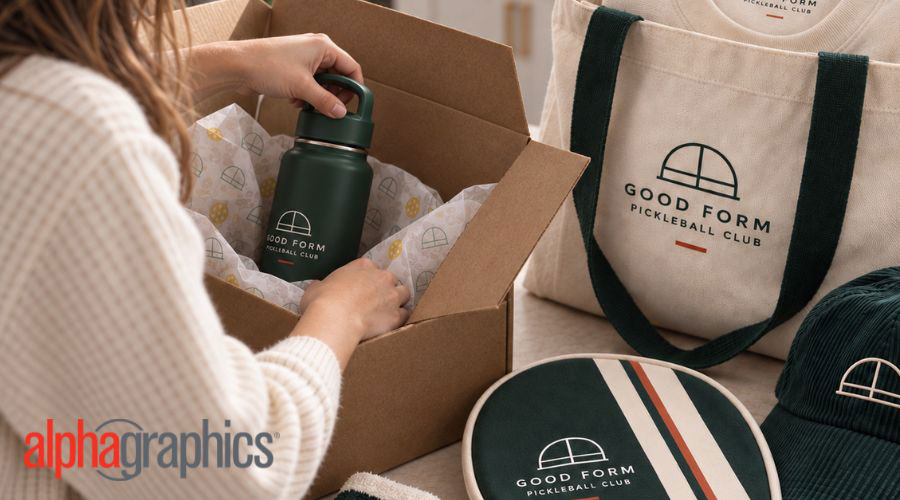
Sourcing corporate swag means choosing branded merchandise that fits the recipient, purpose and brand, then confirming the product, decoration method, artwork requirements and production details before ordering. The best starting point is not “What should we put our logo on?” but “What would this audience actually want to use?”
That distinction matters. Useful, high-quality products that feel relevant to the recipient are more likely to be kept and used. The goal is to choose merchandise that earns a place in someone’s routine rather than simply finding another place to put your logo.
What counts as corporate swag?
Corporate swag is branded merchandise an organization gives to employees, customers, prospects, event attendees or other audiences. Common categories include apparel, drinkware, bags, writing instruments, technology accessories and other practical items.
The purpose can vary just as much as the product. Swag may be used for employee onboarding, recognition, client appreciation, events, conferences, recruiting or marketing campaigns. The right item depends on who is receiving it and why.
How do you choose swag people actually keep?
Choose for usefulness, quality and relevance before novelty. The best corporate swag fits naturally into the recipient’s day: drinkware they will reach for, a bag they can use regularly, apparel they would choose to wear or another item that serves a practical purpose. Quality matters, too. Products that feel useful and well made are more likely to stick around.
Relevance matters just as much. A product does not need to be flashy to make an impression; it needs to make sense for the audience and feel intentional coming from your brand.
Before choosing an item, ask:
-
Who will receive it?
-
Where and how are they likely to use it?
-
Does the item solve a small, real problem or fit naturally into their routine?
-
Does the quality feel consistent with the brand giving it?
-
Would the item still be useful if the logo were removed?
That last question is a useful filter. A product that earns a place in someone’s day has a better chance of being kept than something selected only because it can carry a logo.
How much should you budget per person?
There is no single national per-person budget for corporate swag. Product type, quantity, decoration method, number of imprint colors or stitches, packaging, shipping and other project requirements can all affect cost.
Instead of starting with a fixed price point, build the budget around the purpose of the program and the number of recipients. A broad giveaway, an employee welcome kit and an executive gift have different jobs, so they should not automatically use the same product strategy or spend.
A useful planning framework is:
| Program type |
Prioritize |
Budget questions to answer |
| Broad distribution |
Utility and simple fulfillment |
How many recipients? Does the item need individual shipping? |
| Employee or client gifting |
Quality, relevance and presentation |
Is packaging part of the experience? Is personalization needed? |
| Executive or high-touch gifting |
Fit, quality and restraint |
Would one stronger item be more appropriate than several items? |
Once the program is defined, compare quotes using the same specifications rather than comparing the base product alone. Decoration, setup, packaging, freight and fulfillment all contribute to the total project cost.
How far ahead do you need to order corporate swag?
Lead time varies by the product, decoration method, quantity and complexity of the order, so there is no universal production timeline. PPAI notes that some production methods require additional setup; for example, die casting requires mold creation, which can lengthen lead times and make late changes more difficult.
The safest approach is to work backward from the date the merchandise must be in hand, not the date of the event itself. Build time into the schedule for product selection, artwork preparation, proofs or samples when applicable, production, shipping and distribution.
For holiday gifting in particular, confirm the actual production and shipping schedule for the products you are considering before committing to an in-hands date. Avoid assuming that every product or decoration method follows the same timeline.
How do decoration methods affect the final product?
Decoration is the process used to add a logo, message or design to the item, and the method should be matched to both the product and the artwork. Common approaches include screen printing, embroidery, laser engraving and heat-transfer methods. Different methods suit different materials, artwork and quantities.
Artwork matters too. PPAI’s apparel guidance recommends high-quality art and notes that vector artwork can be especially useful for processes such as embroidery and cut-vinyl decoration because it can be scaled without losing sharpness. Providing high-quality, print-ready vector artwork avoids delays in the production process and ensures the final product looks its best.
Before finalizing an item, confirm:
-
Which decoration methods are appropriate for the product
-
The available imprint area
-
How many colors the design uses
-
Whether the artwork meets production requirements
-
Whether a virtual proof or physical sample is appropriate before the full run
How do you keep branding consistent across locations?
Start with one shared set of approved brand assets and specifications. The more locations, teams or vendors involved, the more important it becomes to define which logo files, colors, placements and product standards are approved before orders are placed.
For each item, use approved brand assets and confirm the decoration method and specifications appropriate for the product.
A simple brand-control file can include:
-
Approved logo files
-
Approved logo variations
-
Brand color specifications
-
Minimum or preferred logo sizes
-
Preferred decoration methods
-
Examples of approved placements
-
A list of products or categories approved for the program
What are the most common swag sourcing mistakes?
Most sourcing problems begin before production: choosing an item without considering the recipient, prioritizing novelty over usefulness, using low-quality artwork, or waiting until the in-hands date is too close to comfortably accommodate production and shipping.
The first two are especially important. Merchandise that is not useful or feels poorly made is less likely to create the experience you intended. A lower unit cost does not necessarily create better value if the product is quickly discarded or never used.
Watch out for these common mistakes:
-
Choosing the item before defining the audience and purpose
-
Selecting on unit cost alone instead of considering usefulness and quality
-
Assuming every product has the same production timeline
-
Submitting artwork without confirming production requirements
-
Adding too much information to a small imprint area
-
Changing products or artwork after production details have been approved
-
Ordering for multiple locations without a shared brand standard
A practical corporate swag sourcing checklist
-
Define the audience and purpose
-
Set the total program budget rather than relying on a universal per-item price
-
Choose products based on usefulness, quality and relevance
-
Confirm quantities and delivery locations
-
Select the decoration method
-
Provide approved, production-ready brand assets
-
Confirm proofing or sampling requirements
-
Verify the production and shipping timeline for the specific order
-
Review packaging and fulfillment needs
-
Approve final specifications before production
Good corporate swag sourcing is less about finding the largest catalog and more about making a series of deliberate choices. Start with the recipient, choose something useful enough to earn a place in their routine, and make sure the product, decoration and delivery plan all support the same goal.
Frequently Asked Questions
What is corporate swag?
Corporate swag is branded merchandise given to employees, customers, prospects, event attendees or other audiences. Common categories include apparel, drinkware, bags, writing instruments and technology accessories.
What makes a good promotional product?
A good promotional product is useful, well made and relevant to the recipient. Products that fit naturally into someone’s routine are more likely to be kept and used.
How much should a company spend on corporate swag?
There is no universal national price. Budget depends on the program, quantity, product, decoration, packaging, shipping and fulfillment requirements. Decoration costs can also vary by quantity and design complexity.
How early should corporate swag be ordered?
There is no universal lead time. Work backward from the in-hands date and confirm the actual production and shipping schedule for the specific product and decoration method.