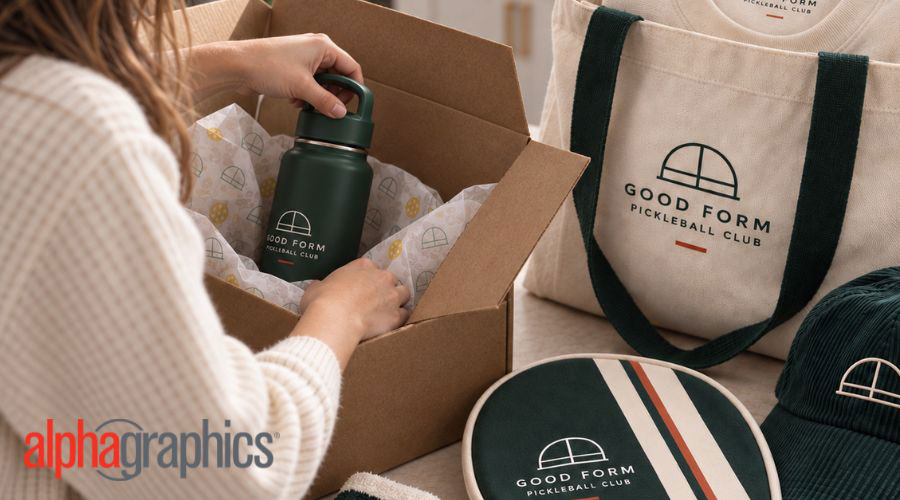
Employee swag works best when it feels like it was chosen for the person receiving it, not simply as another place to put a company logo. For new-hire welcome kits, that means choosing useful items that help someone feel prepared and connected to the company. For employee gifts, it means matching the gift to the moment, whether you're recognizing a milestone, celebrating a team accomplishment or saying thank you.
The best employee swag does not need to include a lot of items. A few useful, well-chosen products paired with a thoughtful message can create a more intentional experience than a box filled with items employees are unlikely to use.
What should be included in an employee welcome kit?
A new-hire welcome kit should combine practical information with a few items that help introduce the employee to the company and its culture.
Promotional Products Association International (PPAI) recommends considering a personalized welcome kit before a new employee's first day, including company information, a welcome letter and branded items. The exact contents should depend on the employee, their role and where they work.
Common welcome kit items include:
-
A personalized welcome note
-
A notebook or journal
-
Pens or other writing tools
-
Drinkware
-
Branded apparel
-
A tote, backpack or laptop bag
-
Desk or technology accessories
-
Information about the company's mission, values or culture
-
Role-specific materials the employee will need
Think of the kit as part of the onboarding experience rather than a standalone gift. The goal is to give the employee something useful while reinforcing the message: We're ready for you, and we're glad you're here.
How many items should go in a new-hire welcome kit?
There is no ideal number.
Start with the experience you want to create and the budget available for the program. A welcome kit with three useful products can be more effective than one with eight items selected primarily to fill the box.
Ask:
-
Will the employee actually use each item?
-
Does it make sense for their work environment?
-
Does the quality reflect the company?
-
Does every item serve a purpose?
-
Would one better item be preferable to several lower-value items?
Packaging matters, too. If multiple products are being presented together, think about how the employee experiences the kit when they open it rather than treating each product as a separate order.
What makes a good employee gift?
A good employee gift should feel relevant to both the recipient and the reason it is being given.
An onboarding gift has a different purpose than a five-year anniversary gift. A company-wide holiday gift has a different purpose than recognition for an individual accomplishment.
Gallup and Workhuman's workplace research identifies personalization, authenticity and equitable recognition among the characteristics of effective employee recognition.
That is a useful principle for employee gifting as well. Before choosing a gift, define the moment:
|
Occasion
|
What to prioritize
|
|
New employee
|
Welcome, usefulness and connection to the company
|
|
Work anniversary
|
Recognition of the milestone and the individual
|
|
Team accomplishment
|
Shared celebration
|
|
Employee appreciation
|
Gratitude and broad relevance
|
|
Holiday gift
|
Quality, usefulness and inclusive appeal
|
|
Individual recognition
|
Personalization and connection to the accomplishment
|
The product is only part of the experience. A short note explaining why the employee is being recognized can give the gift context that a branded item alone cannot provide.
What are good corporate swag ideas for employees?
The best category depends on your workforce, but useful employee swag commonly falls into a few groups.
Apparel
T-shirts, sweatshirts, jackets, hats and other apparel can work well when employees genuinely want to wear them.
Before ordering apparel, think beyond the logo. Consider fit, sizing options, material, climate and whether the style is something employees would choose for themselves.
Drinkware
Tumblers, water bottles and mugs are common because they can become part of an employee's daily routine. Consider where employees work and how they are likely to use the item.
Bags
Totes, backpacks, laptop bags and travel accessories can work particularly well when employees commute, travel or carry equipment between locations.
Desk and work accessories
Notebooks, journals, writing instruments, mouse pads and technology accessories can complement onboarding because employees can begin using them immediately.
Higher-touch gifts
For significant milestones or individual recognition, one higher-quality item may make more sense than a collection of smaller products.
Whatever category you choose, start with the recipient rather than the catalog.
What should you put in a welcome kit for a remote employee?
Remote employees may never receive the physical cues that naturally introduce an office-based employee to the company, so a mailed welcome kit can provide a tangible connection to the organization.
PPAI's remote-onboarding guidance recommends sending new employees useful company-branded products along with information about the company's mission and vision.
A remote welcome kit might include:
-
A welcome letter
-
A notebook and pen
-
Drinkware
-
A piece of apparel
-
Desk or technology accessories
-
Company information or culture materials
-
Items related to the employee's specific role
The kit should arrive at the employee's home or remote work location when possible, so collect shipping information and confirm fulfillment requirements before production begins.
Should every employee receive the same swag?
Not necessarily.
Consistency can make programs easier to manage, particularly for large organizations or companies onboarding employees throughout the year. But consistency does not have to mean every employee receives exactly the same product.
You might create a standard core kit and allow variation in:
-
Apparel size or style
-
Product color
-
Role-specific items
-
Office versus remote work needs
-
Geographic or climate considerations
-
Individual recognition gifts
For recognition programs in particular, personalization can matter. Gallup and Workhuman's research emphasizes that effective recognition is not necessarily one-size-fits-all.
The important distinction is between intentional personalization and inconsistent treatment. Establishing a clear program structure can help organizations offer choice while maintaining consistency.
How much should you spend on employee swag?
There is no universal national budget for an employee welcome kit or corporate gift.
Cost can vary based on:
-
Number of employees
-
Product selection
-
Quantity
-
Decoration method
-
Personalization
-
Packaging
-
Individual shipping
-
Fulfillment requirements
-
Frequency of the program
Instead of starting with a fixed per-person number, begin with the total program budget, number of recipients and purpose.
For example, an organization onboarding employees every month may prioritize a repeatable kit that can be stocked and fulfilled throughout the year. A milestone-recognition program may use fewer, more personalized gifts.
Compare the total program cost, not just the unit price of the products.
When should you order employee welcome kits?
Work backward from when employees need to receive them.
Production time varies by product, quantity, decoration, packaging and fulfillment requirements. A program involving several products packed into individual boxes and shipped to employees has more steps than an order of one branded item delivered to a single office.
Build time into the schedule for:
-
Product selection
-
Artwork preparation
-
Proofing or sampling when appropriate
-
Production
-
Kitting and packaging
-
Shipping
-
Individual distribution
For ongoing onboarding programs, consider creating a repeatable system rather than starting a new order every time someone is hired.
That may mean maintaining approved products and artwork, defining reorder points and establishing a process for submitting new employee names, sizes and shipping information.
How can you make an employee welcome kit feel more thoughtful?
Personalization does not have to mean putting someone's name on every item.
A thoughtful kit can be as simple as choosing useful products and explaining why they were selected.
Consider adding:
-
A welcome letter from the employee's manager or leadership
-
A note from the employee's team
-
Information about company traditions or culture
-
A personalized name card
-
Role-specific resources
-
A short explanation of the company's mission or values
One PPAI case study of a multi-location onboarding program describes welcome boxes that combined several branded items with explicit "Welcome to the Team" messaging and shipped them directly to new hires and interns.
The lesson is not that every company needs an elaborate box. It is that the products and the message should feel like one experience.
Can employee welcome kits be shipped directly to employees?
Yes, depending on the fulfillment program.
Direct-to-employee shipping can be particularly useful for:
-
Remote teams
-
Hybrid workforces
-
Companies with multiple locations
-
Employees starting at different times
-
National onboarding programs
If kits will ship individually, account for fulfillment when planning the program rather than treating it as the final step.
You will need a process for collecting accurate names, addresses, apparel sizes and any personalization information while handling employee information appropriately.
Also determine how inventory will be managed if the program runs throughout the year.
What are common employee swag mistakes?
Choosing products before defining the purpose
Start with the occasion and recipient. A product that makes sense for onboarding may not be the right choice for employee recognition.
Prioritizing quantity over usefulness
More products do not automatically create a better gift. Choose items employees have a reason to keep.
Forgetting about remote employees
If part of the workforce is remote, make sure the program can reach them without creating an entirely separate experience.
Treating the logo as the entire design
Not every item needs the largest possible logo. Consider the product, decoration method and how employees will actually use or wear it.
Waiting until the last minute
Product availability, decoration, proofing, packaging and individual shipping all affect the schedule.
Forgetting the message
Swag can support recognition, but it does not replace recognition. Tell employees why they are receiving the gift.
Employee welcome kit checklist
Before placing an order:
-
Define the purpose of the program
-
Identify the recipients
-
Set the total program budget
-
Decide whether the program is one-time or ongoing
-
Choose useful, audience-appropriate products
-
Confirm apparel sizes and variations
-
Prepare approved brand assets
-
Confirm decoration methods and imprint areas
-
Decide whether personalization is needed
-
Determine packaging and kitting requirements
-
Collect shipping information when needed
-
Confirm production and shipping timelines
-
Proof names, artwork and messaging
-
Establish a reorder process for ongoing programs
The best employee swag programs start with the employee, not the product. Whether you're welcoming someone on their first day or recognizing years of contribution, choose items that fit the moment, make sense for the recipient and reinforce the message you actually want to send.
Frequently Asked Questions
What should be in an employee welcome kit?
A welcome kit can include a welcome note, company information and a small selection of useful branded items such as a notebook, drinkware, apparel, a bag or work accessories. Choose the contents based on the employee and how they work.
What is a good welcome gift for a new employee?
A good new-employee gift is useful, relevant and appropriate to the company's culture. Rather than focusing on novelty, choose something the employee has a reason to use and pair it with a genuine welcome message.
How much should a company spend on a new-hire welcome kit?
There is no universal amount. Budget based on the number of employees, purpose of the program, product quality, decoration, packaging, shipping and fulfillment requirements.
Should remote employees receive welcome kits?
Remote employees can be included by shipping kits directly to their work location. Plan for individual addresses, sizing, fulfillment and shipping when building the program.
Is employee swag the same as employee recognition?
No. Swag can support a recognition program, but the product itself is not the recognition. Effective recognition should communicate what the employee is being thanked or recognized for.