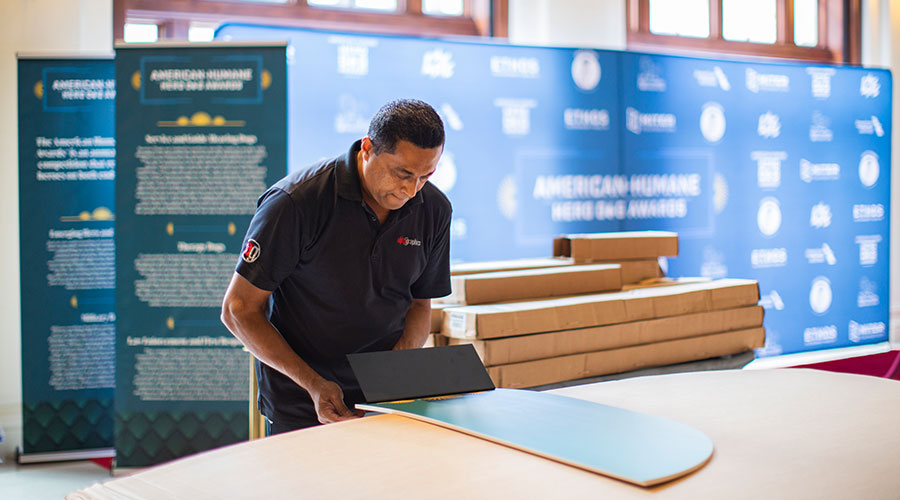
A fundraising gala typically needs signage that does three jobs: helps guests navigate the event, supports the program and fundraising activities, and fulfills sponsor-recognition commitments. A practical starting checklist includes a welcome or check-in sign, directional signs, sponsor recognition, a photo backdrop when appropriate, table identification, auction or fundraising signage, stage signage, and a printed or digital event program.
Not every gala needs every piece. The right event signage checklist depends on the venue, program, sponsorship agreements and fundraising activities. Start with what guests need to find and understand, then layer in sponsor visibility and event branding.
What signage does a gala need?
Most gala signage falls into three categories: wayfinding, program or fundraising support, and sponsor recognition. Fundraising-event planning resources commonly call for registration signage, programs, sponsor-recognition signage, auction materials and step-and-repeat or other event signage.
| Sign or printed piece |
What it does |
Where it may go |
Needed at every gala? |
| Welcome / check-in sign |
Confirms arrival and directs guests to registration |
Entrance or registration area |
Usually |
| Directional signage |
Helps guests find key spaces and activities |
Entrances, corridors, transitions |
Depends on venue |
| Sponsor recognition board |
Acknowledges event sponsors |
Registration, reception or other high-traffic area |
If promised in sponsorship benefits |
| Step-and-repeat backdrop |
Creates a branded photo location and can recognize sponsors |
Reception or photo area |
Optional |
| Table numbers / identification |
Helps guests find assigned seating |
Dining or program area |
If using assigned tables |
| Auction / fundraising signage |
Explains items, sections, bidding or donation activities |
Auction or fundraising areas |
If applicable |
| Stage signage |
Supports event branding or sponsor commitments near the program focal point |
Stage or presentation area |
Optional |
| Event program |
Provides program flow, event information and recognition |
At check-in or place settings; may also be digital |
Depends on event format |
Use the table as a planning framework, not a mandatory shopping list. A small dinner in one ballroom may need very little directional signage; a gala spread across a lobby, reception space, auction area and ballroom may need considerably more.
What is a step-and-repeat, and do you need one?
A step-and-repeat is a branded photo backdrop that repeats an organization’s logo, sponsor logos or both. Fundraising organizations commonly include step-and-repeat placement as a sponsorship benefit, and gala planning resources treat the backdrop as part of the event’s photography and sponsor-recognition system.
You need one only if it serves a purpose. It makes sense when the event includes professional photography, a red-carpet or arrival moment, media coverage, or sponsorship benefits tied to photo visibility. If guests will not be photographed in front of it, or sponsor agreements do not call for it, it may not be necessary.
Placement matters as much as the backdrop itself. Put the photo area somewhere guests naturally pass without blocking registration or circulation. Match materials and hardware to the actual environment, and check venue rules before event day.
How do you recognize sponsors on printed materials?
Start with the sponsorship agreement. Sponsor recognition should reflect what was promised at each sponsorship level rather than adding every logo to every surface.
Gala sponsorship packages commonly differentiate benefits by tier, including logo placement on event signage, step-and-repeat backdrops, programs, screens and other event materials. That makes the sponsorship matrix the best source of truth for deciding which logos belong where.
Before design begins:
-
List every sponsor and sponsorship level.
-
Document the recognition promised to each level.
-
Collect approved logo files and any applicable brand guidelines.
-
Map each promised benefit to a specific sign, program placement or digital display.
-
Confirm sponsor names and logos before final production.
This approach also helps prevent visual overload. Sponsor visibility should be intentional enough to fulfill the agreement without making every sign a wall of logos.
How far ahead should event signage be ordered?
There is no universal national production timeline for gala signage. Timing depends on the number and type of pieces, materials, finishing, installation requirements, proofing, and how quickly final sponsor assets are available.
One of the biggest scheduling risks is often sponsor artwork. Collect sponsor logos and brand assets early enough to allow time for design, proofing and signage production.
Work backward from the event date and set a sponsor-logo deadline before final artwork approval. That creates room for design, proofing, production and any installation or delivery requirements.
What sizes should gala signage be?
There is no single standard size that every gala should use. Size should be determined by viewing distance, venue layout, available hardware, the amount of content, and how many people need to appear in front of or interact with the sign.
For directional signs, prioritize quick comprehension: one clear message, an obvious arrow where needed, and enough contrast and type size to be readable from the point where guests make the decision.
For step-and-repeat backdrops, determine the size based on the photography plan and expected group size rather than choosing a dimension by default. For sponsor boards and stage signage, consider sightlines and where guests will encounter the piece.
Before designing any large-format sign, measure the installation area and confirm the venue’s rules. Some venues restrict tape, wall attachments or ground stakes, which can change the hardware or format required.
Can sponsors pay for gala signage?
Yes. Gala signage can be structured as a sponsorship benefit because event sponsors are often promised visible recognition in exchange for their support. Current and recent nonprofit sponsorship packages show organizations offering sponsor logo placement on event signage, step-and-repeat backdrops, programs and other event materials as part of sponsorship tiers.
That does not mean a sponsor automatically pays a printer’s invoice directly. Instead, sponsorship revenue can help fund the event while the organization fulfills the recognition benefits described in the sponsorship package.
If signage is part of the sponsor value proposition, define the benefit before sponsorships are sold. That gives the event team a clear framework for logo hierarchy, placement and production.
What gala signage can be reused next year?
Signs without changing dates, sponsor rosters, honoree names or event-specific details are the easiest to reuse. Reusable hardware can also be retained while printed inserts or graphics are replaced.
Potentially reusable pieces include:
-
Generic organization-branded welcome signs
-
Directional sign holders or A-frame hardware
-
Retractable banner stands with replaceable graphics
-
Table-number holders
-
Generic donation or mission signage
-
Photo-backdrop hardware
-
Frames, easels and other display hardware
Sponsor signage usually needs more scrutiny because sponsors and benefit levels can change. Keep dates and other event-specific details off pieces intended for reuse, and build consistent templates that can be updated for future events.
A final event-day signage walk
Before guests arrive, walk the venue in the same order they will experience it. Focus on clear guest flow and place signs where people actually need information.
-
Can guests tell where to enter and check in?
-
At every decision point, is the next destination obvious?
-
Are auction or fundraising instructions visible where the activity happens?
-
Are table numbers easy to find?
-
Does sponsor recognition match the promised benefits?
-
Is the photo area accessible without blocking traffic?
-
Can important signs be read from the distance at which guests will encounter them?
-
Are all signs installed using methods approved by the venue?
If a guest has to stop and ask where to go, that is usually the place to reconsider the wayfinding. Good gala signage should make the event easier to navigate without becoming the event itself.
Frequently Asked Questions
What signs are needed for a fundraising gala?
Start with welcome or registration signage, wayfinding, sponsor recognition, table identification, and any signage needed for auctions or fundraising activities. Step-and-repeat and stage signage depend on the event format and sponsorship commitments.
Does every gala need a step-and-repeat?
No. A step-and-repeat is most useful when the event includes a planned photography moment, media coverage or sponsor benefits tied to photo visibility.
How should sponsors be recognized at a gala?
Use the sponsorship agreement as the guide. Gala sponsorship packages commonly assign different logo placements and recognition opportunities to different sponsorship tiers.
How early should gala signage be ordered?
There is no universal production timeline. Work backward from the event date and confirm the schedule for the specific signs, materials, proofs, delivery and installation required. Set a sponsor-logo deadline early enough to protect that schedule.
Can gala signage be reused?
Yes, especially hardware and signs without dates, sponsor names or other changing information. Reusable templates and replaceable graphics can make annual events easier to update.