Year-end appeals should arrive in donors’ mailboxes before Giving Tuesday, which falls on December 1 in 2026. Working backward, aim to have your appeal in the mail by November 6, with artwork, donor data and mailing lists finalized by the third week of October.
A successful year-end appeal mailing timeline is less about picking a mail date and more about working backward from when you want donors to receive and respond to your message. Giving your team enough time for writing, design, printing, personalization and mailing can help prevent rushed decisions at one of the most important fundraising moments of the year.
When should a year-end appeal arrive?
For a Giving Tuesday-focused campaign, your year-end fundraising letter should ideally be in donors’ hands before December 1.
That gives recipients time to read your message and consider their gift before Giving Tuesday arrives. It also avoids relying on a single day to drive your entire year-end fundraising effort.
Organizations planning a broader year-end campaign may continue communicating with donors throughout December, but the initial appeal should reach them early enough to start the conversation, not arrive after year-end fundraising is already underway.
What is the mail date you have to work backward from?
For 2026, a useful target is to have your year-end appeal in the mail by November 6 if you want it to arrive ahead of Giving Tuesday.
That means the November mail date shouldn't be the beginning of your planning process. By then, the major decisions should already be made.
| Milestone |
2026 target |
Primary owner |
| Finalize appeal strategy and message |
Early October |
Development team |
| Finalize creative and donor list |
Third week of October |
Development + marketing |
| Approve final artwork and personalization |
Late October |
Development team |
| Print, personalize and prepare mailing |
Late October–early November |
Print/mail partner |
| Mail year-end appeal |
By November 6 |
Print/mail partner |
| Appeal arrives |
Before December 1 |
N/A |
| Giving Tuesday |
December 1 |
Development team |
Build some breathing room into your schedule whenever possible. Changes to donor lists, approvals, personalization or artwork can quickly compress the production window.
What goes in a year-end appeal package?
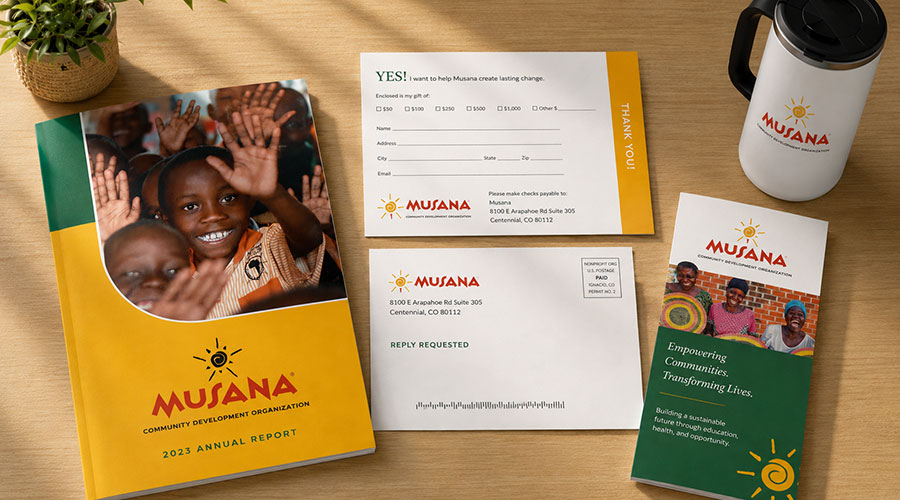
A typical nonprofit year-end appeal package includes an appeal letter, reply device, reply envelope and outer envelope, with an optional insert when additional information is useful.
Each piece has a different job. The outer envelope gets the appeal opened. The letter tells the story and makes the case for giving. The reply device makes the requested action clear, while the reply envelope removes friction for donors who prefer to give by mail.
An insert can be useful for impact statistics, a short program update or other information that supports the appeal without overcrowding the letter itself.
For donors who prefer to give online, the printed appeal can also provide a clear URL or QR code leading to the organization’s donation page.
Should you personalize the ask amount?
Personalizing suggested donation amounts can make a year-end appeal more relevant to individual donors, particularly when an organization has reliable giving-history data.
Rather than sending every donor the same suggested amounts, variable data printing allows elements of the appeal to change based on information in the donor list. That could include the recipient's name, previous giving behavior or suggested gift amounts.
For example, someone who has historically donated $250 doesn't necessarily need the same suggested giving ladder as someone whose typical gift is $25.
Personalization should be intentional, though. Good data is a prerequisite. Before using variable information, review your donor database for duplicates, outdated addresses, inconsistent fields and missing information. A personalization error can undermine the very sense of connection you're trying to create.
How long does a nonprofit mailing take to produce?
For a November 6 mail date, plan to have your artwork and mailing list finalized approximately two weeks earlier, during the third week of October.
The exact production schedule depends on the size and complexity of the mailing. A simple letter-and-envelope package will have different requirements than an appeal using multiple pieces, custom finishing or extensive variable data.
Your timeline also needs to account for work that happens before anything reaches the press: final copy approval, design revisions, donor-list cleanup, proofing and personalization setup.
One of the easiest ways to protect the schedule is to establish one final approval date for both creative and data. If either continues changing while production is underway, the mailing timeline can move with it.
What does a year-end appeal cost?
There isn't one standard price for a nonprofit year-end appeal because cost depends on the specifications of the mailing.
The biggest variables typically include:
-
Number of recipients
-
Number of pieces in the package
-
Paper and envelope selections
-
Color and finishing requirements
-
Personalization or variable data
-
Mailing-list preparation
-
Postage and mailing method
For that reason, cost per mailed appeal is usually more useful than comparing printing prices alone.
A less expensive print option isn't necessarily less expensive overall if it requires additional manual work, separate vendors or additional mailing preparation. When comparing estimates, make sure each quote includes the same scope so you're comparing the full project rather than one line item.
Can a sponsor pay for year-end appeal printing?
Generally, a traditional year-end fundraising appeal is not the best place to use sponsor recognition to offset printing costs.
Sponsorship works particularly well for fundraising events because sponsor logos naturally belong on programs, recognition boards, banners and event signage. A donor appeal is different: the communication should remain focused on the nonprofit's mission and the donor's relationship with the organization.
If sponsorship dollars are available, consider using them for a gala or other fundraising event where sponsor recognition provides clear value to the sponsoring organization.
Start with the date that can't move
For a year-end appeal, the most useful planning question isn't, “When should we start?” It's, “When does this need to be in donors' hands?”
Once you establish that date, work backward through mailing, production, approvals, data preparation, design and writing. For nonprofits targeting Giving Tuesday 2026, that means planning around a November 6 mail date and having the major pieces finalized in October.
The earlier those decisions are made, the more room your team has to focus on the message itself instead of racing the production calendar.
Frequently Asked Questions
When should nonprofits send year-end appeal letters?
For a Giving Tuesday campaign in 2026, aim to mail by November 6 so the appeal can reach donors before December 1.
When is Giving Tuesday in 2026?
Giving Tuesday falls on December 1, 2026.
What should be included in a year-end fundraising appeal?
A typical mailed appeal includes the fundraising letter, an outer envelope, a reply device and a reply envelope. Some campaigns also include an insert.
Can nonprofit direct mail be personalized?
Yes. Variable data printing can personalize names, messaging and suggested gift amounts using information from a nonprofit's donor database.
How early should a nonprofit start planning its year-end appeal?
For a November 6 mail date, the campaign should already be in development in early October, with creative and donor data finalized around the third week of October.