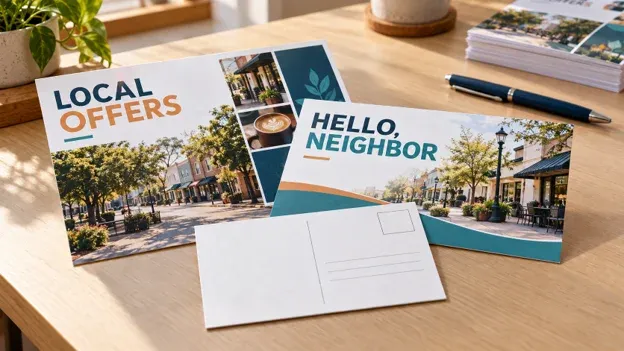
A standard postcard size is 4 × 6 inches. For a card mailed with a retail First-Class postcard stamp, USPS allows dimensions from 3½ × 5 inches to 4¼ × 6 inches. Qualifying commercial First-Class postcards can be larger—up to 6 × 9 inches.
That difference matters when you are planning a business mailing. The right size depends on your message, audience, and mailing method. A customer reminder, a restaurant offer, and a neighborhood introduction do not all need the same format.
Before you approve the design, decide how the piece will be mailed. That helps you avoid printing a card that costs more to send than expected—or does not qualify for the program you intended to use.
What Are the USPS Postcard Size Requirements?
USPS has separate rules for retail postcard postage and commercial First-Class postcard pricing. “Postcard” describes a printed format, but it does not tell you which postage price applies.
Retail First-Class postcards
For postcards mailed individually with a postcard stamp, the USPS retail requirements include:
-
Minimum size: 3½ inches high × 5 inches long.
-
Maximum size: 4¼ inches high × 6 inches long.
-
Thickness: 0.007 to 0.016 inches.
-
Maximum weight: 3.5 ounces.
-
Shape: Rectangular.
A finished 4 × 6 card fits those size limits. A 5 × 7 or 6 × 9 card exceeds them and needs a different postage price when mailed at retail.
Commercial First-Class postcards
Under USPS commercial postcard standards, qualifying postcards may measure up to 6 inches high × 9 inches long and have a maximum thickness of 0.016 inch.
Cards taller than 4¼ inches or longer than 6 inches need a minimum thickness of 0.009 inches. For commercial card prices, the length-to-height ratio must generally be between 1.3 and 2.5. The address layout and mailing preparation must also meet USPS standards.
This means a 5 × 7 or 6 × 9 postcard can qualify for commercial First-Class postcard pricing. It does not mean you can put a retail postcard stamp on it.
Commercial First-Class mailings generally require at least 500 pieces and meet applicable preparation requirements.
USPS Postcard Size Chart for Business Mailings
Use this chart to compare common finished sizes. The EDDM column shows whether the dimensions meet the program’s size threshold; it does not establish complete eligibility.
|
Finished size
|
Retail postcard dimensions
|
Commercial postcard dimensions
|
EDDM Retail size threshold
|
Possible business use
|
|
4 × 6 inches
|
Yes
|
Yes
|
No
|
Reminders and simple announcements
|
|
4¼ × 6 inches
|
Yes
|
Yes
|
No
|
Short offers and customer updates
|
|
5 × 7 inches
|
No
|
Yes
|
No
|
Invitations and focused promotions
|
|
6 × 9 inches
|
No
|
Yes
|
No
|
Offers with a headline, image, and supporting details
|
|
6 × 11 inches
|
No
|
No
|
Yes, by length
|
Menus and neighborhood promotions
|
|
6½ × 9 inches
|
No
|
No
|
Yes, by height
|
Local EDDM campaigns
|
|
8½ × 11 inches
|
No
|
No
|
Yes, by height
|
Menus, maps and multiple offers
|
|
6½ × 12 inches
|
No
|
No
|
Yes, by height and length
|
Larger promotional layouts
|
Thickness, weight, flexibility, layout and preparation still matter. Confirm the complete specifications before printing.
First-Class Mail, Marketing Mail or EDDM: Which Should You Choose?
First-Class Mail: for addressed mailings
First-Class Mail can be a useful choice when you are mailing to specific customers or prospects and delivery timing matters.
For smaller mailings, retail postage offers a straightforward way to send individual pieces. For larger campaigns, ask whether commercial First-Class pricing is available. USPS lists a 500-piece minimum for commercial First-Class prices.
A 6 × 9 card may be worth considering if your message needs more room and your mailing qualifies for commercial postcard pricing.
USPS Marketing Mail: for promotional campaigns
USPS Marketing Mail is an option for eligible advertising sent to an addressed mailing list. It generally requires at least 200 pieces or 50 pounds of mail.
Pricing depends on preparation, destination, weight, and whether the piece qualifies as a letter or flat. There is no single Marketing Mail price that applies to every business postcard.
Compare the full campaign cost with your mailing provider. A larger card may still fit an economical mailing category, but you also need to include printing and preparation costs.
Every Door Direct Mail: for reaching selected neighborhoods
Every Door Direct Mail, or EDDM, lets you reach addresses along selected postal routes without purchasing a list of individual names and addresses.
For example, a Conroe restaurant introducing a takeout menu could consider routes near its location. A home services company could choose routes within the area it serves. EDDM reaches the selected routes rather than a handpicked list of individual households.
EDDM Retail has its own size rule: the piece must be more than 10½ inches long, more than 6⅛ inches high, or more than ¼ inch thick. It must weigh no more than 3.3 ounces. Maximum dimensions are 15 inches long × 12 inches high × ¾ inch thick, and the piece must meet the applicable flexibility and uniform-thickness standards.
An ordinary thin 6 × 9 card does not meet that threshold. A 6 × 11 card can qualify by length, while a 6½ × 9 card can qualify by height.
USPS EDDM Retail requirements generally require at least 200 pieces or 50 pounds, with a maximum of 5,000 pieces per day per ZIP Code. Delivery by a particular date is not guaranteed.
Our mailing and fulfillment services in Conroe include EDDM and mail preparation.
How Much Does It Cost to Mail a Postcard?
The mailing method determines which price applies. These USPS prices were checked on October 11, 2026:
|
Mailing option
|
Postage
|
|
Eligible retail First-Class postcard
|
$0.65 per piece
|
|
Eligible stamped First-Class letter, up to 1 ounce
|
$0.82 per piece
|
|
Eligible EDDM Retail piece, up to 3.3 ounces
|
$0.260 per piece
|
These are postage prices only. They exclude design, printing, mailing-list acquisition and preparation. Commercial First-Class and other Marketing Mail prices vary by eligibility and preparation.
For example, postage for 2,000 eligible postcards mailed at the $0.65 retail rate would be $1,300. Whether another mailing method is a better choice depends on the audience, quantity, delivery needs, and total production cost.
Check the current USPS Notice 123 price list before scheduling a campaign.
Which postcard size is best for Your Business?
Choose the smallest format that comfortably communicates your message and fits your mailing plan.
Choose 4 × 6 for one clear message
A 4 × 6 postcard gives you 24 square inches on each side, minus space for postal information. It can work well for a reminder, brief announcement, or single offer.
Keep the copy focused. One headline, one offer, and one clear next step are easier to read than a crowded list of services.
Consider 6 × 9 when the offer needs more explanation
A 6 × 9 card provides 54 square inches per side—more than twice the area of a 4 × 6 card.
That extra room can help you explain a service, show a product, or include useful details without shrinking the type. It may also qualify for commercial First-Class postcard pricing when prepared correctly.
A bigger card does not automatically produce a better response. The audience, offer, and message clarity still drive the campaign.
Consider an EDDM format for neighborhood coverage
Sizes such as 6½ × 9, 6 × 11 and 8½ × 11 can give you room for a menu, map, coupons or several related offers.
Before choosing a larger piece, consider whether readers need that information. More space is useful when it makes the offer easier to understand; filling every inch with copy can have the opposite effect.
If you are comparing formats, our Conroe postcard printing team can help with design, layout, printing, and mailing.
What Should You Check Before Printing?
Confirm the finished size and cardstock
USPS evaluates the finished mailpiece. Check its actual dimensions and thickness, including any coatings or attachments.
A paper description such as “14-point” or “16-point” is a starting point, not a guarantee that the finished piece meets every postal requirement. Thicker stock can affect the postage category.
Use a template for your mailing method
The address side needs room for the delivery address, postage, and any required postal markings.
Barcode requirements depend on how you prepare the mailing. Where a lower-right barcode clear zone is required, USPS specifies an area 4¾ inches wide × ⅝ inch high. A qualifying barcode in the address block can change that requirement.
Use a template matched to the mailing program rather than assuming one layout works for every postcard.
Keep bleed separate from the trim size
Bleed extends artwork beyond the edge so it can be trimmed cleanly. It does not increase the finished mailing dimensions.
For example, if your printer requests ⅛-inch bleed on every side, a finished 4 × 6 card needs artwork measuring 4¼ × 6¼ inches. Confirm the file setup with your printer before exporting.
Make the next step easy to find
Give the reader a clear action: book an appointment, redeem an offer, visit a landing page, or call your team.
A campaign-specific URL, QR code, or offer code can help you track responses. Test the destination and make sure the offer on the card matches what the reader sees after scanning or clicking.
Frequently Asked Questions About Postcard Sizes
What is the standard postcard size?
A common standard postcard size is 4 × 6 inches. It fits the retail First-Class postcard dimensions when the finished piece meets the other USPS requirements.
Can I mail a 5 × 7 postcard with a postcard stamp?
A 5 × 7 card is too large for retail postcard-stamp pricing. However, it can qualify for commercial First-Class postcard pricing if the mailing is properly prepared and eligible.
Can a 6 × 9 postcard be used for EDDM?
An ordinary thin 6 × 9 card does not meet the EDDM Retail size threshold. Consider a qualifying format such as 6½ × 9 or 6 × 11 instead.
Is the largest postcard always the best choice?
No. Choose a size that gives your message enough room and fits the audience, budget and mailing method. A concise reminder may work well on a smaller card, while a menu or detailed offer may need more space.
Plan Your Postcard Mailing With AlphaGraphics Conroe
Bring us your proposed quantity, audience, message, and delivery deadline. If you already have artwork or a mailing list, include those too.
AlphaGraphics Conroe offers postcard design, printing and mailing services. We can help you compare formats and plan the production and mailing preparation together.
Contact our Conroe team or call (936) 283-6887 to discuss your next postcard campaign.