You've spent months on the new brand. New logo, new colors, new messaging. The design team is proud of it. Leadership signed off. The website looks great.
And then someone realizes the sales team has been handing out old business cards for three weeks. The lobby sign still has the previous logo. There's a pallet of outdated brochures in the storage room. The fleet trucks are rolling through Nashville, still bearing last year's branding on the doors.
This is where rebrands fall apart. Not in strategy. In execution. Specifically, tracking down every printed and physical piece that carries your brand and getting them updated before the inconsistency starts to confuse customers and embarrass your team.
We have put this checklist together because most rebrand guides online focus on digital. They'll walk you through updating your website, social profiles, and email templates. Great. But the physical, printed side of a rebrand involves dozens of items spread across multiple departments, vendors, and locations. Things slip through the cracks constantly.
Here's your complete list. Print it out if you need to. Seriously.
Business Cards
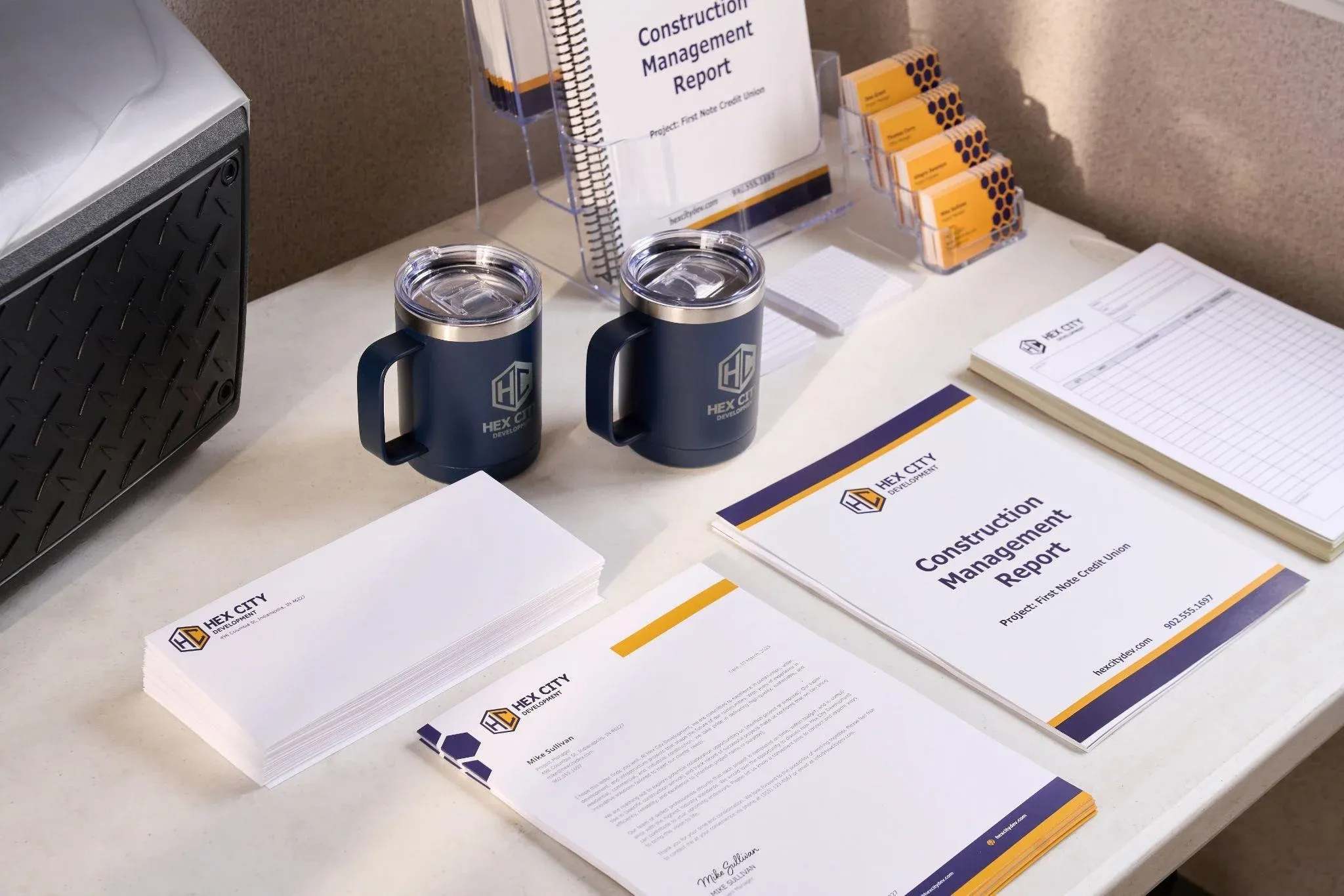
This is the first thing most people think of. And for good reason. Your business cards are the most frequently exchanged physical brand asset your company produces. Every handshake at a meeting, conference, or networking event involves one.
Don't just swap the logo and call it done. A rebrand is the perfect time to reconsider the paper stock, the finish, and the overall design. If your old cards were generic, this is your chance to make something people actually keep.
Order enough to cover your whole team, but avoid printing thousands per person right away. Titles change. People leave. Start with a reasonable first run and reorder as needed.
Letterheads and Envelopes
Easy to forget. Hard to excuse when a client gets a proposal on paper with your old logo at the top.
Your letterheads, envelopes, and stationery need to match the new brand on day one of the launch, or at least within the week. This includes standard #10 envelopes, window envelopes, and any specialty sizes your accounting or legal teams use.
Check with finance and HR specifically. They often have their own stash of printed letterhead that nobody else tracks.
Brochures and Booklets
This one hurts because brochures aren't cheap to produce in volume, and nobody wants to throw away a perfectly good box. But using outdated brochures after a rebrand does real damage to your credibility. A prospect holding your old brochure while looking at your new website is going to wonder what's going on.
Do a full inventory of all brochures and booklets your company distributes. Sales team folders, trade show handouts, lobby materials, leave-behinds for client meetings. All of it. A rebrand is also a good excuse to rethink the content. If the messaging has shifted, the brochure copy probably needs work too.
Presentation Folders
The branded pocket folders your sales team uses to package proposals and meeting materials. People forget about these constantly. Then someone stuffs a beautifully redesigned brochure into a folder with the old logo on the front, and the whole thing looks sloppy.
Check how many you have in stock and plan replacements accordingly.
Forms and Documents
This category is a rabbit hole, but you need to go down it.
Invoices. Purchase orders. Packing slips. Work orders. Contracts with branded headers. Estimate templates. Printed forms that your operations or warehouse teams use daily. Compliance documents with your logo in the header.
Talk to every department head and ask them to remove anything printed that includes the company name or logo. You'll be surprised by how many branded forms exist that marketing has never seen.
Flyers and Sell Sheets
Your flyers and promotional sheets are often scattered in more places than you'd expect. Sales reps keep stacks of them. The front desk has a display rack. Someone left a pile at the chamber of commerce six months ago.
Round up everything. Recycle the old ones. And when you reprint, consider if you even need the same pieces or if the rebrand is an opportunity to simplify your collateral.
Postcards and Mailers
If your company does any kind of direct mail, your postcards, mailers, and self-mailer brochures all need new artwork. Make sure your mailing templates are updated in your CRM or mail platform, too. It's not just about what's already printed. It's about preventing the old brand from appearing in future mailings.
Signage (This Gets Expensive Fast)
Signage is usually the single most expensive print-related line item in a rebrand. And it's also the most visible. Your sign is what customers, employees, and everyone driving past sees every day.
Here's what to audit:
Your building signage is the obvious one. Exterior signs, monument signs, door graphics, awnings. But then there's interior signage too. Lobby signs. Directional signs. Conference room nameplates. Restroom signs, if they're branded. ADA signs if they carry your company name.
Don't forget wall and window graphics. That frosted glass in your conference room with the old logo? The motivational quote on the wall with your brand colors? The window decals at the front entrance? All of it.
Plan this out early. Custom signage has longer lead times than most print jobs, so get orders placed as soon as the new brand guidelines are finalized.
Vehicle Graphics
If your company has wrapped vehicles, service vans, or even just door magnets on company cars, this is on the list. Vehicle graphics are rolling billboards. A half-rebranded fleet, with some trucks displaying the new logo and others the old one, sends a confusing message.
Full wraps are a significant investment to redo. Budget for it and schedule the rollout so you can phase it by vehicle if needed. Start with the ones that get the most public visibility.
Banners and Posters
Indoor banners, outdoor banners, retractable banners for events, posters in your office or waiting room. These are items that often live in closets or storage until someone needs them for an event, at which point they get pulled out without anyone checking if the branding is current.
Do a sweep of every storage area. Pull out every banner and poster. Decide what gets replaced and what gets retired.
Trade Show Materials
Your trade show kit is its own little ecosystem of branded stuff. Booth backdrops, table throws, pop-up displays, counter displays, literature racks, and badge holders with your logo on the lanyard. Every piece needs to match your new brand before the next event.
If you exhibit regularly, this should be near the top of your priority list. Nothing looks worse than a booth that's half old brand and half new.
Labels and Stickers
Product labels for physical goods. Shipping labels with your logo. Stickers and decals you hand out as promo items or use on packaging. Return address labels. Equipment asset tags with your branding.
Small items. Easy to miss. But customers notice.
Packaging
If you ship products, your packaging is a brand experience. Branded boxes, tissue paper, packing tape with your logo, inserts, and thank-you cards inside the box. All of it.
Even if your packaging is simple, check everything that goes into or onto a shipment. The unboxing experience should match the new brand from the moment it arrives.
Manuals and Catalogs
Training manuals, employee handbooks, product catalogs, safety guides, and onboarding documents. These tend to be longer print runs, and people hesitate to toss them because of the production cost.
Replace them anyway. Having employees on board with an outdated handbook or handing a client a catalog with the old logo undermines everything you invested in the rebrand.
Uniforms and Apparel
Embroidered polos. Branded hats. Safety vests with your logo. Jackets. Aprons if you're in food service. Name badges.
Talk to your HR or operations manager about what exists and build a replacement schedule. Not everything has to happen day one, but get the highest-visibility items first. If your team faces customers, their apparel needs to reflect the new brand quickly.
The Stuff Nobody Remembers
Here's a rapid-fire list of things that routinely get missed during rebrands. Go through each one and check whether your company has it:
-
Gift cards or branded promotional items
-
Rubber stamps with your company name
-
Branded check stock for your bank account
-
Parking passes or visitor badges
-
ID cards and employee badges
-
Branded pens, notepads, and folders you give to clients
-
Donation and sponsorship materials, like golf tournament signage.
-
Branded napkins, cups, or plates for the break room or events.
-
Certificates, awards, and diploma-style documents you hand out.
Every single one of these carries your brand. And every single one can undermine the new identity if it still shows the old one.
Get the New Brand Right
Before you print a single card, make sure your brand identity and design files are buttoned up. That means finalized vector logo files in every format you'll need. Defined Pantone and CMYK color values for print. Approved fonts with proper licensing. Clear guidelines for logo placement, minimum sizes, and spacing rules.
If these files aren't production-ready when you go to print, you'll end up with colors that don't match between your business cards and your building sign. Or a logo that looks slightly different on your brochure than it does on your letterhead. Your printer can help you catch these issues early, but only if you get them involved before the first order goes in.
Start Printing
AlphaGraphics in Brentwood works with companies across Middle Tennessee on exactly this kind of project. Full rebrand print rollouts. Every piece, every format, coordinated under one roof.
Whether you need new business cards and stationery, updated building and office signage, rebranded vehicle wraps, refreshed brochures and marketing materials, or all of it at once, we handle the coordination so nothing falls through the cracks.
Call us at (615) 263-4444 or stop by at 18 Cadillac Drive, Suite 300 in Brentwood. Bring your new brand guidelines, and we'll map out everything you need.