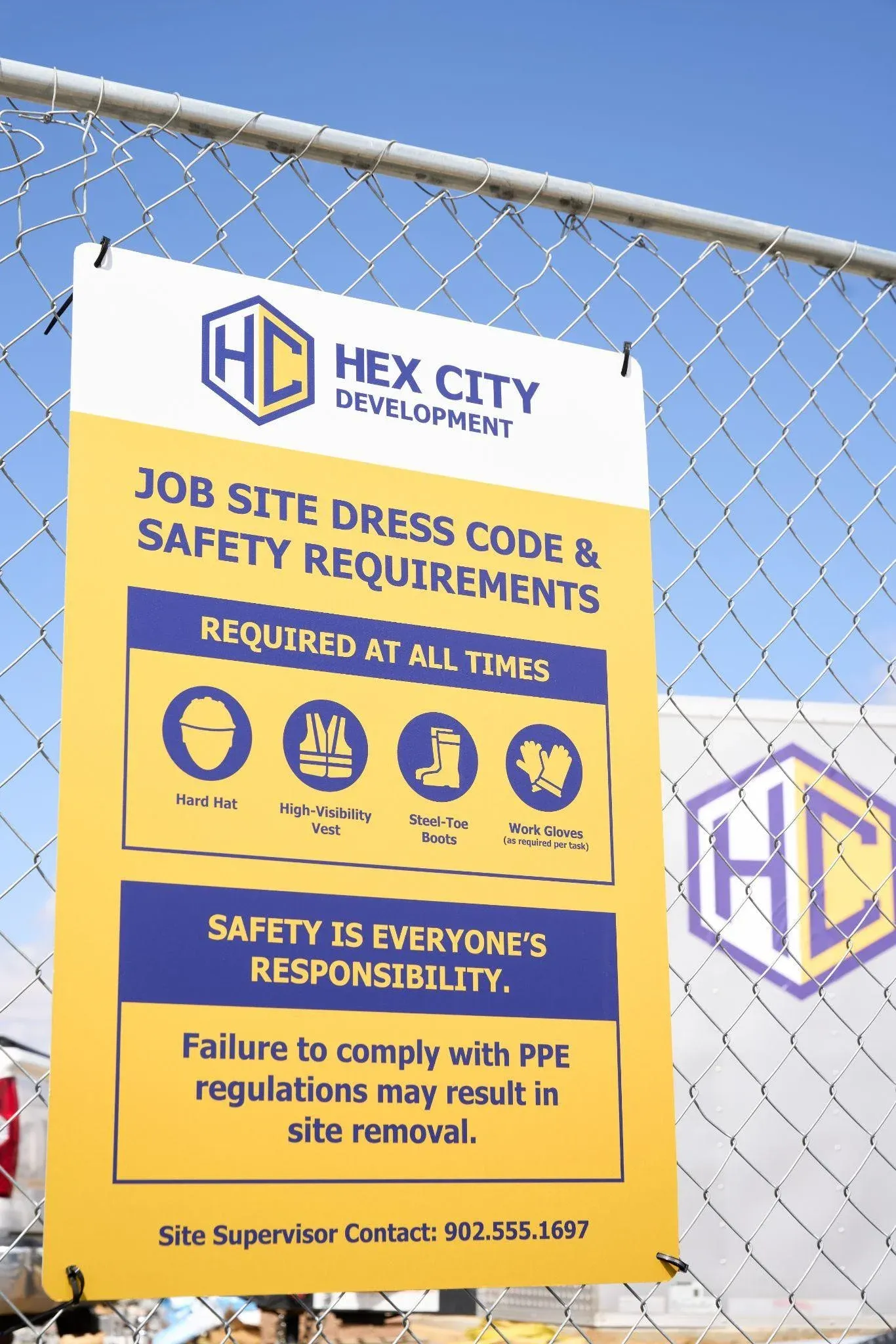
If you run a construction site in Tennessee, signage is not just a “nice to have.” When workers, visitors, drivers, or the public may be exposed to hazards, contractors need clear accident-prevention signs, tags, and traffic-control devices that match the site conditions. TOSHA enforces Tennessee’s OSHA-approved state plan and has adopted the federal OSHA construction standards, including 29 CFR 1926 Subpart G for signs, signals, and barricades. Penalties can add up quickly, especially when multiple violations are cited, so signage should be treated as part of the site’s safety and compliance plan.
Here's a quick answer, then the practical detail every project manager, GC, and safety officer actually needs.
Quick Answer: Common Construction Site Signs and Tags Contractors Should Plan For
OSHA does not require the exact same set of signs on every construction site. Instead, signage must match the hazards, access points, traffic conditions, and work areas present on the job site. A typical construction signage plan may include:
-
Danger signs – for immediate hazards that could cause serious injury or death.
-
Warning signs – commonly used for serious hazards, following ANSI-style safety-sign formatting where appropriate.
-
Caution signs – for potential hazards or unsafe practices.
-
Safety instruction signs – for general safety information, first aid, eyewash stations, emergency procedures, or required safety reminders.
-
Exit signs – where required, with red letters at least 6 inches high on a white background.
-
Directional signs – for wayfinding around the site, including visitor check-in, deliveries, parking, offices, exits, and assembly areas.
-
Traffic-control signs and devices – when work affects vehicles, pedestrians, public roads, lane closures, detours, flaggers, or equipment crossings.
-
Accident-prevention tags – for temporary hazards such as defective tools, out-of-service equipment, or unsafe machinery.
Contractors may also need project identification signs, permit signs, emergency contact signage, bilingual signs, or branded perimeter signs, depending on local code, permit conditions, project specifications, workforce needs, and site conditions. On multilingual job sites, English/Spanish signs and clear pictograms are often best practices because safety communication needs to be understandable to people working on the site.
Below, we'll walk through each requirement, where to place signs, what materials hold up in Tennessee weather, and the audit checklist contractors actually use.
Why Construction Site Signage Is a Legal and Life-Saving Requirement
Construction remains one of the highest-risk industries in the U.S. In 2024, the private-sector construction industry recorded 1,034 workplace deaths, and more than one-third of those fatalities were caused by falls, slips, and trips. That is why clear job-site communication, including properly placed safety signage, is so important.
Signage is the first line of defense. It's also one of the cheapest ways to prevent an incident, satisfy an inspector, and protect your company from liability if something does go wrong.
Construction signage requirements are shaped by several overlapping standards and references, depending on the hazard and the type of site activity:
-
OSHA 29 CFR 1926 Subpart G – the federal construction standard covering signs, signals, barricades, accident-prevention signs, and accident-prevention tags.
-
ANSI Z535 references – used for safety-sign design elements such as signal words, colors, formats, and tags where incorporated by OSHA.
-
MUTCD, the Manual on Uniform Traffic Control Devices – the standard referenced for traffic-control signs and devices used to protect construction workers in roadway or traffic-facing areas.
In Tennessee, TOSHA enforces occupational safety and health standards for construction workplaces. Tennessee has adopted the federal OSHA construction standards with limited exceptions, so 29 CFR 1926.200 is an important baseline for construction-site signage. Contractors should still check local building department rules, permit conditions, TDOT requirements, and project specifications because those may add signage requirements beyond OSHA’s hazard-sign rules.
Common Construction Site Sign Categories Contractors Should Know
Each sign category communicates a different type or level of risk through color, wording, symbols, and placement. The right signage plan depends on the actual hazards present on the site, so contractors should match each sign to the condition it is meant to warn about or explain.
1. Danger Signs
Used only when an immediate hazard exists that could cause serious injury or death. Think exposed high-voltage panels, open trenches, fall hazards over six feet, or confined spaces.
-
Colors: red upper panel, black border, white lower panel for additional wording
-
Common examples: "DANGER – High Voltage," "DANGER – Open Excavation," "DANGER – Authorized Personnel Only."
-
Placement: as close to the hazard as safely possible, positioned so that workers, visitors, or drivers can see and understand the warning before entering the danger area.
2. Warning Signs
Warning signs are commonly used under ANSI-style safety-sign formatting for hazards that could result in serious injury or death, but that are not classified as immediate “Danger” hazards. They help communicate serious risks in areas such as crane operations, overhead work, equipment movement, hot surfaces, and restricted work zones.
-
Colors: orange background, black panel, black lettering
-
Common examples: "WARNING – Crane Operating Overhead," "WARNING, Hot Surface."
-
When to use: moving equipment zones, swing radius areas, hot work zones
3. Caution Signs
Caution signs warn of potential hazards or unsafe practices that could cause minor or moderate injury. They're the workhorses of any active site.
-
Colors: yellow background, black panel, yellow "CAUTION" lettering on the black panel
-
Common examples: "CAUTION – Watch Your Step," "CAUTION – Slippery When Wet," "CAUTION – Hard Hats Required Beyond This Point."
4. Safety Instruction Signs
These provide general safety information and reminders rather than warning of a hazard. Think first-aid stations, emergency contacts, eyewash locations, and PPE expectations.
-
Colors: white background with a green upper panel; white lettering on green for the main message, black for additional text
-
Common examples: "First Aid Station," "Safety Meeting Area," "Eye Wash Station."
5. Exit Signs
OSHA gets specific here: exit signs must be lettered in legible red letters at least 6 inches high on a white field, with the principal stroke of each letter at least three-fourths of an inch wide.
-
Where: exits and egress paths where workers, visitors, or emergency responders need clear direction out of a building, temporary structure, trailer, or enclosed work area.
-
Why it matters: exit signage needs to remain visible, legible, and unobstructed so people can quickly identify the way out during an emergency.
6. Directional Signs
Used for general wayfinding around the site, toward the office trailer, parking, deliveries, the muster point, or the visitor check-in.
-
Colors: white with a black panel and a white directional symbol; any additional wording in black on white
-
Tip: this is where AlphaGraphics' wayfinding, yard, and site signs earn their keep, you can keep the visual language consistent across the project so visitors aren't guessing.
7. Traffic Control Signs
When a construction site affects public roads, lane closures, detours, pedestrian routes, flagging operations, or equipment crossings, traffic-control signs and devices must follow the MUTCD and any applicable TDOT, local road authority, or project-specific traffic-control requirements. This can include “Road Work Ahead,” “Flagger Ahead,” lane shift signs, stop/slow paddles, barricades, cones, channelizing devices, and pedestrian detour signage.
8. Accident Prevention Tags
Tags aren't a replacement for signs; they're a temporary tool to flag a specific hazard until it's corrected. The classic example: a "Do Not Operate" tag clipped to a defective ladder, scaffold, or piece of equipment.
OSHA treats accident-prevention tags as temporary warnings for existing hazards, such as defective tools, unsafe equipment, or out-of-service machinery. They should not be used as a substitute for an accident-prevention sign when one is required.
Project Identification & Public-Facing Signs
Beyond OSHA hazard signage, many projects also require a public-facing project identification sign through local building departments, permit conditions, owner requirements, or GC project specifications. The required content varies by jurisdiction and project, but it often includes:
-
General contractor name and license number
-
Project address and permit number
-
24-hour emergency contact
-
Project owner/developer
-
Architect or engineer of record
-
Estimated completion date
Some jurisdictions have very specific rules for project information signs, while others handle these requirements through local building departments, permit conditions, or project specifications. In Tennessee and across much of the Southeast, contractors should confirm requirements with the local permitting authority and the project owner or GC before the job starts. Even when the exact format is not dictated by OSHA, a clear site identification sign is still a smart way to organize the project and provide emergency contact information.
This is also where contractors often miss a marketing opportunity. A clean, branded site sign, with your logo, "Built By," website, and phone number, turns the perimeter fence into a billboard. We help local crews handle both the compliance and the brand visibility on the same panel.
Sign Placement: A Zone-by-Zone Walkthrough
Most articles list sign types and stop there. The harder part is placement. Construction signs should be positioned so that workers, visitors, and drivers can see and understand them before entering a hazard area. A strong signage plan keeps signs:
-
Clearly visible before the hazard or decision point
-
As close as safely possible to the condition they identify
-
Free of obstructions
-
Maintained, legible, and undamaged
-
Updated or removed when the hazard or project phase changes
Here is how a well-organized Tennessee job site may lay out signage by zone, depending on the scope of work, hazards, traffic conditions, and project requirements:
At the Site Entrance & Perimeter Fence
-
Project identification panel
-
"Construction Site – Authorized Personnel Only"
-
"Hard Hat / Safety Vest / Eye Protection Required Beyond This Point"
-
24-hour emergency contact placard
-
Visitor check-in directional
Inside Active Work Zones
-
Specific Danger and Warning signs tied to the actual hazard (overhead work, excavation, energized equipment)
-
"Watch Your Step" and "Slippery When Wet" caution signs in high-traffic walkways
-
PPE reminder signs at zone transitions
On Equipment & Temporary Power
-
"Danger – High Voltage" on temporary panels and spider boxes
-
"Do Not Operate" tags on any out-of-service tool, ladder, or piece of equipment
-
Crane operation and swing radius warnings
At Exits & Egress Paths
-
6-inch red lettered exit signs (lit when required)
-
Muster point/assembly area directional signs
-
Fire extinguisher location identifiers
Public-Facing Sides
-
Pedestrian walkway signage if you've narrowed or covered a sidewalk
-
"Sidewalk Closed – Use Other Side" with a directional arrow
-
Vehicle traffic control signs conforming to MUTCD
A useful rule of thumb on inspection day: stand at the site entrance and ask yourself, "Could a delivery driver who has never been here before figure out where to go and what to wear without asking?" If the answer is no, your signage plan needs another pass.
Sign Materials That Actually Hold Up on a Job Site
Tennessee weather, humid summers, freeze-thaw cycles, occasional severe storms, chews up cheap signage. The substrate matters as much as the artwork.
-
Coroplast (corrugated plastic): lightweight, inexpensive, and the standard for short-term signs (3–6 months). Easy to zip-tie to fencing.
-
Aluminum: the go-to for permanent project signs and high-traffic warnings. Holds up for years, won't warp.
-
Vinyl banners with mesh: ideal for fence wraps and large-format perimeter signs that need to handle wind without sailing.
-
Reflective sheeting: required for any sign that must be readable at night or in low light, especially for traffic control devices.
If you've ever shown up Monday morning to find half your signs faded, curled, or blown across the site, the answer is usually a substrate upgrade. Our exterior temporary signage and aluminum signs are spec'd specifically for the abuse a Tennessee job site puts them through.
Bilingual Signage: When You Need It
OSHA does not automatically require bilingual signs on every construction site, but safety communication must be understandable to the workforce. If a site has workers who do not read English, English-only safety signs may not be effective. For that reason, bilingual English/Spanish signage and clear pictograms are a strong best practice on multilingual job sites and may be necessary to support an effective safety program.
Best practices for bilingual signs:
-
Use the same color, format, and signal word standards in both languages
-
Don't shrink the secondary language to fit, use a two-panel sign instead
-
Pictograms (the universal hazard symbols from ANSI Z535.3) are even better, because they don't depend on language at all
Penalties for Non-Compliant Signage
Penalty amounts depend on whether the citation is issued under federal OSHA or a state plan, such as Tennessee’s TOSHA.
Federal OSHA’s maximum penalties were adjusted in 2025 to $16,550 for serious, other-than-serious, and posting-requirement violations, and $165,514 for willful or repeated violations.
Tennessee’s current state penalty amounts differ under Tennessee law, with lower caps for serious, non-serious, willful, and repeat violations. Because penalty amounts can change and multiple violations can be cited on the same site, contractors should verify current TOSHA penalty exposure before relying on a specific dollar figure.
Beyond the fine itself, a safety citation can create documentation that affects future inspections, bid qualifications, safety scoring, and insurance conversations. A well-maintained signage plan is one of the simplest and most cost-effective ways to improve job-site communication and reduce avoidable compliance risk.
A 10-Point Site Signage Audit Checklist
Walk your site with this list before your next OSHA inspection, or before you hand the project off to the crew on Monday morning:
-
Are Danger/Warning/Caution signs posted at every recognized hazard?
-
Are all signs large enough, clear enough, and placed early enough for workers, visitors, and drivers to understand them before reaching the hazard?
-
Are exit signs red-on-white, at least 6-inch letters, and unobstructed?
-
Is there a project identification sign at the main entrance with current contact info?
-
Are PPE requirements posted at every entry point to the site?
-
Are traffic control devices MUTCD-compliant on any public-facing roadway?
-
Are accident prevention tags on every defective tool, ladder, or piece of equipment?
-
Is signage bilingual where the workforce requires it?
-
Are signs intact, weather-resistant, and free of fading or damage?
-
Are signs taken down or updated as project phases change?
If you can't check all ten with confidence, you have a gap.
How AlphaGraphics Brentwood Helps Tennessee Contractors Stay Compliant
We've supplied signage for general contractors, road crews, and developers across Brentwood, Nashville, Franklin, Smyrna, and the wider Middle Tennessee market for years. That experience shows up in three ways most generic sign shops can't match:
-
Compliance-focused design. Our team can produce construction signage using OSHA, ANSI, and MUTCD-style layouts, colors, signal words, and durable materials, helping contractors build a more organized and inspection-ready job site.
-
Job-site-grade materials. From Coroplast for short-term signs to UV-stable aluminum and reflective vinyl for permanent and traffic-facing applications.
-
Branded site presence. Your perimeter fence, project ID signs, and vehicle graphics are mobile billboards. We build packages that satisfy the inspector and market your company to every neighbor and passerby.
If you are starting a project, scaling up, or realizing your current site signs are faded, damaged, or outdated, our construction industry solutions team can help scope, design, produce, and deliver a signage package built for active job-site conditions.
Frequently Asked Questions
What OSHA standard covers construction site signage?
The primary federal standard is 29 CFR 1926 Subpart G, with §1926.200 ("Accident prevention signs and tags") doing most of the heavy lifting. It defines required sign categories, colors, lettering, and placement, and references ANSI Z535 for design specifications and the MUTCD for traffic control devices.
What is the difference between a Danger, Warning, and Caution sign?
The three signal words map to three risk levels. Danger is reserved for immediate hazards that will cause serious injury or death if ignored (red). Warning flags hazards that could cause serious injury or death but aren't immediate (orange). Caution is for potential hazards or unsafe practices likely to cause minor to moderate injury (yellow). Using the wrong signal word for the actual risk is a common citation.
How far away does an OSHA construction sign need to be readable?
OSHA’s construction signage standard requires signs and symbols to be visible while work is being performed, but the right readable distance depends on the sign’s purpose, size, location, lighting, and audience. A hazard sign inside a work zone may need a different size and placement than a traffic-control sign facing drivers. For roadway work, MUTCD and local traffic-control requirements should guide sign size, placement, distance, and reflectivity.
Are bilingual safety signs required by OSHA?
OSHA does not have a blanket rule in 29 CFR 1926.200 requiring every construction sign to be bilingual. However, OSHA expects safety information and instructions to be communicated in a language and vocabulary that workers can understand. If a site has workers who do not read English, bilingual signs, translated safety instructions, and pictograms may be necessary for effective hazard communication, and are a strong best practice on multilingual job sites.
Do small or short-term construction projects still need signage?
Yes. OSHA construction standards apply regardless of project size or duration, but the specific signage required depends on the hazards and site conditions. A short-term project may still need hazard warnings, pedestrian or traffic-control signs, PPE reminders, or restricted-access signage if workers, visitors, drivers, or the public could be exposed to risk. The signage plan may be smaller, but it still needs to match the work being performed.
Who is responsible for posting signage on a construction site?
The employer, most commonly the general contractor, is responsible for ensuring required signs are posted, maintained, and removed when no longer applicable. On multi-employer sites, OSHA's multi-employer citation policy can hold the controlling contractor, the creating contractor, the exposing contractor, and the correcting contractor each accountable for signage failures within their respective areas of responsibility.
Need job-site-grade construction signage in Brentwood, Nashville, or anywhere across Middle Tennessee? AlphaGraphics Brentwood can help with OSHA-style hazard signs, project ID panels, fence wraps, traffic-facing signs, vehicle graphics, and full branded site packages. Request a quote or call (615) 263-4444 to talk through your next project.