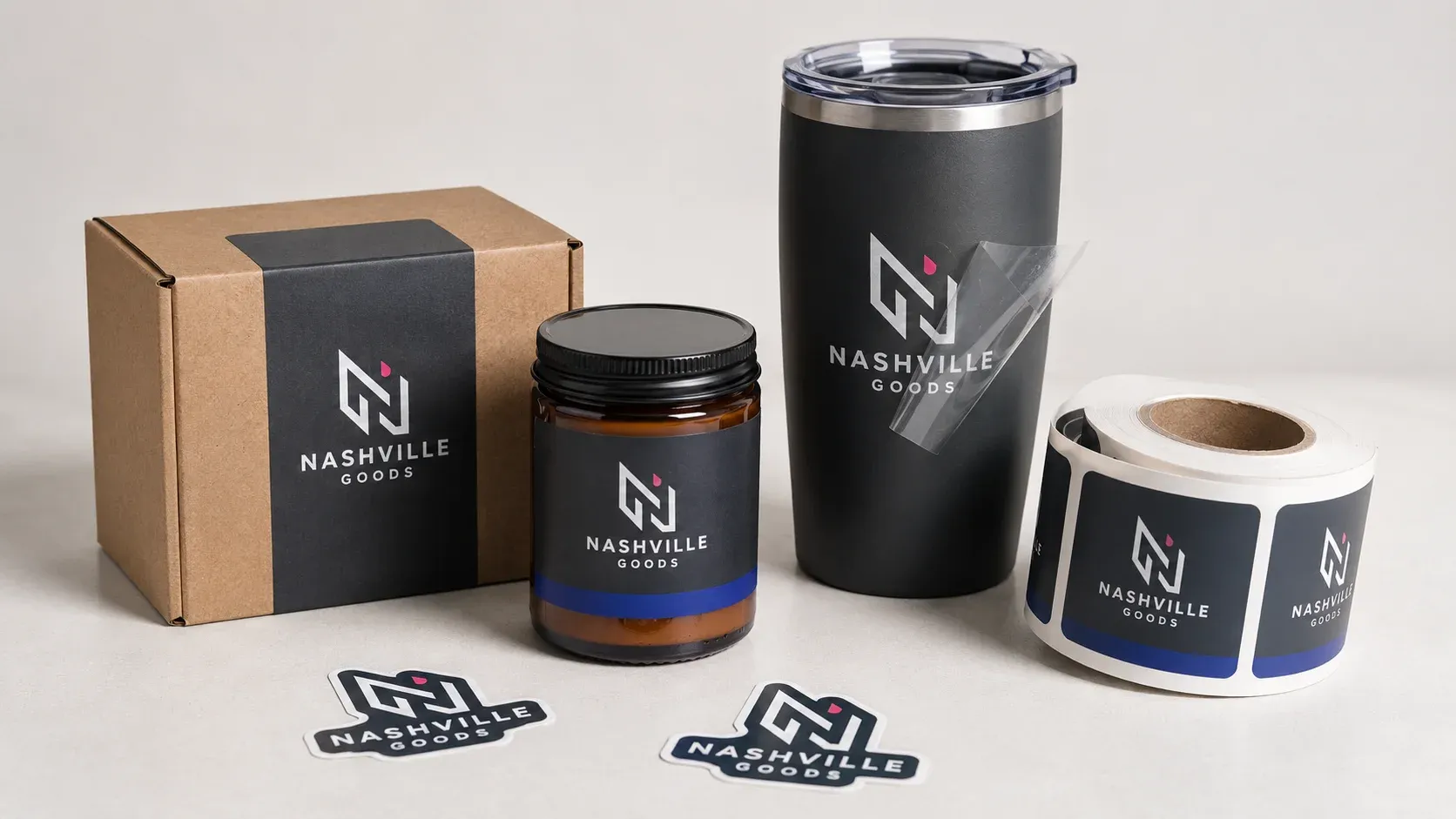
Custom stickers and labels help businesses brand packaging, identify products, support sales teams, manage multi-location promotions, and add graphics to vehicles, equipment, and hard goods. For a commercial buyer, the best option depends on the surface, environment, expected lifespan, application process and total program volume. Paper labels work well for dry packaging; durable vinyl is better for demanding environments; roll labels improve repeated application; and UV DTF transfers add full-color graphics to many hard objects without leaving a surrounding vinyl background.
The important part is building the product around the job—not simply ordering the lowest-cost sticker. A food label, warehouse identification decal, multi-location window promotion, fleet graphic and UV DTF tumbler transfer may all use adhesive, but they require different materials, production methods and finishing. Businesses that reorder should also plan for version control, color consistency, roll direction, inventory, and future fulfillment.
Which Type of Business Sticker or Label Should You Choose?
Use this quick comparison as a starting point:
|
Option
|
Best For
|
Primary Advantage
|
What to Consider
|
|
Paper stickers and labels
|
Packaging seals, bags, boxes and short-term promotions
|
Economical for dry indoor applications
|
Not intended for moisture or extended outdoor use
|
|
Roll labels
|
Bottles, jars, cartons and recurring product lines
|
Efficient for repeated hand or machine application
|
Core, unwind direction and applicator requirements must be confirmed
|
|
Vinyl stickers and decals
|
Equipment, hard hats, windows and outdoor applications
|
Durable, with weather-resistant options available
|
Material, adhesive and laminate should match the environment
|
|
Clear stickers
|
Glass, transparent packaging and minimalist designs
|
Creates a clean, printed-on appearance
|
White ink may be needed so colors remain opaque
|
|
Die-cut stickers
|
Brand marks, campaign graphics and custom shapes
|
Follows the outer shape of the artwork
|
Intricate shapes may need simplified cut paths
|
|
Kiss-cut stickers
|
Sales kits, onboarding packets and multi-design sheets
|
Sticker is cut while the backing remains intact
|
Includes visible backing around the design
|
|
Fleet and window decals
|
Vehicles, storefronts and multi-location campaigns
|
Creates high-visibility branded surfaces
|
Requires application-specific film and may require professional installation
|
|
UV DTF transfers
|
Tumblers, glass, acrylic, metal, hard plastic and promotional products
|
Leaves only the printed design, with no surrounding vinyl field
|
Works best on clean, compatible hard surfaces and is not intended for fabric
|
If you are unsure which construction fits your project, AlphaGraphics Brentwood can compare materials, adhesives, finishes and application methods through our custom labels, stickers and decals service.
Stickers, Labels, Decals and UV DTF Transfers: What Is the Difference?
These terms overlap in everyday conversation, but they often describe different applications.
-
A sticker is usually a printed adhesive graphic intended for branding, decoration, or promotion.
-
A label typically communicates product information, such as a product name, ingredients, instructions, a barcode or a warning. Labels are commonly supplied on sheets or rolls.
-
A decal generally refers to a larger or more durable adhesive graphic used on windows, walls, equipment or vehicles.
-
A UV DTF transfer, often marketed as a UV DTF sticker, is a UV-cured graphic printed onto transfer film and then applied to a hard object. After you remove the carrier film, only the printed artwork and adhesive remain.
The name matters less than the final application. Your printer needs to know what the graphic will be applied to, whether that surface is flat or curved, whether it will be indoors or outdoors, and how it will be cleaned or handled.
Types of Custom Stickers and When to Use Each
Die-Cut Stickers
Die-cut stickers are cut around the design's outer contour. The finished sticker can follow the shape of a logo, mascot, product, or illustration instead of being limited to a square or circle. You can include or remove a white border, depending on the artwork and desired look.
Die-cut stickers are a strong choice for campaign graphics, branded sales kits, product inserts, and corporate merchandise because the custom shape helps the design feel more intentional than a standard rectangle.
Kiss-Cut Stickers and Sticker Sheets
With kiss cutting, the cut passes through the sticker material but leaves the backing sheet intact. This makes the sticker easier to peel and allows multiple designs to share one sheet.
Use kiss-cut stickers for retail sticker packs, children’s activities, subscription boxes, event kits or any project where presentation and easy peeling matter.
Paper Stickers and Labels
Paper is an economical choice for dry, indoor and short-term applications. Common uses include tissue seals, bakery boxes, shopping bags, envelopes, price labels and event promotions.
Paper may be the right solution when a sticker only needs to last through delivery or purchase. If it will be exposed to moisture, abrasion or outdoor conditions, ask about a more durable film.
Vinyl Stickers and Decals
Vinyl is used when the graphic needs more durability or flexibility than paper can provide. Depending on the vinyl, adhesive, ink, and laminate selected, it can be specified for windows, equipment, vehicles, coolers, and other demanding surfaces.
“Vinyl” is a broad category, not a single durability rating. A short-term removable window graphic and a long-term outdoor decal are different products even though both may be described as vinyl. For vehicle applications, review our guide to choosing the right vehicle wrap or decal.
Clear Stickers
Clear stickers let the underlying surface show through, creating a clean look on glass, bottles, and transparent packaging. They work especially well with simple logos and designs that use negative space.
Transparent material changes how printed color appears. Without white ink beneath the artwork, lighter colors may become translucent or disappear on dark objects. Testing the design on the actual surface helps avoid surprises.
Roll Labels
Roll labels are efficient for businesses that repeatedly label bottles, jars, boxes, or packaged products. They are easier to dispense than individually cut stickers and can be configured for hand application or labeling equipment.
Before production, confirm the finished size, shape, core size, and unwind direction. These details are especially important when the labels will be applied by machine.
Specialty Stickers
Holographic, metallic, textured, removable and permanent adhesive options can help a product stand out or solve a specific application challenge. Specialty finishes work best when they support the brand rather than compete with the design.
What Are UV DTF Stickers?
UV DTF stands for ultraviolet direct-to-film. The artwork is printed with UV-cured ink onto a specialized film and transferred to a hard object using pressure. Then the carrier film is removed, leaving the printed design on the surface.
Unlike a conventional clear sticker, a UV DTF transfer does not leave a large transparent film around the artwork. Small letters, separate shapes, and detailed graphics can appear as though they were printed directly onto the object. White ink can make colors opaque on dark surfaces, while clear varnish can add gloss or a subtle dimensional effect.
Best Uses for UV DTF Transfers
UV DTF is especially useful for short-run customization and hard-to-print objects, including:
-
Tumblers and drinkware
-
Glass jars and bottles
-
Acrylic signs and display pieces
-
Metal containers and promotional items
-
Hard plastic cases and equipment
-
Gift boxes and rigid packaging
-
Small branded items with curved or irregular surfaces
When UV DTF Is Not the Best Choice
UV DTF is designed primarily for compatible hard surfaces. It is generally not the right method for shirts, fabric bags, or other textiles; those products use apparel DTF, screen printing, embroidery, or another garment-decoration process.
It may also be a poor fit for silicone, heavily textured materials, flexible surfaces or areas that receive constant abrasion. Adhesion can vary by coating and substrate, so test when the object has an unknown finish or demanding use conditions.
UV DTF vs. Traditional Stickers
Choose a conventional sticker when you need quick peel-and-stick application, a removable option, a large solid background, or economical high-volume labeling. Consider UV DTF when you want detailed, full-color artwork on a hard object with minimal visible material surrounding the design.
For a broader explanation of how UV printing, traditional digital printing, and apparel DTF fit into commercial production, see our guide to the types of commercial printing businesses use in Nashville.
How to Design Business Stickers and Labels for Production
1. Begin With the Surface and Purpose
Before designing, decide where the sticker will go and how it will be applied. A product label used on an automated line, a safety decal for field equipment, and a window promotion distributed to 20 locations have different viewing distances, adhesive needs, production specs, and information requirements. UV DTF artwork also needs to account for the color and shape of the object beneath it.
2. Keep the Main Idea Simple
Small stickers cannot carry as much information as a brochure. Use one recognizable logo, icon, illustration, or short message. If a phone number, URL, or QR code is essential, give it enough room and remove less important copy.
3. Use Strong Contrast
Evaluate contrast against the final surface, not just a white computer screen. Dark artwork can disappear on black packaging, and translucent colors can weaken on clear material. A white underbase may be needed for clear stickers and UV DTF transfers.
If brand color accuracy matters, read our guide explaining why printed colors may differ from your screen.
4. Design for Brand Consistency
Stickers and labels often appear across packaging, sales materials, equipment, and promotional products. Use the approved logo, brand colors, typography and graphic elements consistently. Record production colors and material specifications when repeat orders must match earlier runs. A promotional sticker can still be visually appealing without becoming a miniature sales flyer.
5. Build a Clean Cut Path
The cut line, sometimes called a dieline or contour cut, tells the finishing equipment where the sticker ends. Avoid extremely tight corners, tiny projections, and complicated shapes that could be difficult to cut or peel.
6. Add Bleed and a Safe Area
If color extends to the sticker’s edge, extend the artwork beyond the cut line. A common starting point is 0.125 inches of bleed, but the required amount can vary by product and finishing method. Keep logos and important text safely inside the cut line. Our guide to bleed in print design explains why this extra artwork prevents unwanted white edges.
7. Test at the Finished Size
Print the design at actual size before ordering. Check small text, fine lines, and QR codes from the distance at which they will be used. Scan every QR code from a physical proof rather than relying only on the digital file.
If the artwork needs professional refinement, our graphic and logo design team can help simplify the design and prepare it for production.
How to Prepare Sticker Artwork for Printing
For the cleanest result, provide vector artwork whenever possible. Adobe Illustrator, EPS, SVG, and print-ready PDF files preserve sharp edges when you resize a logo. Raster artwork should generally be 300 DPI at its final printed dimensions.
A production-ready sticker file may include:
-
Artwork at the correct finished size
-
CMYK or approved spot colors
-
A separate vector cut path
-
Bleed beyond the cut line
-
A safe margin for text and logos
-
Outlined or embedded fonts
-
Separate white-ink or varnish layers when required
-
Clear identification of each design and quantity
Do not assume every sticker product uses identical specifications. White ink, clear material, UV DTF, and specialty finishing can require additional production layers. Send the intended application with the file so the prepress team can evaluate the artwork correctly.
For more detail, follow our guide to preparing files for professional printing.
8 Ways Businesses Use Custom Stickers, Labels and Decals
1. Product and Packaging Labels
A custom label can carry the product name, brand, ingredients, instructions, barcode, compliance information, or other required content. Pressure-sensitive labels make it practical to manage multiple products or versions without ordering fully custom packaging for each one.
2. Branded Shipping and Unboxing
Logo labels can turn plain cartons, mailers, bags and tissue paper into branded packaging. This gives ecommerce companies, retailers and service businesses a more intentional customer experience without requiring fully custom-printed packaging for every box size.
3. Retail Promotions and Limited Editions
Stickers can highlight new products, seasonal flavors, promotional bundles, limited editions, and special offers. Businesses can update existing packaging or displays for a campaign without redesigning the entire package. Multiple versions can also support different products, locations, or customer segments.
4. UV DTF Branded Products and Merchandise
Apply detailed graphics to tumblers, jars, acrylic pieces, presentation boxes, awards and other compatible hard goods. UV DTF supports branded merchandise, customer gifts, employee kits, product launches, and event programs without placing every object directly inside a printer.
5. Customer Giveaways, Events and Sales Kits
Include branded stickers with purchases, event packets, sample kits, folders or trade-show materials. Consumer-facing brands can create designs customers actually want to display, while professional and B2B organizations can use coordinated stickers to customize sales materials for industries, territories or campaigns.
6. Storefront Windows and Doors
Window decals can display hours, services, logos, QR codes and seasonal promotions. Surface, installation side, and expected duration all affect the correct material. Explore additional ideas in our guide to outdoor business signs and window graphics.
7. Vehicle and Equipment Decals
Logo decals and lettering can identify work trucks, delivery vehicles, toolboxes and equipment. Vehicle graphics need an appropriate automotive film and professional installation; a general-purpose promotional sticker is not a substitute.
8. Loyalty Campaigns, QR Codes and Variable Data
Use stickers for loyalty programs, return-visit offers, product registration, reviews, event check-ins or links to campaign landing pages. Variable-data production can support sequential numbers, unique QR codes, barcodes, or location-specific information when you establish the specifications before printing. Test every critical code in its final printed form.
How Much Does Commercial Sticker and Label Printing Cost?
Commercial stickers and labels are quoted based on the complete program, not a generic price per sticker. Higher-volume repeat runs can reduce unit cost, while multiple versions, specialty adhesives, durable laminates, sequential data and UV DTF transfers add production requirements. The same three-inch design can cost very differently depending on its surface, lifespan, and delivery format.
The main pricing factors are:
-
Finished size: Larger stickers use more material and ink.
-
Quantity and annual usage: Setup and finishing costs are distributed across the order, so unit cost usually falls as volume increases. Planned annual usage may help determine a practical run size.
-
Material and adhesive: Paper, removable vinyl, permanent outdoor film, clear stock and specialty materials carry different costs.
-
Shape and finishing: Standard shapes are typically simpler than intricate contour cuts. Lamination, white ink, varnish, and specialty effects add production steps.
-
Number of versions or SKUs: Ten designs at 1,000 pieces each are planned differently from one design at 10,000 pieces.
-
Application and delivery method: Individually cut stickers, sheets, rolls, kits, and UV DTF gang sheets use different workflows.
-
Variable data: Sequential numbering, barcodes and unique QR codes require data setup and verification.
-
Design and file preparation: Artwork cleanup, cut-path creation and color matching may affect the final quote.
-
Inventory and distribution: Include individual-location packing, kitting, storage, and scheduled releases when relevant.
For accurate pricing, provide the size, quantity per version, estimated annual usage, intended surface, indoor or outdoor use, application method and preferred finish. That information lets the print team recommend the most economical construction without under-specifying the product.
How to Apply Stickers and UV DTF Transfers
Applying a Conventional Sticker or Decal
-
Clean the surface and allow it to dry completely.
-
Position the sticker before removing the entire liner.
-
Peel back a small portion of the liner and anchor one edge.
-
Apply gradually using firm, even pressure from the center outward.
-
Let the adhesive bond before heavy handling or cleaning.
Large decals and vehicle graphics may require professional installation to prevent bubbles, stretching, and alignment problems.
Applying a UV DTF Transfer
-
Confirm that the object is clean, dry, and compatible with the transfer.
-
Remove the backing film without touching the adhesive more than necessary.
-
Position the transfer carefully; you may not be able to reposition it after contact.
-
Burnish the artwork firmly across the entire design, including small details.
-
Peel the carrier slowly while checking that every element has transferred.
-
Follow the care instructions supplied for the specific ink, film, and object.
When appearance or durability is critical, test one finished item before producing the full quantity.
Common Sticker Mistakes to Avoid
Choosing by Price Alone
An inexpensive paper label is not a bargain if it fails in a cooler, and a premium outdoor laminate may be unnecessary for a one-day event. Specify the environment first, then compare cost.
Treating Every Surface the Same
Glass, painted metal, textured plastic, corrugated packaging, and silicone have different adhesion characteristics. Describe the exact surface and, when possible, provide a sample for testing.
Using the Wrong Kind of DTF
Apparel DTF is heat-transferred to fabric. UV DTF is pressure-applied to many hard objects. The two processes are not interchangeable.
Skipping the White Underbase
Clear stickers and UV DTF graphics may need white ink behind selected colors. Without it, artwork can appear washed out or change dramatically on dark or transparent objects.
Supplying Low-Resolution Artwork
A small web image may look acceptable on a screen but print with jagged edges. Use vector artwork or a high-resolution file at the final size.
Forgetting Bleed or the Cut Path
Missing bleed can create unwanted edges, while an unclear cut path can delay production. Keep the cut path simple, closed, and separate from the printed artwork.
Making a QR Code Too Small
QR performance depends on size, contrast, surrounding quiet space, print quality, and scanning distance. Always test the final printed code on the intended material.
Custom Sticker and Label Printing in Nashville
The right sticker should be designed around how an organization will produce, apply, distribute, and reorder it. AlphaGraphics Brentwood serves companies and organizations throughout Nashville and the surrounding metro area, including Brentwood, Franklin and communities across Middle Tennessee. We help select materials, adhesives, cut styles and finishes for product lines, packaging, operations, sales programs, windows, vehicles and hard-surface UV DTF applications.
Bring us the artwork, product container, application specifications, or a sample of the object. We can evaluate the surface, recommend the appropriate production method, prepare the file and produce a proof before the full run. For an accurate quote, include the number of designs, quantity per design, estimated usage, deadline, and any packing or distribution requirements. Explore commercial sticker, label and decal printing or request a project quote from our Nashville-area team in Brentwood.
Frequently Asked Questions
What type of sticker or label is best for business branding?
For product packaging, sheet or roll labels are often the most efficient. For equipment, storefronts and outdoor applications, an application-specific vinyl decal may be better. UV DTF is useful for compatible hard goods that need detailed graphics without a surrounding vinyl field. The best choice depends on the surface, environment, application method, and desired lifespan.
What is a UV DTF sticker?
A UV DTF sticker is more accurately described as a transfer. UV-cured artwork is printed onto a specialized film, applied to a hard object with pressure, and released from the carrier. Only the printed design remains, creating a direct-to-object appearance.
What is the difference between UV DTF and regular DTF?
UV DTF is generally used for hard goods such as glass, acrylic, metal, and compatible plastics. Apparel DTF uses a heat press to transfer a design onto fabric. UV DTF does not replace the garment-decoration process.
Can UV DTF transfers be used on tumblers and cups?
They can be used on many compatible drinkware surfaces, but adhesion and care requirements vary by coating, shape, and transfer system. Test the specific item and follow the recommended care instructions. Do not assume every UV DTF transfer is automatically dishwasher-safe or approved for food-contact areas.
Are vinyl stickers waterproof?
Many vinyl sticker constructions are water-resistant or weather-resistant, but durability depends on the face material, adhesive, ink and protective laminate. Tell your printer whether the sticker will be submerged, washed, placed outdoors or exposed to chemicals.
Should business labels be supplied on sheets or rolls?
Sheets work well for lower-volume hand application and orders containing several designs. Rolls are usually more efficient for repeated application and may be required for labeling equipment. Confirm core size and unwind direction before ordering roll labels.
Can custom stickers be used as product labels?
Yes. Stickers are widely used for candles, cosmetics, food packaging, beverages and handmade goods. The business is responsible for confirming any industry-specific labeling, safety and regulatory requirements.
What file format is best for sticker printing?
Vector PDF, AI, EPS or SVG artwork is preferred for logos and contour-cut designs. A 300-DPI PNG or TIFF at final size may also work. Include fonts, bleed and a separate cut path when requested.
Can business stickers include barcodes, sequential numbers or variable QR codes?
Yes, many digital workflows can produce variable information. Establish the data file, numbering rules, barcode format, and verification process before production. Test every critical code at final size on the actual printed material.
How long does commercial sticker and label printing take?
Turnaround depends on material availability, proof approval, quantity, finishing and installation needs. Standard small orders may be produced quickly, while specialty films, complex contour cutting, color matching or large installations require additional time. Confirm the deadline before production begins.
Build the Sticker Program Around the Business Need
Custom stickers and labels can support packaging, operations, sales, facilities, fleets and promotional programs—but one product cannot do every job. Use paper for economical dry applications, vinyl when added durability matters, clear stock for transparent surfaces, roll labels for repeated packaging, and UV DTF when you want detailed graphics transferred onto compatible hard objects.
Start with the surface, environment, application method, volume, and reorder requirements. Once those are clear, choosing the right material, adhesive, cut style, and finish becomes much easier. AlphaGraphics Brentwood can help build a repeatable sticker, label, decal, or UV DTF program that looks professional, applies correctly, and supports how the organization operates.