Trade Shows & Events
August 1, 2026
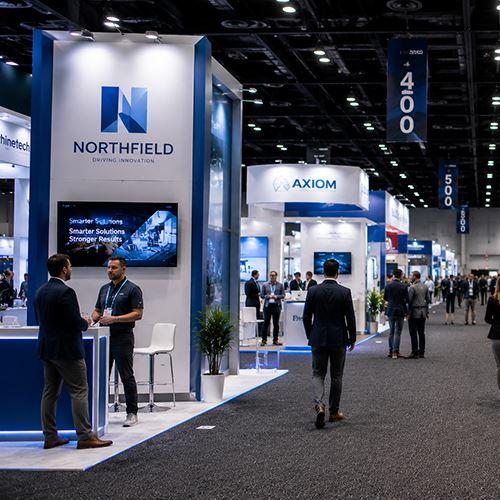
Walk into any trade show, convention, or industry expo and you’ll immediately notice the challenge.
Hundreds of booths.
Thousands of attendees.
An endless stream of logos, banners, giveaways, demonstrations, and sales pitches all competing for the same thing:
Attention.
The reality is that most attendees won’t remember the majority of exhibitors they pass.
That’s not because those companies don’t offer valuable products or services. It’s because visibility is difficult in an environment designed to overwhelm the senses.
The good news?
Getting noticed doesn’t require the largest booth, the biggest budget, or the flashiest display.
It requires clarity.
Here’s how successful exhibitors attract attention, start conversations, and create memorable experiences in even the busiest exhibit halls.
Most trade show booths try to say too much.
Attendees are already processing hundreds of competing messages. If your booth requires visitors to stop and decode what you do, you’ve probably lost them.
Instead, focus on answering three questions immediately:
Your logo and company name should be visible.
A clear headline should communicate your value.
Focus on the outcome you help create.
If attendees can answer those questions within a few seconds, you’re already ahead of many exhibitors.
Most booth evaluations happen from several feet away.
Attendees often decide whether to approach long before they arrive at your space.
That’s why your booth should be designed for visibility first.
Ask yourself:
Many exhibitors mistakenly design graphics for people standing inside the booth instead of people walking toward it.
Visibility begins from a distance.
Trade shows are not websites.
They’re not brochures.
They’re not sales presentations.
Your booth doesn’t need to communicate every product, service, feature, and capability.
Its job is much simpler:
Get the right people to stop.
Once someone stops, the conversation can do the rest.
Focus on one primary message supported by a few key points.
Simplicity often outperforms complexity.
In a sea of booths, height naturally attracts attention.
Exhibitors often use:
The goal isn’t necessarily to make the booth larger.
The goal is to make it easier to see.
A strong vertical element can dramatically increase visibility from across the exhibit hall.
Even a beautifully designed booth needs an invitation.
Ask yourself:
Why would someone pause here?
Potential reasons include:
People are naturally drawn to activity.
Attendees often come to learn.
Participation creates engagement.
Useful promotional products can encourage conversations.
Helpful advice often attracts more attention than a sales pitch.
The best booths provide value before asking for anything in return.
Booth staff often have a greater impact than the booth itself.
Unfortunately, many exhibitors unintentionally create barriers.
Common mistakes include:
Instead:
People engage with people.
Giveaways can be effective—but only when they support a larger goal.
Instead of simply handing out products, use them as conversation starters.
Ask:
What promotional item would actually be useful to this audience?
Popular options include:
The most effective promotional products are the ones attendees continue using long after the event.
Your exhibit space is only one part of your event presence.
Consider additional visibility opportunities such as:
A cohesive event strategy creates more touchpoints and increases brand recognition throughout the event.
Many attendees prefer to access information digitally.
QR codes can help bridge the gap between physical and digital experiences.
Consider using QR codes for:
Just make sure the destination provides genuine value.
A QR code without a compelling reason to scan rarely gets used.
One of the biggest misconceptions about trade shows is that success is measured by traffic.
It isn’t.
A booth that generates fifty meaningful conversations often outperforms one that generates hundreds of casual interactions.
Focus on:
Meaningful engagement almost always produces better outcomes than sheer volume.
Industry jargon rarely stands out.
Too much information creates confusion.
Attendees should immediately know who you are.
Displays attract attention. People create engagement.
Every interaction should have a logical follow-up.
People remember experiences more than they remember signs.
When attendees leave your booth, ask yourself:
What will they remember?
The conversation?
The demonstration?
The giveaway?
The message?
The answer should be intentional.
Every element of the booth should work together to create a memorable experience that supports your brand and your objectives.
Getting noticed in a crowded exhibit hall isn’t about being louder than everyone else.
It’s about being clearer.
Clear messaging.
Clear branding.
Clear value.
Clear next steps.
The companies that consistently succeed at trade shows understand that visibility isn’t just about attracting attention—it’s about earning it.
And when your booth communicates value quickly, creates meaningful interactions, and leaves attendees with something memorable, standing out becomes much easier.