Wayfinding & Directories
August 1, 2026
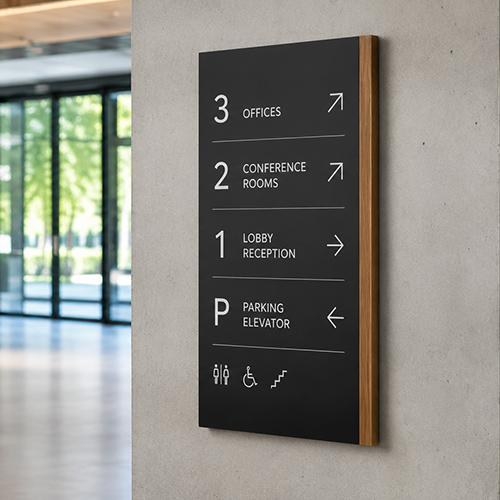
Most people don’t notice wayfinding when it’s working.
They simply arrive, find their destination, and move through a space without thinking twice about it.
But when wayfinding is missing—or poorly designed—people notice immediately. Visitors get lost. Customers become frustrated. Employees spend time giving directions. Patients miss appointments. Guests feel confused before they’ve even reached their destination.
That’s why effective wayfinding is one of the most important elements of a well-designed environment.
Wayfinding is the system of visual cues, signs, maps, landmarks, and information that helps people understand where they are, where they need to go, and how to get there.
At its simplest, wayfinding helps people answer three questions:
Where am I?
Where do I need to go?
How do I get there?
Good wayfinding makes navigation feel intuitive. People can move confidently through a space without constantly stopping to ask for help.
Wayfinding systems are used anywhere people need help navigating an environment.
Common examples include:
Healthcare facilities
Hospitals and medical campuses
Universities and schools
Corporate offices
Government buildings
Airports and transit centers
Hotels and resorts
Retail centers and shopping districts
Manufacturing facilities
Multi-building campuses
The larger or more complex the environment, the more important wayfinding becomes.
No one enjoys feeling lost.
When visitors can easily find their destination, they arrive feeling confident rather than frustrated.
For healthcare facilities, schools, hotels, and corporate offices, that experience can have a significant impact on overall satisfaction.
Without clear signage, employees often become part-time tour guides.
Receptionists, administrators, nurses, teachers, and staff members regularly spend time giving directions that could have been communicated through a well-designed wayfinding system.
When people spend less time searching, facilities operate more smoothly.
Visitors arrive on time. Deliveries reach the correct location. Meetings start as scheduled. Customers find what they’re looking for more quickly.
Wayfinding helps create environments that are easier for everyone to navigate, including first-time visitors, individuals with disabilities, and people unfamiliar with the space.
Most wayfinding systems are built using four categories of signs.
Identification signs confirm that someone has arrived at the correct destination.
Examples include:
Room numbers
Office signs
Department names
Conference room signs
Restroom signs
These signs answer the question:
“Am I in the right place?”
Directional signs guide people from one point to another.
Examples include:
Arrows
Hallway signs
Parking lot directions
Building navigation signs
Floor directories
These signs answer the question:
“Which way should I go?”
Informational signs provide context and useful details.
Examples include:
Campus maps
Building directories
Visitor information boards
Operating hours
Facility instructions
These signs answer the question:
“What do I need to know?”
Regulatory signs communicate rules, restrictions, and requirements.
Examples include:
ADA signs
Safety signs
Exit signs
Restricted access signs
Occupancy notices
These signs answer the question:
“What am I allowed—or required—to do?”
The best wayfinding systems share several common traits.
Signs should use the same terminology, colors, symbols, and visual style throughout a facility.
Consistency helps visitors recognize information quickly and build confidence as they move through a space.
More information is not always better.
The most effective signs provide only the information needed at that specific moment.
Signs should be placed where people naturally pause, make decisions, or need guidance.
A perfectly designed sign can’t help if it’s installed in the wrong location.
Font size, contrast, color, and viewing distance all affect how easily people can process information.
People should be able to understand a sign quickly—even while walking.
Many organizations unintentionally create navigation challenges by:
Using inconsistent terminology
Installing signs too late in the journey
Providing too much information
Creating conflicting directions
Ignoring visitor perspectives
Failing to update signage after renovations
Even a few small issues can create confusion throughout an entire facility.
The best wayfinding systems often combine multiple elements, including:
Building signage
Directories
Maps
Wall graphics
Floor graphics
Color-coded zones
Architectural landmarks
Together, these elements create a navigation experience that feels natural and intuitive.
Wayfinding isn’t just about signs. It’s about helping people feel confident in a space.
Whether you’re managing a healthcare facility, university, corporate office, retail center, or multi-building campus, effective wayfinding can improve visitor experiences, reduce confusion, and help people get where they need to go more efficiently.
When done well, wayfinding often goes unnoticed—and that’s exactly the point.