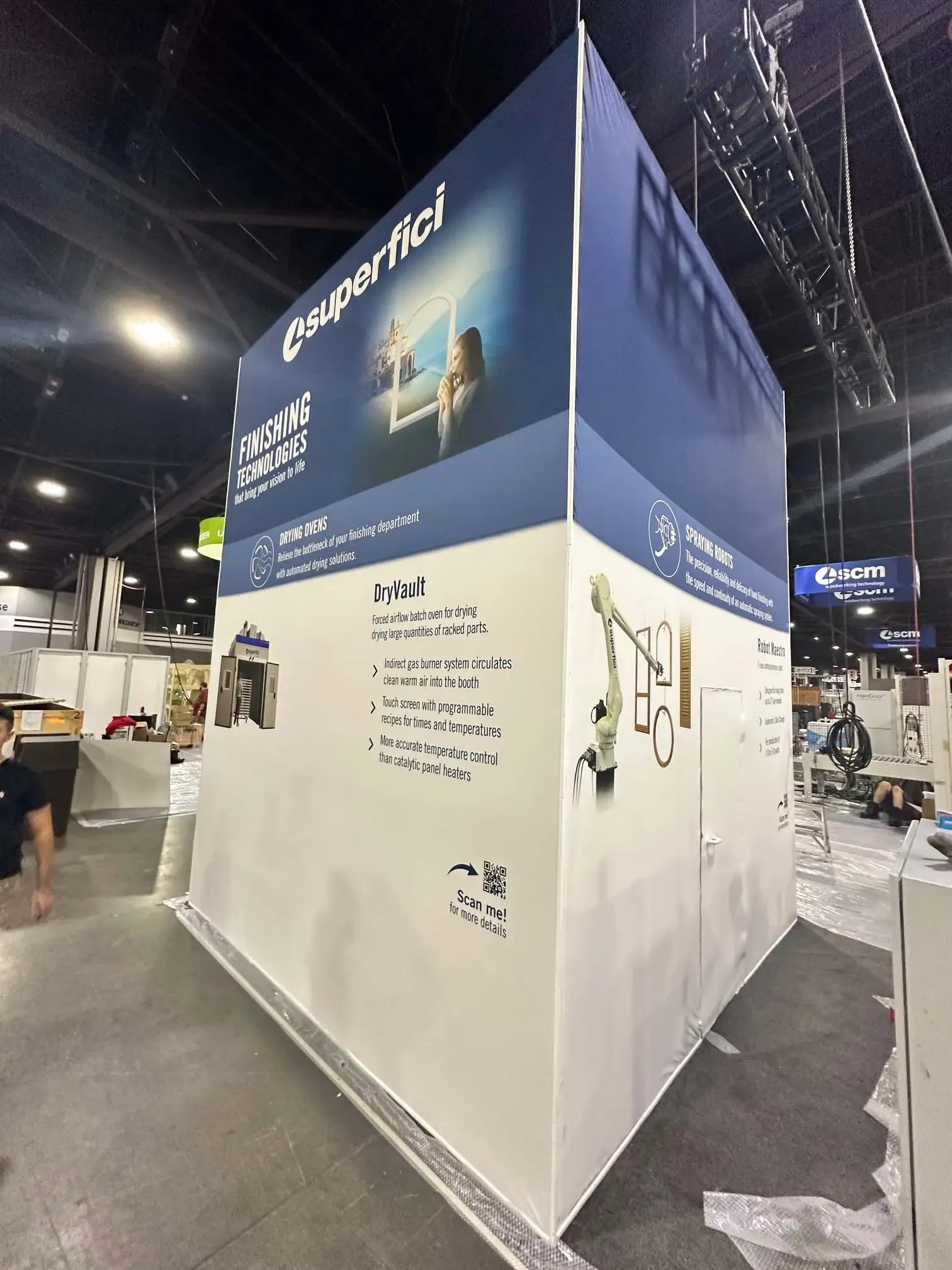
A guide to communicating your booth's value before attendees walk past.
Trade shows are busy.
Attendees are navigating crowded aisles, scanning hundreds of booths, checking schedules, answering emails, and trying to determine which exhibitors deserve their attention.
In that environment, your booth has only a few seconds to communicate its value.
Not thirty seconds.
Not a minute.
A few seconds.
That's why the most effective trade show booths don't try to explain everything. They focus on communicating one clear idea quickly.
If attendees can't immediately understand who you are, what you do, and why it matters, they'll keep walking.
Here's how to create booth messaging that gets noticed—and remembered.
Imagine standing twenty feet away from your booth.
Ask yourself:
Can a first-time visitor quickly answer these three questions?
Who are you?
Your company name and logo should be immediately visible.
What do you do?
Your headline should communicate your offering clearly.
Why should someone care?
What problem do you solve?
What outcome do you deliver?
If attendees need to read a paragraph to figure it out, the message is too complicated.
The best booth messaging is about the customer.
Many exhibitors lead with statements like:
While those claims may be true, they don't immediately communicate value.
Instead, focus on the customer's challenge.
Consider the difference:
Company-Focused
"We provide comprehensive workforce management software."
Customer-Focused
"Reduce scheduling headaches and save administrative time."
The second version tells attendees why they should care.
People don't buy products.
They buy outcomes.
When developing booth messaging, ask:
What result are customers trying to achieve?
Examples:
Instead of:
Consider:
Print Projects Delivered On Time. Every Time.
Instead of:
Consider:
Turn More Leads Into Customers.
Instead of:
Consider:
Help Your Team Work Smarter.
The outcome is often more compelling than the service itself.
One of the most common trade show mistakes is trying to communicate too much.
Companies want to showcase:
The result is often visual clutter and messaging overload.
Attendees don't need to know everything.
They need a reason to stop.
Focus on:
One Primary Message
Supported by:
Three or Fewer Supporting Points
The rest of the conversation can happen after someone engages.
Your booth headline should be readable from a distance.
Many exhibitors underestimate how far away attendees are when first evaluating a booth.
As a general rule:
The most important message should be the largest element on the display.
Your headline should command attention before attendees notice:
The hierarchy should be obvious.
Trade show attendees don't spend time decoding technical language.
Avoid phrases like:
Instead, use plain language.
Simple communication is not less professional.
It's more effective.
The easier your message is to understand, the more people will understand it.
One simple technique:
Use the word "you."
Examples:
Instead of:
Integrated marketing solutions.
Try:
Get your message in front of more customers.
Instead of:
Commercial signage services.
Try:
Help customers find—and remember—your business.
People naturally pay attention when they see themselves reflected in the message.
Graphics should reinforce the headline—not compete with it.
Effective booth graphics often include:
Avoid using images simply because they look attractive.
Every visual should support the message you're trying to communicate.
Your logo matters.
But most attendees won't stop because they recognize your logo.
They stop because your message feels relevant.
Your logo should be prominent.
Your value proposition should be even more prominent.
Once you've captured attention, make it clear what attendees should do next.
Examples:
Without a clear next step, even strong messaging can lose momentum.
Before printing anything, perform a simple test.
Show your booth design to someone unfamiliar with your business.
Ask:
What does this company do?
Who is this for?
What would you do next?
If they struggle to answer, simplify the message.
The best booth messaging feels obvious.
Too Much Text
Attendees won't read paragraphs from the aisle.
Too Many Messages
One strong message usually outperforms five competing ones.
Generic Claims
Words like "quality," "innovative," and "trusted" are often overused.
Feature Overload
Lead with benefits and outcomes before discussing technical details.
No Call to Action
Make the next step obvious.
Trade show attendees are constantly making decisions.
Where to stop.
Who to talk to.
What to ignore.
Your booth messaging should make that decision easy.
A clear headline, customer-focused value proposition, simple visuals, and a strong call to action can dramatically increase engagement.
Because in a crowded exhibit hall, clarity beats complexity every time.
And when you only have three seconds, every word matters.