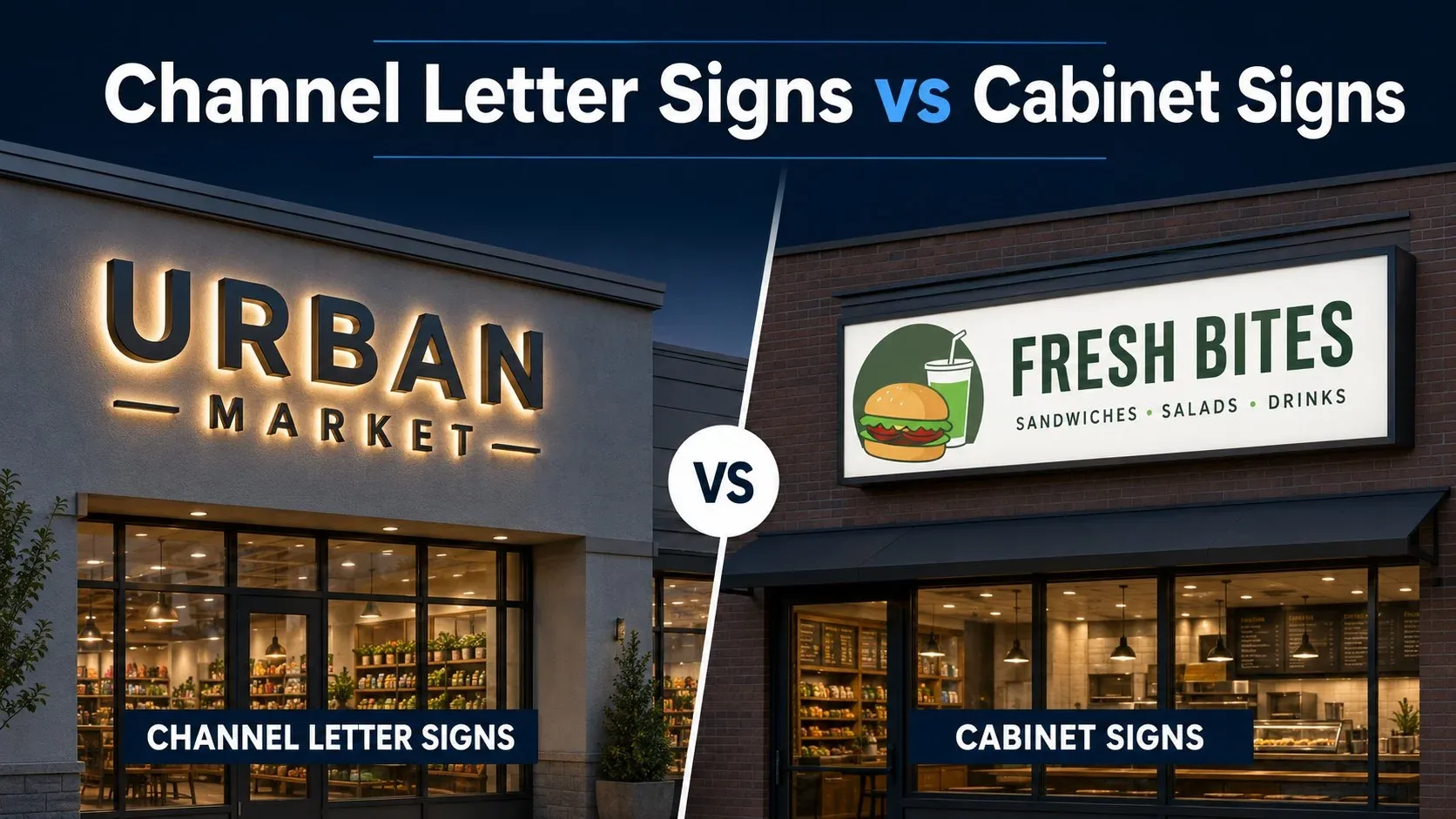
Channel letter signs vs cabinet signs is one of the most consequential decisions a business owner makes when planning storefront signage. The choice affects how customers perceive your brand, how much you spend upfront, how much you pay in ongoing energy costs, how long your sign lasts, and whether your landlord will even approve your project. Most sign guides treat this as a simple aesthetic preference. It's not. Channel letter signs vs cabinet signs involve real tradeoffs with real consequences that play out over 10 to 20 years.
The honest reality is that neither channel letter signs nor cabinet signs are universally better. Channel letter signs win on prestige, dimensionality, and long-term value. Cabinet signs win on cost, visibility, and graphic flexibility. Your specific situation determines which one is right for your business. Landlord requirements, budget, brand positioning, road visibility, and your city's permitting rules all factor into the decision.
This guide covers everything you need to know about channel letter signs vs cabinet signs to make an informed choice. It includes real cost breakdowns, illumination options within each type, hybrid approaches most guides don't mention, and the Tennessee-specific considerations for business signage in the Nashville metro area.
If you're planning a storefront sign for your business, this guide provides the answers your sign provider should be giving you.
What Are Channel Letter Signs?
Channel letter signs are three-dimensional signs in which each letter or logo element is individually fabricated and mounted on the building facade. Each letter is typically made from aluminum with an acrylic face, with LED lighting inside to illuminate at night.
Think of any Starbucks, Bank of America, or Chipotle storefront. Those individual glowing letters mounted separately on the building? Those are channel letter signs.
Key characteristics of channel letter signs:
- Individual letters and logo elements
- Three-dimensional depth (typically 3 to 5 inches deep)
- Aluminum construction with acrylic faces
- Internal LED illumination
- Multiple illumination style options (front-lit, halo-lit, combo-lit)
- Direct mounting or raceway mounting
- Custom colors matching brand Pantone specifications
- Premium visual appearance
Channel letter signs are commonly specified by upscale businesses, national retailers, healthcare facilities, financial institutions, and businesses in high-end retail centers throughout the Nashville area, including Cool Springs, The Mall at Green Hills, Franklin, and premium Brentwood retail locations.
What Are Cabinet Signs?
Cabinet signs (also called box signs or lightbox signs) are single-unit enclosed signs featuring a flat or slightly formed face displaying graphics, lettering, or full-color imagery. The sign is essentially a large illuminated box mounted to the building or on a pylon.
Cabinet signs display all information within a single continuous panel. LED lighting inside the cabinet evenly illuminates the entire face. Graphics can include complex logos, multiple colors, photos, text, and any design that can be printed.
Key characteristics of cabinet signs:
- Single-unit construction
- Flat or slightly formed face
- Aluminum frame with polycarbonate or acrylic face
- Full-face LED illumination
- Complex graphic capability including full-color imagery
- Wall-mounted or pylon-mounted options
- Lower cost per square foot than channel letters
- Higher information density possible
Cabinet signs are commonly specified by fast food restaurants, gas stations, franchises with complex logos, multi-tenant buildings, and businesses along high-speed roads where distance visibility matters more than close-range refinement.
Channel Letter Signs vs Cabinet Signs: The Real Cost Comparison
Cost is one of the biggest factors in the channel letter vs. cabinet sign decision. Here's what each option actually costs.
Channel Letter Signs Cost
Channel letter signs are priced per letter based on letter height and complexity.
Cost by letter height:
- 12-inch letters: $200 to $400 per letter
- 18-inch letters: $300 to $550 per letter
- 24-inch letters: $400 to $750 per letter
- 36-inch letters: $700 to $1,200 per letter
- 48-inch letters: $1,000 to $2,000 per letter
- 60-inch letters: $1,500 to $3,000 per letter
Total project cost examples:
- Small business "SMITH LAW" (9 letters at 18 inches): $2,700 to $5,000 (plus installation and permits)
- Medium retail "FURNITURE PLUS" (13 letters at 24 inches): $5,200 to $9,750 (plus extras)
- Large storefront "PREMIUM AUTO SERVICE" (20 letters at 36 inches): $14,000 to $24,000 (plus extras)
Additional costs for channel letter signs:
- Raceway mounting (if required): $500 to $2,000
- Structural engineering: $500 to $1,500
- Sign permit and application: $200 to $1,000
- Installation labor: $1,500 to $8,000
- Electrical hookup: $500 to $2,000
- Backer or wireway (aesthetic): $500 to $3,000
Realistic total channel letter sign projects:
- Basic project (small business): $5,000 to $12,000 total
- Mid-range project: $12,000 to $30,000 total
- Premium project: $30,000 to $100,000+ total
Cabinet Sign Cost
Cabinet signs are priced per square foot of illuminated face area.
Cost per square foot:
- Basic cabinet signs: $150 to $250 per square foot
- Mid-tier cabinet signs: $250 to $400 per square foot
- Premium cabinet signs: $400 to $600 per square foot
Total project cost examples:
- Small cabinet sign (4' x 8' = 32 sq ft): $4,800 to $12,800 total
- Medium cabinet sign (6' x 12' = 72 sq ft): $10,800 to $28,800 total
- Large cabinet sign (8' x 20' = 160 sq ft): $24,000 to $64,000 total
- Pylon-mounted cabinet: Add $3,000 to $15,000 for pole structure
Additional costs for cabinet signs:
- Pylon or pole mounting: $3,000 to $15,000
- Structural engineering: $500 to $1,500
- Sign permit: $200 to $1,000
- Installation and crane: $1,000 to $6,000
- Electrical hookup: $500 to $2,000
Realistic total cabinet sign projects:
- Basic wall-mounted: $6,000 to $15,000 total
- Mid-range wall-mounted: $12,000 to $30,000 total
- Large pylon-mounted: $25,000 to $80,000+ total
The Cost Comparison at Similar Sizes
For a business needing signage covering approximately 50 square feet of area:
Channel letter signs approach: 15 letters at 24 inches, averaging 3.5 sq ft per letter = 52 sq ft. Total: $15,000 to $25,000 including installation and permits.
Cabinet sign approach: 5' x 10' cabinet = 50 sq ft. Total: $10,000 to $18,000 including installation and permits.
Cabinet signs typically cost 25 to 40% less than channel letter signs for equivalent sign area. This cost difference is one of the primary factors in the channel letter vs. cabinet sign decision for cost-conscious businesses.
Visibility Comparison
Visibility is where channel letter signs vs cabinet signs show meaningful differences.
Daytime Visibility
Channel letter signs excel during the day. The three-dimensional depth creates shadows and highlights that make letters distinctive even when unlit. Each letter stands out from the building surface, catching light throughout the day.
Cabinet signs perform adequately during the day. They're readable but lack the visual depth and interest of dimensional letters. Their impact comes from their large flat surface area and color rather than dimensionality.
Winner for daytime: Channel letter signs, especially for close-range viewing.
Nighttime Visibility
Channel letter signs offer focused illumination. Each letter glows independently, creating clean, readable text at night. The individual letter definition works particularly well for shorter business names with distinctive fonts.
Cabinet signs offer maximum illuminated surface area. The entire face lights up, creating a brighter overall presence from distance. Cabinet signs typically appear brighter and more visible from far away.
Winner for nighttime distance visibility: Cabinet signs, especially for businesses along fast-moving traffic like Nashville's I-65, I-40, or Franklin Road.
Winner for nighttime close-range visibility: Channel letter signs, especially for storefronts in walkable shopping areas like Downtown Franklin, Cool Springs, or 12 South.
Distance Visibility
The distance at which your sign needs to be readable is a key factor in the channel letter vs. cabinet sign decision.
For distances under 100 feet: Both signs work well. Channel letters look more premium.
For distances of 100 to 300 feet, both signs work with proper sizing. Cabinet signs typically deliver more visual impact.
For distances 300+ feet: Cabinet signs generally win. Their large illuminated surface creates more distant visibility than individual letters can match.
For pylon and monument applications: Cabinet signs almost universally win. Individual channel letters lose readability at pylon heights and typical viewing distances.
Illumination Options Within Each Sign Type
Both channel letter signs and cabinet signs offer multiple illumination options that affect appearance and cost.
Channel Letter Sign Illumination Options
Front-lit channel letters (most common). LEDs inside each letter illuminate through the acrylic face. Bright, direct visibility at night. Standard cost tier.
Halo-lit (reverse) channel letters. LEDs mounted on the back of each letter cast light onto the wall behind. Creates a distinctive glowing outline effect. Premium appearance. 15 to 25% higher cost than front-lit.
Combo-lit channel letters. Combines front and halo illumination for maximum visual impact. Highest cost. Distinctive high-end appearance.
Open face channel letters. No acrylic face, exposing the LED lighting directly. Vintage/industrial appearance. Requires careful design to avoid complaints about glare.
Non-illuminated channel letters. No lighting. Lower cost. Best for businesses closing before dark or where illumination is prohibited.
Cabinet Sign Illumination Options
Internally illuminated cabinet signs (standard). LEDs inside the cabinet evenly illuminate the entire face. Most common configuration.
Perimeter-lit cabinet signs. LEDs mount around the perimeter of the cabinet. Uses less energy but with less even face illumination.
Externally illuminated cabinet signs. Ground-mounted or overhead lights illuminate the face from outside. Traditional appearance. Lower energy cost.
Digital LED cabinet signs. Digital display allowing changing content. Highest cost. Most flexibility. Regulated by some municipalities.
Longevity and Maintenance
The decision between channel letter signs and cabinet signs has significant long-term implications.
Channel Letter Sign Lifespan
Well-built channel letter signs last 15 to 25 years with basic maintenance.
Component lifespan:
- Aluminum letter bodies: 25+ years
- LED modules: 50,000 to 100,000 hours (10 to 20 years of typical use)
- Acrylic faces: 15 to 20 years before noticeable yellowing
- Power supplies: 8 to 12 years
Maintenance realities:
- Individual letter repair possible (fix one letter without touching others)
- LED replacement can be done per letter
- Cleaning is straightforward
- Component replacement costs are moderate
Cabinet Sign Lifespan
Well-built cabinet signs last 12 to 20 years with proper maintenance.
Component lifespan:
- Aluminum cabinet frame: 25+ years
- LED lighting systems: 50,000 to 80,000 hours
- Polycarbonate or acrylic face: 8 to 15 years before yellowing or cracking
- Power supplies: 8 to 12 years
Maintenance realities:
- Face replacement often needed at 8 to 15 years (major expense)
- LED array replacement is a larger project than individual channel letter repair
- Cleaning requires access to face panel
- Yellowing or cracked face requires full panel replacement
Face replacement cost: $2,000 to $8,000 depending on cabinet size. This is a significant expense that channel-letter signs don't incur.
Repair Economics
The repair economics of channel letter signs vs cabinet signs differ significantly.
Channel letter sign repairs:
- Failed LED in one letter: $200 to $500 to repair
- Damaged single letter: $300 to $1,500 to replace
- Total repair cost over 20 years: typically $2,000 to $5,000
Cabinet sign repairs:
- Failed LED array: $1,000 to $3,000 to repair
- Yellowed or damaged face: $2,000 to $8,000 to replace
- Total repair cost over 20 years: typically $4,000 to $12,000
Cabinet signs typically require higher repair costs over their lifetime because damage often requires full-panel replacement rather than component-level repair.
Landlord and Shopping Center Requirements
One of the biggest factors most guides skip: your landlord may have already made this decision for you.
Most modern retail centers, professional buildings, and shopping centers in the Nashville area have signage criteria that specify:
Common landlord requirements:
- Channel letters only (very common in premium retail centers)
- Specific letter height limits
- Approved font styles
- Approved illumination types
- Maximum sign area
- Specific mounting requirements (raceway vs direct mount)
- Approved sign vendors or approval requirements
Common shopping centers with strict channel letter requirements:
- Cool Springs Galleria area shopping centers
- The Streets of Indian Lake (Hendersonville)
- Franklin Downtown historic district
- Green Hills area retail
- CoolSprings Marketplace and similar upscale developments
Common properties allowing cabinet signs:
- Older strip mall developments
- Industrial parks
- Standalone commercial properties
- Some suburban retail
Before making the channel letter vs. cabinet sign decision, review your lease and confirm what your landlord allows. Getting sign approval before design work begins prevents wasted design time and expense.
Permitting Considerations in Tennessee
Nashville metro sign permitting affects the decision between channel-letter and cabinet signs.
City of Brentwood typically processes signs efficiently (2 to 4 weeks). Sign codes limit total area and height. Both channel letters and cabinet signs are commonly approved.
City of Franklin has more stringent design guidelines, especially in historic districts. Downtown Franklin often favors channel letters over cabinet signs.
City of Nashville and Davidson County vary by district. Metropolitan sign codes generally allow both types.
Williamson County unincorporated areas generally more permissive than city jurisdictions.
Williamson County shopping centers with pylon signs often use cabinet signs in the pylon structure with individual channel letters on tenant storefronts.
Municipal sign permit costs: Typically $200 to $1,000 in the Nashville metro area, depending on the jurisdiction.
Electrical permits (required for illuminated signs): Typically an additional $150 to $400.
Sign permit timeline: 2 to 6 weeks in most Nashville metro jurisdictions.
When to Choose Channel Letter Signs
Channel letter signs make sense when:
Your brand positioning is premium or professional. Channel letters signal an established, professional business. Law firms, medical practices, financial services, upscale retail, and premium restaurants typically benefit from channel letter aesthetics.
Your landlord requires them. Many shopping centers and premium retail properties specify channel letters. Compliance requires this choice.
Your business name is short and readable. Channel letters work best with names of 8 to 20 characters. Longer names or complex logos may work better as cabinet signs.
Long-term value matters more than upfront cost. Channel letters cost more initially but often deliver better long-term value through longer face life and lower repair costs.
Nighttime close-range visibility is important. Channel letters excel in walkable shopping areas where customers evaluate signage at close range.
You want brand color precision. Channel letters allow precise Pantone color matching in the acrylic face. Cabinet signs also allow this but with slightly different visual character.
Your building architecture is contemporary or upscale. Channel letters complement modern retail architecture. They can look out of place on older buildings or strip malls.
Energy efficiency matters. LEDs in channel letters typically consume less energy than the larger illuminated area of cabinet signs.
When to Choose Cabinet Signs
Cabinet signs make sense when:
Budget is a primary constraint. Cabinet signs typically deliver more sign area per dollar than channel letters.
Your logo is complex or highly graphical. Cabinet signs allow full-color printed graphics that individual channel letters cannot replicate. Businesses with detailed logos, illustrations, or complex color schemes benefit from cabinet signs.
Your business relies on distance visibility. Businesses on high-traffic roads, near highways, or requiring visibility from 300+ feet often benefit from cabinet signs.
Your building is far from the road. Cabinet signs mounted higher or larger can compensate for building setbacks. Individual channel letters may become unreadable at long distances.
You need a pylon or monument sign. Cabinet signs work well in pole-mounted applications where individual channel letters would be hard to read.
Your business name is very long. Cabinet signs handle long business names or multi-line content better than individual channel letters.
You want to display promotions or messaging. Cabinet signs (especially digital versions) allow changing content that channel letters cannot match.
Your industry is casual or price-focused. Fast food, quick service, gas stations, and value-focused businesses often use cabinet signs successfully.
Hybrid Sign Approaches
Many businesses benefit from combining both channel letter signs and cabinet signs.
Common hybrid approaches:
Channel letters plus cabinet logo. Business name in channel letters with a cabinet-style logo box for the icon or emblem. Common among fast-food chains and businesses with distinctive graphic logos.
Building channel letters plus pylon cabinet. Individual channel letters on the storefront facade with a large cabinet sign on a pylon or monument for distance visibility.
Channel letters with cabinet tagline panel. Primary business name in channel letters with a smaller cabinet panel below or beside for tagline, services, or additional information.
Interior channel letters plus exterior cabinet. Some businesses use channel letters inside for close-range brand experience with cabinet signs outside for distance visibility.
Hybrid approaches allow businesses to leverage strengths of both sign types while managing costs. A discussion with your sign vendor should include hybrid options if your situation might benefit from them.
Making the Decision: A Framework
The channel letter signs vs cabinet signs decision comes down to weighting these factors:
Weight your priorities:
- What is your maximum sign budget?
- What does your landlord require or allow?
- What is your brand positioning?
- How important is distance visibility?
- How important is nighttime visibility?
- How complex is your logo?
- How long is your lease?
- What does your city's sign code allow?
- What's your competition using?
- What's your maintenance capacity?
Simple decision framework:
Choose channel letter signs if:
- Your landlord requires them
- Budget allows $12,000+ for signage
- Brand positioning is premium or professional
- Business name is 8-20 characters
- Building is contemporary or upscale
- Nighttime close-range visibility is important
Choose cabinet signs if:
- Budget is tight (under $12,000)
- Logo is complex or highly graphical
- Distance visibility is critical
- Business name is very long
- Building is far from the road
- Landlord permits either type
Consider hybrid if:
- Budget allows $15,000+ total
- Business benefits from both close and distance visibility
- Logo has both text and complex graphic elements
- You want to leverage strengths of both types
Common Mistakes with Storefront Sign Selection
Certain patterns lead to poor outcomes with either channel letter signs or cabinet signs.
Choosing based on lowest bid. The difference between a quality and a mediocre installation is often less than 20% of the total cost. Cheap signs fail faster and reflect poorly on your brand.
Choosing letter height too small. Signs that can't be read at an appropriate distance don't deliver marketing value regardless of type.
Ignoring landlord requirements. Getting sign approval before design begins prevents wasted design time and expense.
Skipping face material quality on cabinet signs. Polycarbonate faces yellow much more slowly than acrylic faces. Premium materials justify their cost through longer face life.
Choosing the wrong type of illumination for the environment. Halo lighting on a dark background creates minimal visibility. Front lighting on a highly reflective building causes glare.
Not considering long-term costs. Cabinet signs cost less upfront but often more over 20 years due to face replacement.
Ignoring energy costs. Sign electrical costs over 15 years add up to substantial amounts. LED efficiency varies between sign types.
Skipping structural engineering. Insufficient engineering causes signs to fail in Tennessee weather, including tornado-force wind events.
Poor design for the sign type. Designs that work for channel letters often don't work for cabinet signs and vice versa. Design must match the sign type.
Frequently Asked Questions About Channel Letter Signs vs Cabinet Signs
Which is more expensive: channel letter signs or cabinet signs?
Channel letter signs typically cost 25 to 40% more than cabinet signs for equivalent sign area. However, channel letters often deliver better long-term value through longer face life and lower per-letter repair costs than cabinet face replacement.
Which sign type lasts longer?
Channel letter signs typically last 15 to 25 years with basic maintenance. Cabinet signs typically last 12 to 20 years but often require face replacement at 8 to 15 years. Long-term costs typically favor channel letters when face replacement is factored in.
Are channel letter signs more energy efficient than cabinet signs?
Yes, in most cases. Channel letters illuminate only the letter shape rather than the entire face. Energy consumption is typically 30 to 50% lower for channel letters versus similar-sized cabinet signs.
Which is better for nighttime visibility?
It depends on distance. Cabinet signs provide better nighttime visibility at distances of 200+ feet due to a larger illuminated surface. Channel letter signs deliver better close-range readability with cleaner text definition.
Can I have both channel letter signs and cabinet signs?
Yes. Hybrid approaches combining channel letters for the business name with cabinet signs for logos, taglines, or pylon visibility are common and often more effective than either alone.
Do most landlords require channel letters?
Many premium retail properties in Nashville metro require channel letters. Older commercial properties, industrial buildings, and value-focused retail often permit either type. Review your lease before making decisions.
How long does it take to install a channel letter or cabinet sign?
The total timeline from consultation to sign activation is 8 to 16 weeks for either type. Permits (2 to 6 weeks in Nashville metro) and fabrication (3 to 8 weeks) drive most of the timeline.
Which sign type is better for pylon or monument signs?
Cabinet signs almost universally work better for pylon and monument applications. Individual channel letters lose readability at pylon heights and typical viewing distances.
Do channel letter signs require special maintenance?
Basic cleaning and periodic LED replacement is all most channel letter signs require. Individual letter damage can be repaired without affecting other letters, which is a significant advantage over cabinet signs.
Can cabinet signs be made three-dimensional?
Slightly, through pan-forming (creating gentle dimension on the face). However, full three-dimensional appearance is exclusive to channel letters. Businesses wanting significant depth should choose channel letters.
Which sign type is better for franchises?
Depends on brand standards. Many franchise chains specify a single type in their brand guidelines. Fast food, gas stations, and quick service often specify cabinet signs. Upscale franchises and financial institutions often specify channel letters.
Are digital cabinet signs allowed in the Nashville area?
Most Nashville metro municipalities allow some digital signage with restrictions on brightness, transition frequency, and content. Some historic districts and specific zones prohibit digital signs. Check local codes before investing.
How do I know if I need channel letter signs or cabinet signs?
Consider your budget, landlord requirements, brand positioning, visibility needs, and logo complexity. Most premium and professional businesses benefit from channel letters. Most value-focused, high-traffic, or complex-logo businesses benefit from cabinet signs. Hybrid approaches often work best when budget allows.
Can I upgrade from cabinet signs to channel letter signs later?
Yes, but this typically involves replacing the entire sign. Reusing electrical infrastructure and mounting hardware is sometimes possible depending on the original installation. Plan for essentially a new sign investment.
Do channel letter signs increase property values?
Well-designed permanent signage can support property values for commercial real estate, especially for owner-occupied buildings. Channel letters typically read as more permanent and premium than cabinet signs.
Getting the Right Sign for Your Business
The channel letter sign vs. cabinet sign decision comes down to matching the sign to your business goals, location, budget, and permitting requirements. There is no universally right answer. There is a right answer for your specific situation.
Steps to make the decision:
- Review your lease for landlord requirements
- Confirm what your city's sign code allows
- Set a realistic budget including installation and permits
- Consider your brand positioning
- Evaluate your visibility needs (distance vs close-range)
- Assess your logo complexity
- Talk with an experienced sign provider who knows local codes
- Consider hybrid approaches if budget allows
The businesses that get exceptional value from signage invest appropriately in the right sign type for their situation. The businesses that end up dissatisfied almost always cut corners on materials, choose the wrong type for their situation, or fail to consider landlord and permitting requirements early enough.
Need Channel Letter Signs or Cabinet Signs in Brentwood or Nashville?
AlphaGraphics Brentwood provides complete signage services including channel letter signs, cabinet signs, building signage, monument signs, and hybrid approaches for businesses throughout the Nashville metro area including Brentwood, Nashville, Franklin, Cool Springs, Antioch, Columbia, Nolensville, and Smyrna.
Our team handles the complete process from initial consultation through permitting, fabrication, and installation. We regularly work with local municipalities and know which designs are approved efficiently in each Nashville metro jurisdiction.
If you're evaluating channel letter signs vs cabinet signs for your business, we offer complimentary consultations to review your building, discuss your brand goals, and provide realistic cost estimates.
AlphaGraphics Brentwood, 18 Cadillac Drive, Suite 300, Brentwood, TN 37027, 615 263 4444, Monday through Friday, 8:00 AM to 5:00 PM
Get a quote, contact us, or view our signage services to discuss your project.
AlphaGraphics Brentwood. Locally owned print, signage, and marketing solutions serving Brentwood, Nashville, and the greater Middle Tennessee area.