Signage & Displays
November 9, 2026
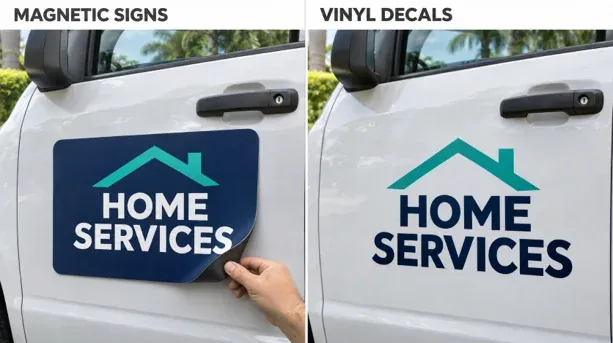
You just started a landscaping company. Or maybe you’ve been running your HVAC business for a decade, and your work truck still has nothing on it besides mud and a phone number scratched into the tailgate dust. Either way, you’re finally ready to put your name on your vehicle — and now you’re stuck between two options.
Magnetic signs or vinyl decals?
Both get your business name on a vehicle. Both work. But they solve different problems, and picking the wrong one can cost you time, money, and a few headaches you didn’t see coming — especially here in the Tampa Bay area, where the sun and humidity have opinions about everything.
Let’s break it down so you can make a decision you won’t second-guess six months from now.
Magnetic vehicle signs are printed on flexible magnetic sheets. Place them on any flat steel panel, and they hold in place through magnetic force alone—no adhesive, no tools. Pull them off when you’re done for the day, toss them in the garage, and your truck goes back to being a personal vehicle.
Vinyl decals are adhesive graphics applied directly to your vehicle’s painted surface. Once they’re on and fully cured (usually 24 to 48 hours), they’re weather-resistant, highway-speed tested, and designed to stay put for years. Removing them takes a heat gun and patience, but they won’t damage factory paint if you do it correctly.
The short version: magnets give you flexibility. Vinyl gives you durability and a more polished look. Everything else flows from that core tradeoff.
| Magnetic Signs | Vinyl Decals | |
| How they attach | Magnetic force (no adhesive) | Pressure-sensitive acrylic adhesive |
| Lifespan | 1–2 years with proper care | 3–7 years depending on material and UV exposure |
| Removal | Instant — peel off by hand | Requires heat and careful peeling |
| Surface requirements | Flat steel panels only | Works on steel, aluminum, fiberglass, glass, composites |
| Appearance | Slightly raised; visible edges | Flush, “painted-on” look |
| Reusable? | Yes — move between vehicles | No — one-time application |
| Design flexibility | Rectangular or simple shapes | Complex shapes, die-cuts, custom contours |
| Typical cost | 50–200 per pair | 150–600+ depending on coverage |
| Best for | Part-time use, leased vehicles, testing a brand | Full-time work trucks, long-term branding, fleet identity |
Most comparison articles online are written for moderate climates. Tampa isn’t moderate.
Between May and October, your vehicle sits in direct sunlight and 90°F-plus heat for hours. That changes the math on magnetic signs in a couple of ways that matter.
Heat bonding is real. When a magnetic sign bakes onto a hot vehicle panel day after day without being removed, the magnet can essentially fuse with the clear coat. At that point, removing it risks pulling paint. The fix is simple—remove your magnets regularly, at least once a week—but it’s a maintenance step most people forget until there’s damage.
Sun ghosting is the other issue. A magnetic sign blocks UV from hitting the paint underneath it. Over time, the exposed paint around the sign fades while the covered section doesn’t. Pull the magnet off after several months, and you may see a visible outline where it sat. On darker vehicles, this can be noticeable.
Humidity and trapped moisture. Florida’s humidity means condensation can form between the magnet and the panel, especially overnight. If dirt or grit gets trapped in that moisture, it acts like fine sandpaper on your clear coat every time the magnet shifts slightly. Regular cleaning prevents this, but again—it’s a task you actually have to do.
Vinyl decals don’t carry any of these risks. They bond to the surface, move with the paint through temperature swings, and get washed with the rest of the vehicle. In a Florida climate, vinyl is generally the lower-maintenance option over time.
That doesn’t mean magnets are a bad choice here. It means you need to commit to the upkeep if you go that route.
Here’s something that catches a lot of business owners off guard: magnetic signs only work on steel.
And a growing number of trucks, vans, and SUVs use aluminum body panels.
The Ford F-150 switched to an aluminum body back in 2015. The Ford Super Duty models followed with aluminum components. Many newer vans, crossovers, and nearly all electric vehicles use aluminum, composite, or mixed-material construction. If a fridge magnet won’t stick to your door panel, a car magnet won’t either.
Before you order magnetic signs, do that fridge magnet test on the exact panels where you’d want them placed. If they slide off, vinyl decals are your only practical option — unless you want to explore a car topper, which sits on the roof.
This is one of the biggest reasons we see Tampa business owners switch from magnets to vinyl after their first order. Nobody told them to check first.
Magnets aren’t always the wrong call. They’re the right call in specific situations:
You use your personal vehicle for work and personal driving. If you don’t want your business name on your car while you’re picking up your kids or running weekend errands, magnets let you switch modes in seconds.
You’re on a short-term lease. Most lease agreements prohibit adhesive modifications. Magnets leave no residue and won’t violate your lease terms.
Your branding isn’t finalized yet. Just launched? Still tweaking your logo, phone number, or service list? Magnets let you update without the cost of removing and reapplying vinyl.
You rotate signage between multiple vehicles. If you have three drivers sharing two sets of signs, magnets move from truck to truck without any hassle. That flexibility is hard to beat on a tight budget.
You run a seasonal business. A holiday lighting company or a tax preparation service that only operates part of the year may not need permanent signage on a vehicle that sits idle for months.
For most full-time businesses with dedicated work vehicles, vinyl decals deliver more value over time. Here’s why:
They look professional in a way magnets can’t match. Vinyl sits flush against the vehicle surface. No raised edges, no visible seams, and no sign that looks like it might blow off on the highway. When you pull up to a customer’s home or business, vinyl decals communicate that you’re established, that you’ve invested in your brand, and that you plan to be around.
They last years, not months. Quality vinyl decals hold up for three to seven years in outdoor conditions. Even under Tampa’s aggressive UV, professional-grade cast vinyl with UV-resistant laminate maintains color and adhesion for years. The per-year cost of vinyl is often lower than replacing magnets every 12 to 18 months.
They handle any surface. Aluminum panels, fiberglass, curved surfaces, windows — vinyl works everywhere magnets can’t.
They offer unlimited design options. Die-cut logos, multicolor graphics, full partial wraps, window perf — vinyl opens up design possibilities that rectangular magnetic sheets simply can’t deliver. If your branding relies on a custom shape, specific color matching, or a graphic that wraps around a body line, vinyl is the way to go.
Zero daily maintenance. No removing, cleaning, and reapplying. No worrying about heat bonding or ghosting. Wash your vehicle the way you normally would, and the graphics take care of themselves.
Pricing depends on a lot of variables — size, complexity, material grade, quantity — so broad generalizations only get you so far. But here’s a realistic framework:
Magnetic signs typically run between $50 and $200 for a pair of door panels, depending on size and print quality. You might need to replace them every one to two years. If you’re running two sets across a small fleet, you’ll reorder periodically.
Vinyl decals for basic lettering and a logo on both doors usually fall in the $150 to $600 range, including professional installation. More complex graphics with partial wraps can go higher. But that investment lasts several years.
Run the numbers over a three-year window. A $150 set of magnets replaced twice costs $450 total—and that doesn’t count the time you spend maintaining them weekly. A $400 vinyl decal job done once may cost less and look better the entire time.
The real question isn’t “which costs less up front?” It’s “which gives me better return over the life of this vehicle?”
And on that note — data from the Outdoor Advertising Association of America (OAAA) shows that a single branded vehicle can generate anywhere from 30,000 to 70,000 daily impressions depending on where and how much it’s driven. In a metro area like Tampa, that number skews higher. Every day your vehicle is on the road without signage is exposure you’re leaving on the table.
Yes, and it’s a strategy worth considering.
Some businesses put permanent vinyl decals — logo, business name, core services — on their primary work vehicle, then keep a set of magnetic signs for temporary promotions, seasonal offerings, or secondary vehicles that rotate in and out.
A plumber with a dedicated service van might use vinyl for their main branding and add magnetic panels advertising a winter water heater special. When the promotion ends, the magnets come off, and the van still looks fully branded.
This hybrid approach gives you the permanence of vinyl where it counts and the flexibility of magnets where you need it.
This comes up more than you’d expect. Business owners worry that vinyl decals will hurt their trade-in or resale value.
In practice, professional-grade vinyl applied to factory paint in good condition removes cleanly. An experienced sign shop can remove decals without damaging the surface. In some cases, the vinyl actually protects the paint underneath from UV fading and minor scratches, so the area beneath the decals may look better than the rest of the vehicle when removed.
Magnetic signs avoid this concern entirely—there’s nothing to remove—but ghosting and potential clear coat issues from Florida heat can create cosmetic problems of their own if maintenance was neglected.
Ask yourself these five questions:
Is this vehicle used for work only, or does it double as your personal car? Work only → vinyl. Dual use → consider magnets.
Are the door panels steel? Do the fridge magnet test. If they’re aluminum or composite, magnets aren’t an option.
How long will you keep this vehicle? Three years or more → vinyl is almost always the better investment.
Is your branding locked in? If your logo, phone number, and services are settled, go vinyl. If things are still in flux, start with magnets.
Will you realistically maintain magnetic signs weekly? Be honest. If the answer is “probably not,” vinyl saves you from paint damage you didn’t budget for.
Whether you choose magnetic signs or vinyl decals, print quality matters. Cheap magnets fade fast. Poorly applied vinyl bubbles, peels, and looks worse than having nothing at all.
Work with a sign shop that understands both products, can walk you through material options for your specific vehicle, and handles installation with the care your paint deserves. At AlphaGraphics Northwest Tampa, we produce magnetic graphics and vinyl decals for businesses across the Tampa Bay area—and we’re straightforward about which option makes more sense for your situation.
Not sure which direction to go? Bring your vehicle by our shop on Hillsborough Avenue, or call us at (813) 875-7083. We’ll take a look at your panels, talk through your goals, and help you make a choice that works for your business and your budget.
Not if you maintain them properly. The damage comes from dirt and debris trapped between the magnet and the panel. Remove your magnets at least once a week, wipe down both surfaces, let everything dry completely, and reapply to a clean panel. In Florida’s heat and humidity, cleaning more often is a good idea.
Professional-grade cast vinyl with UV laminate typically lasts five to seven years, even in direct Florida sun. Cheaper calendered vinyl may only last two to three years before showing noticeable fading. The material grade matters — ask your sign shop what they’re using.
It depends on your lease terms. Some leases allow removable decals as long as you remove them professionally before returning. Others prohibit any adhesive modifications. Check your lease agreement or ask your dealer before committing. If it’s a no-go, magnetic signs are your best alternative.
Quality magnets on a flat steel surface hold at highway speeds under normal conditions. Problems happen when the magnet is placed over a curved section, a body line, or a panel gap — those areas don’t allow full magnetic contact. Edges can catch wind and peel up. Proper placement on a completely flat section of the door is key.
Yes, when removed correctly. A heat gun softens the adhesive, and the vinyl peels away cleanly from factory paint in good condition. Old, damaged, or aftermarket paint can sometimes react differently, so it’s worth mentioning your paint situation to your installer beforehand.