Print Production & Setup
November 10, 2026
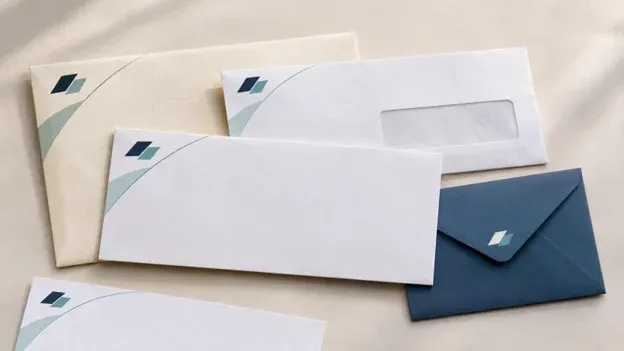
Think about the last piece of business mail you actually opened. Not the one with the generic return address label peeling at the corner. The one that looked like it came from a company that had its act together — clean logo, consistent colors, quality paper you could feel before you even tore the flap.
That envelope did its job before you read a single word inside.
Custom envelopes are one of the most overlooked branding tools a business has. They’re affordable, they touch every client and prospect who receives your mail, and they communicate professionalism in a way that a plain white envelope with a rubber-stamped return address never will.
This guide covers the sizes you need to know, the printing and paper options that actually matter, and how to turn your business envelopes into a quiet but consistent extension of your brand.
Envelopes aren’t interchangeable. Each size exists because a specific type of content fits inside it. Ordering the wrong size means your documents get folded when they shouldn’t, or your envelope arrives half-empty and floppy — neither of which looks professional.
Here are the sizes you’ll encounter most often:
|
Size |
Dimensions |
What It Holds |
Common Uses |
|
#10 |
4⅛" × 9½" |
Standard letter folded in thirds |
Invoices, contracts, general correspondence, statements |
|
#9 |
3⅞" × 8⅞" |
Fits inside a #10 as a reply envelope |
Return envelopes, remittance, RSVP |
|
#6¾ |
3⅝" × 6½" |
Personal notes, checks |
Payments, thank-you notes, short correspondence |
|
6" × 9" |
6" × 9" |
Half-fold letter, small booklets |
Marketing mailers, brochures, catalogs |
|
9" × 12" |
9" × 12" |
Full 8.5" × 11" sheets unfolded |
Contracts, presentations, legal documents, real estate packets |
|
10" × 13" |
10" × 13" |
Full sheets with room to spare |
Thick document sets, catalogs, media kits |
|
A7 |
5¼" × 7¼" |
5" × 7" cards |
Invitations, announcements, greeting cards |
|
A2 |
4⅜" × 5¾" |
Small cards, RSVP cards |
Thank-you notes, response cards, gift enclosures |
The #10 is the workhorse. It handles roughly 80% of US business mail. If you’re only going to order one custom envelope size, this is it. It fits a standard 8.5" × 11" letter folded into thirds, and it qualifies for regular First-Class letter-rate postage.
The 9" × 12" is for when folding isn’t an option. Contracts, proposals, legal packets, real estate closing documents — anything that needs to arrive flat and pristine. These cost more to mail (USPS classifies them as flats, not letters), but the presentation difference is substantial. A client receiving an unfolded proposal in a branded 9 × 12 envelope perceives it differently than one pulling a tri-folded document out of a #10.
A7 envelopes serve a specific purpose that many businesses underestimate. A branded A7 with a matching card inside works beautifully for client thank-you notes, holiday greetings, event invitations, and personal outreach. Law firms, financial advisors, real estate agents, and hospitality businesses in the Charleston area use these regularly—and those who brand them consistently stand out from the ones who grab a pack from the office supply store.
This isn’t just a feature checkbox. The presence or absence of a window affects how your envelope looks, how it functions, and what it says about your business.
Window envelopes have a transparent panel (usually glassine or poly film) that lets the recipient’s address show through from the letter inside. They’re practical for high-volume transactional mail — invoices, statements, payment notices — because you don’t need to print or write the address on the envelope itself. Your billing software prints the address on the letter in the right spot, and the window does the rest.
The tradeoff: windows limit your design options on the front of the envelope, and they can look transactional even when the contents aren’t. If you’re sending marketing material or a personal note, a window envelope undercuts the personal touch.
Windowless envelopes give you full design control over the front face. You can place your logo, return address, and other design elements wherever they work best. The recipient address prints directly on the envelope (or on a label), creating a cleaner, more intentional look.
For most businesses, the smart approach is to keep both on hand: window #10s for your transactional mail (invoices, statements, routine correspondence) and windowless #10s for everything that benefits from a more polished, branded presentation (proposals, welcome packets, direct mail campaigns).
Paper weight and texture are the physical version of your brand’s handshake. People register an envelope's feel before they consciously evaluate it, and the difference between a flimsy 20-lb stock and a sturdy 28-lb stock is immediately noticeable.
24-lb white wove is the standard for business envelopes. It’s professional, it runs cleanly through office printers and postal machines, and it’s the default for a reason. If you’re ordering your first batch of custom envelopes and you don’t have strong opinions about paper, 24-lb wove is the safe call.
28-lb stock feels noticeably heavier and more substantial. It resists tearing better, provides a crisper printing surface, and communicates a step up in quality. Law firms, financial services companies, and any business where perceived authority matters will benefit from the upgrade. The cost difference is modest — a few dollars more per hundred — but the impression difference is real.
Laid and linen textures add a tactile element that smooth wove stock doesn’t have. Laid paper has fine parallel lines you can feel with your fingertips. Linen has a subtle crosshatch texture. Both suggest formality and attention to detail. They’re excellent for firms that want their mail to feel premium — but keep in mind that heavily textured stocks can cause issues with inkjet printers, so plan to have these printed professionally rather than running them through your office machine.
Colored stock is an option, but use it intentionally. A colored envelope stands out in a mailbox full of white ones, which makes it effective for marketing mailers and event invitations. But for everyday business correspondence — invoices, contracts, official letters — white or natural remains the professional standard. The exception: if your brand colors are distinctive and you commit to colored envelopes as part of your identity, that consistency can become a recognition cue over time.
How your envelope is printed affects cost, visual impact, and turnaround time. Here’s what the options actually mean in practice:
One-color printing (typically black or a single PMS color) is the most economical option and the most common for everyday business envelopes. Your logo, return address, and any tagline or graphic print in one ink color. It’s clean, professional, and fast to produce. For businesses that primarily use envelopes for invoices and standard correspondence, one-color printing does the job without overcomplicating things.
Two-color printing lets you add your brand’s primary color alongside black. This is the sweet spot for many small and mid-sized businesses — your logo prints in its correct brand color, your text prints in black, and the overall effect is polished without the cost of full-color process printing.
Full-color (CMYK) printing opens up every design possibility. Photo-quality graphics, gradients, full bleeds (where ink runs to the edge of the envelope), and complex multi-color logos all become possible. Full-color envelopes make a strong impression and work especially well for direct mail marketing, event invitations, and businesses where visual branding is central to their identity—think hospitality, creative agencies, or upscale retail.
The cost difference between one-color and full-color has shrunk considerably with digital printing technology. For smaller runs (under 500), digital full-color is often comparable in price to traditional offset one-color. For larger runs (1,000+), offset printing significantly lowers the per-unit cost, especially for one- and two-color jobs.
This is a behind-the-scenes decision, but it directly affects your cost and your options.
Digital printing works like a high-end commercial version of your office printer — no plates, no lengthy setup. It’s ideal for short runs (100–500 envelopes), variable data (where each envelope gets a different recipient name or address printed directly on it), and full-color work where you don’t need tens of thousands of pieces. Turnaround is fast, typically two to three business days. The tradeoff: per-unit cost stays relatively flat regardless of quantity, so it doesn’t get dramatically cheaper at higher volumes.
Offset printing uses custom plates and produces consistent, high-quality results at scale. Setup costs more up front, but the per-unit price drops significantly as quantity increases. If you’re ordering 1,000 or more envelopes in one or two colors, offset is almost always more cost-effective. It also handles Pantone (PMS) color matching more precisely than digital, which matters if your brand guidelines specify exact ink colors.
The practical rule: under 500 pieces or need them fast, go digital. Over 1,000 pieces in one or two brand colors, go offset. In between, ask your print shop to quote both — sometimes the numbers surprise you.
This is where many well-intentioned envelope designs run into problems. The US Postal Service has specific requirements for what can and can’t appear in certain areas of an envelope, and ignoring them can lead to undeliverable mail, surcharges, or your beautiful design being obscured by postal barcodes.
The address clear zone. USPS requires a clear area on the lower portion of the envelope’s front—roughly the bottom 5/8 of an inch—where the delivery address and barcode will sit. Dark backgrounds, heavy graphics, or patterns in this zone can interfere with automated mail processing. Your print shop should know the exact specifications, but as a design principle, keep the lower-right quadrant of your envelope front relatively clean.
Return address placement. Place the return address in the upper-left corner of the front face. Include your business name, street address, city, state, and ZIP code. You can incorporate your logo here, but keep the text legible — postal workers need to read it if the piece is undeliverable.
Barcode clearance. Automated mail sorting sprays a barcode on the bottom of each envelope. If your design has ink or a dark color in that zone, the barcode won’t read correctly, and your mail may be delayed or returned. This is the most common design mistake businesses make with full-bleed envelope printing.
Size and thickness. For standard First-Class letter rates, your envelope must be between 3.5" × 5" (minimum) and 6.125" × 11.5" (maximum), and no thicker than ¼ inch. Anything outside those dimensions gets classified as a flat or a parcel, which costs more. Most standard business envelope sizes fall within these limits, but check if you’re using a non-standard size.
A good print shop flags these issues before your envelopes go to press. If yours doesn’t, that’s a red flag.
Custom envelopes deliver the most brand value when they’re part of a coordinated set — not a standalone item. When your envelope, letterhead, business card, and presentation folder all share the same logo placement, color palette, typography, and paper quality, every piece of correspondence reinforces your brand identity.
This doesn’t mean everything has to be identical. It means everything should feel intentionally connected. Your #10 envelope, your letterhead, and your business card should look like they came from the same company — because they did.
Here’s a practical way to approach it:
Start with your business card and letterhead design. Lock in the logo placement, colors, and typography. Then adapt that same design system to your envelopes. Your return address block on the envelope should echo the header on your letterhead. Your font choices should match. Keep the overall visual language consistent.
This is especially valuable for Charleston businesses in professional services — law firms, accounting practices, medical offices, financial advisors, real estate brokerages — where clients receive multiple pieces of correspondence over time. Each cohesive touchpoint builds trust. Each inconsistent one chips away at it.
After years of producing custom envelopes for businesses across the Lowcountry, certain mistakes come up repeatedly:
Ordering too few. Businesses order 250 custom envelopes, burn through them in six weeks, and then go back to plain envelopes until they reorder. If envelopes are part of your brand, keep them in stock. Order in quantities that last at least three to six months based on your actual mail volume. The per-unit cost drops at higher quantities, so ordering 1,000 at once almost always beats ordering 250 four times.
Ignoring the back flap. The envelope flap is printable real estate that most businesses leave blank. A subtle logo, tagline, website URL, or simple design element on the flap adds a finishing touch recipients notice—especially on A7 cards and invitations.
Mismatched branding. The envelope says one thing, the letterhead says another, and the business card uses a third version of the logo. This happens when a business updates its branding gradually instead of all at once. If you’ve recently refreshed your logo or colors, update all your printed materials at the same time so nothing in circulation contradicts the new look.
Designing without printer input. Full-bleed designs, metallic inks, and intricate fine-line work all look stunning on screen. But envelopes have physical constraints — they have seams, flaps, and variable thickness where layers overlap. A design that works perfectly on a flat sheet may not translate cleanly to an envelope. Talk to your printer before finalizing the design, not after.
Skipping the proof. Always request a printed proof, especially on your first order. Screen colors and printed colors don’t always match, and an envelope is a small, high-visibility piece where any color shift or alignment issue is immediately noticeable.
Custom envelopes aren’t complicated, but they benefit from someone who understands paper, printing, and postal requirements and can walk you through the options. That’s especially true for your first order, when you’re establishing the design, selecting paper stock, and making decisions that will carry forward across future reprints.
At AlphaGraphics Charleston, we print custom envelopes in every standard size — from #10 business envelopes to 9 × 12 catalog flats to A7 invitation envelopes — and we handle design, printing, and coordination with your other branded materials so everything works together. We’re at 639 Dupont Road in West Ashley. Call us at (843) 766-2330 or stop by — we’ll look at what you’re mailing, how much you’re mailing, and help you pick the size, paper, and printing approach that fits your business and your budget.
The #10 envelope, measuring 4⅛" × 9½", is the standard for US business correspondence. It holds a standard 8.5" × 11" letter folded into thirds and qualifies for regular First-Class postage rates. If you’re ordering one size to start, this is it.
That depends on your mail volume, but ordering at least 500 to 1,000 at a time usually makes the most financial sense. Per-unit costs drop significantly at higher quantities, especially with offset printing. Estimate how many envelopes you use per month, multiply by six, and order that amount as a starting point.
Yes. Full-color (CMYK) envelope printing is widely available through both digital and offset processes. Digital printing makes full-color practical even for smaller runs. Just be mindful of USPS requirements — you need to keep certain areas of the envelope front clear for addressing and barcode placement.
Window envelopes work best for transactional mail like invoices and statements, where the address prints on the enclosed document and shows through the window. Windowless envelopes give you more design control and are better for marketing mailers, proposals, and any correspondence where you want a more polished, branded look. Many businesses keep both on hand.
24-lb white wove is the industry standard for business envelopes — professional, printer-compatible, and cost-effective. For a more premium feel, 28-lb stock adds noticeable weight and substance without a major cost increase. Textured papers like laid or linen add a tactile quality but should be professionally printed, as they can jam desktop printers.
Absolutely, and you should. Matching your envelope design to your letterhead creates a cohesive brand experience. Bring your current letterhead (or its design file) to your print shop, and they can match the colors, fonts, and layout style across both pieces. If you need new letterhead too, designing both together ensures consistency from the start.