Trade Shows & Events
November 10, 2026
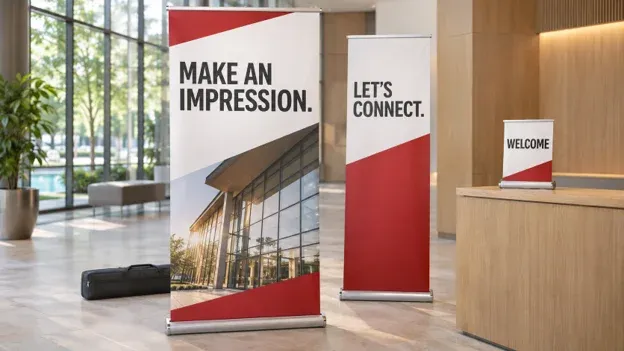
You’ve got a trade show coming up. Or maybe you’re opening a new office and want something in the lobby that says “we’re a real company” without drilling into the walls. Or your HR team needs a display for a college recruiting fair next month.
Whatever the reason, you’re shopping for a retractable banner stand — and within about five minutes of searching online, you’ve realized there are dozens of sizes, three tiers of hardware quality, and a dizzying range of prices from $49 to $500+.
This guide cuts through the noise. We’ll cover what sizes exist and when each one makes sense, what separates a banner stand that lasts five years from one that breaks at its third event, and the design decisions that determine whether people actually stop and read your banner or walk right past it.
A retractable banner stand — also called a roll-up, pull-up, or pop-up banner — is a portable display where a printed graphic rolls up into a metal base. To set it up, you pull the graphic out of the base, hook it onto a telescoping support pole, and you’re done. The whole process takes about 30 seconds, no tools required.
When you’re finished, the graphic retracts back into the base (like a tape measure), the pole collapses, and the whole unit slides into a carrying case. Most complete setups weigh between 5 and 15 pounds.
That combination of portability, fast setup, and professional appearance is why retractable banners have become a staple for businesses of every size. They show up at trade shows, in office lobbies, beside restaurant host stands, at church events, in medical waiting rooms, and at job fairs — basically anywhere you need to put a message in front of people without permanent installation.
Retractable banners aren’t one-size-fits-all. Both width and height matter, and the right dimensions depend on where the banner will live and how much space you have.
Here’s the breakdown of the sizes you’ll actually encounter:
|
Size |
Width × Height |
Best For |
|
Tabletop |
~8.5" × 12" |
Reception desks, checkout counters, registration tables |
|
Narrow |
24" × 80–81" |
Small booth spaces, hallway displays, tight retail spots |
|
Standard |
33–34" × 78–81" |
The industry workhorse — trade show booths, lobbies, events |
|
Wide |
36" × 90–92" |
Larger booths, retail floor displays, open lobbies |
|
Extra-Wide |
47–48" × 80–92" |
Spacious booths, standalone displays, conference backdrops |
|
Jumbo |
57–60" × 90–92" |
Big retail environments, step-and-repeat alternatives, open event spaces |
The 33" × 80" is the default for a reason. It fits inside a standard 10×10 trade show booth without crowding neighboring exhibitors; it’s tall enough to be seen from across an expo hall, and it’s wide enough to display a logo, a headline, and a few key bullet points without feeling cramped. If you’re ordering your first retractable banner and you’re not sure what size to get, this is the safe bet.
Go narrower (24") when space is tight — a hallway, a small pop-up booth, or a spot where you’re placing two or three banners side by side. Narrow banners also work well when your design is vertically oriented, like a product shot of a tall bottle or a full-length photo.
Go wider (47–60") when you have the real estate and want visual impact. A 48" banner in a retail showroom or a 60" banner flanking a conference stage creates a presence that smaller units can’t match. These larger sizes also give your designer room for more complex graphics or wider imagery.
Tabletop models fill a niche that floor-standing banners can’t. They sit on a table or counter and work perfectly at registration desks, checkout points, and small informational displays. Don’t overlook them — they’re one of the most underused formats.
This is where most first-time buyers make expensive mistakes. They focus entirely on the printed graphic — which is important — and ignore the hardware underneath it. Then the retraction mechanism jams at event number three, or the base tips over every time someone walks past.
Banner stand hardware generally falls into three tiers:
Economy (50-120 range). These stands use lightweight aluminum with a basic spring mechanism. The base is narrow, and the support pole is thinner. They work fine for single-use or occasional events — maybe a one-day open house or a seasonal promotion you’ll use twice a year. But if you’re doing six or more events annually, economy hardware starts showing fatigue. The spring loses tension, the pole develops a wobble, and eventually the retraction mechanism fails entirely. Most economy stands carry a 90-day hardware warranty, which tells you something about expected lifespan.
Mid-range (120-250 range). This is the sweet spot for most businesses. You get a wider, more stable base — often with a swivel foot design — a heavier-gauge aluminum pole, and a retraction mechanism that’s rated for hundreds of uses. Mid-range stands typically include a padded carrying case and come with a one- to two-year hardware warranty. For a business that does three to ten events per year, mid-range hardware will last you several years before needing replacement.
Premium (250-500+ range). Premium stands are built for heavy road use — weekly events, traveling sales teams, permanent lobby installations. The base is wider and heavier, the retraction mechanism is commercial-grade (some are rated for 1,000+ retractions), and the overall build quality is noticeably sturdier. Some premium models let you swap out the graphic cassette without tools, so you can change your messaging in minutes. If your banner stand is a core part of your marketing operation, premium hardware pays for itself.
Here’s the practical rule: if you’ll use the stand fewer than five times, economy is fine. If you’ll use it regularly over a couple of years, go mid-range. If it’s traveling with a sales team or sitting in a lobby 365 days a year, invest in premium.
The printed banner itself is the other half of the equation. Two things determine how good it looks and how long it lasts: the material and the print resolution.
Vinyl is the most common graphic material. It’s durable, produces vibrant colors, and handles repeated rolling and unrolling without cracking. Standard vinyl banners are a solid choice for most indoor applications.
Fabric (polyester) has become increasingly popular, especially for higher-end displays. Fabric graphics eliminate the glare vinyl can produce under overhead lighting, a real concern in expo halls and brightly lit showrooms. They also resist wrinkles better than vinyl after being stored in a carrying case. The tradeoff: fabric graphics generally cost a bit more and can show scuffing more easily.
Print resolution should be at least 720 DPI for photo-quality output. Most reputable print shops produce at 720 to 1440 DPI, which gives you sharp imagery and clean text even at close viewing distance.
One thing that separates a forgettable banner from a professional one: finishing details. Hemmed edges, reinforced grommets on the attachment rail, and a proper pole pocket all affect how cleanly the graphic hangs on the stand. A graphic that sags, buckles, or hangs crooked defeats the display's purpose.
Here’s something worth knowing before you order: on many mid-range and premium stands, you can replace just the graphic without buying a new stand.
That means your hardware becomes a long-term investment. Order the stand once, and then print a new graphic whenever your branding changes, you’re running a new promotion, or you’re attending a different type of event. A replacement graphic typically costs 40–60% less than buying a complete banner-and-stand package from scratch.
This approach works especially well for businesses that attend multiple types of events. Your trade show graphic might highlight product features, while your recruiting event graphic focuses on company culture, and your retail graphic pushes a seasonal promotion — all on the same stand.
Ask your print shop whether the stand you’re considering supports graphic swaps. Not all do, and it’s worth confirming before you buy.
A retractable banner stand is a vertical format, roughly two feet wide and six to seven feet tall. That shape dictates your design choices, and most mistakes come from ignoring how the format works.
Start with the top third. The top of your banner is the first thing people see from across a room. Your logo and primary message belong here — not buried in the middle or, worse, near the bottom where a table or crowd might block it.
Limit your text. A retractable banner is not a brochure. People absorb it in three to five seconds as they walk by. If your banner has more than 50 words on it, it probably has too many. Lead with a headline, support it with a subheading or a few short bullet points, and include your contact information at the bottom.
Text size by viewing distance. For a banner that needs to grab attention from 10 feet away — a typical trade show aisle — your headline should be at least 1.5 to 2 inches tall. From 20 feet, you need 3 inches or more. Body text should never be smaller than half an inch, or it becomes unreadable in any real-world setting.
Use high-contrast colors. Light text on a dark background or dark text on a light background. Avoid color combinations that look fine on your monitor but wash out under fluorescent lighting — medium blue text on a dark gray background, for example, becomes almost invisible under expo hall lights.
Leave breathing room. White space isn’t wasted space. It gives the eye somewhere to rest and makes your key messages stand out. A banner crammed edge-to-edge with text and images looks chaotic, not professional.
Keep critical content away from the bottom 6–8 inches. The graphic rolls into the base, and the base blocks the lowest portion when displayed. Some newer stands minimize this, but it’s smart design practice to treat the bottom strip as a dead zone.
Retractable banners are versatile, but they’re not always the answer. Knowing when to use something else saves you money and frustration.
Outdoors in wind. Standard retractable banners are designed for indoor use. Even moderate wind can tip them over or damage the graphic. For outdoor signage, consider feather flags, weighted A-frames, or outdoor-rated banner stands with heavier bases and wind-resistant hardware.
As a primary booth backwall. In a 10×10 trade show booth, a single retractable banner works as a supporting element, not your entire backdrop. If you need a full-width backwall, a tension fabric display, pop-up frame, or large-format printed backdrop gives you a much bigger visual canvas.
For permanent wall-mounted displays. If the message won’t change and the location is fixed, a mounted sign, printed panel, or wall graphic is more appropriate. Retractable stands are built for portability — using one as a permanent fixture underutilizes a fixed space.
When you need interactivity or technology. Digital displays, touchscreens, or video monitors serve different functions than printed banners. If your goal is to engage someone for more than a few seconds, consider integrating digital elements alongside — not instead of — your printed signage.
A few care practices extend the life of your banner stand considerably:
Always retract the graphic after use. Leaving it extended invites dust, accidental tears, and UV fade if it’s near windows. Roll it back into the base — that’s what the base is designed to protect.
Store it upright or in its carrying case. Laying a banner stand flat under a pile of boxes in a storage closet is a recipe for a bent pole or a creased graphic. Use the carrying case it came with — it exists for a reason.
Watch the heat. This matters in Texas. Leaving a banner stand in the back of a vehicle during a July afternoon in Conroe can warp the graphic, weaken adhesives, and stress the retraction mechanism. If the stand has to travel in your car, bring it inside when you arrive. Don’t leave it cooking in a trunk.
Clean the graphic gently. A soft cloth with mild soap and water handles most smudges. Avoid abrasive cleaners or scrubbing, which can damage the print surface.
Here’s a quick reference to put it all together:
If you’re attending your first trade show, a 33" × 80" mid-range stand with a vinyl graphic is the reliable starting point. It fits any standard booth, sets up in seconds, and looks professional without a steep investment.
If you’re outfitting an office lobby or waiting room, consider a premium stand since it’ll be displayed constantly, and a fabric graphic to eliminate glare under indoor lighting.
If you’re a restaurant or retailer, a narrow 24" stand works well beside a host stand or near an entrance without blocking foot traffic. Pair it with a seasonal graphic you can swap out quarterly.
If you’re doing recruiting events or career fairs, invest in the stand hardware once and rotate through different graphics — one for campus events, one for industry job fairs, one for open houses.
If you need tabletop presence at a farmers market, front desk, or registration table, a tabletop retractable is compact, portable, and punches above its size.
At AlphaGraphics Conroe, we produce retractable banner graphics in-house and carry a range of hardware options from economy to premium — and we’ll tell you straight which tier makes sense for how you plan to use it. We’re at 3031 N. Frazier Street in Conroe. Call us at (936) 756-3738 or stop by, and we’ll walk you through the options with your actual event or space in mind.
With proper care and indoor use, a vinyl graphic typically holds its color and print quality for one to three years of regular use. Fabric graphics can last longer since they resist creasing. The stand hardware, assuming mid-range or better quality, outlasts the graphic by several years — which is why buying replacement graphics makes more financial sense than replacing the entire unit each time.
Standard retractable banners are built for indoor environments. Wind is the main problem — even a light breeze can topple a standard stand or damage the graphic. For outdoor events, ask about outdoor-rated banner stands with weighted bases, wider footprints, and wind-resistant construction. Feather flags and A-frames are often better outdoor options.
PDF is the preferred format at most print shops. Adobe Illustrator (.ai) and high-resolution EPS files are also standard. If you’re working from a design tool like Canva, export at the highest resolution available — ideally 300 DPI at actual print size. Include 0.5 inches of bleed on all sides, and keep critical text and logos at least 0.5 inches inside the trim line.
On most mid-range and premium stands, yes. The graphic attaches to a rail that clips into the base, and many designs allow you to slide the old graphic off and attach a new one without tools. Economy stands sometimes have the graphic permanently bonded to the retraction mechanism, so swapping isn’t an option. If you anticipate needing graphic changes down the road, confirm this before purchasing.
For a standard 10×10 booth, one or two retractable banners alongside a table cover and some printed collateral is a solid starting setup. The banner handles your main branding and messaging, while other materials provide supporting detail. Larger booths (10×20 and up) might use three to four banner stands or combine them with a tension fabric backwall for full visual coverage.