
Printing & Production
September 30, 2026
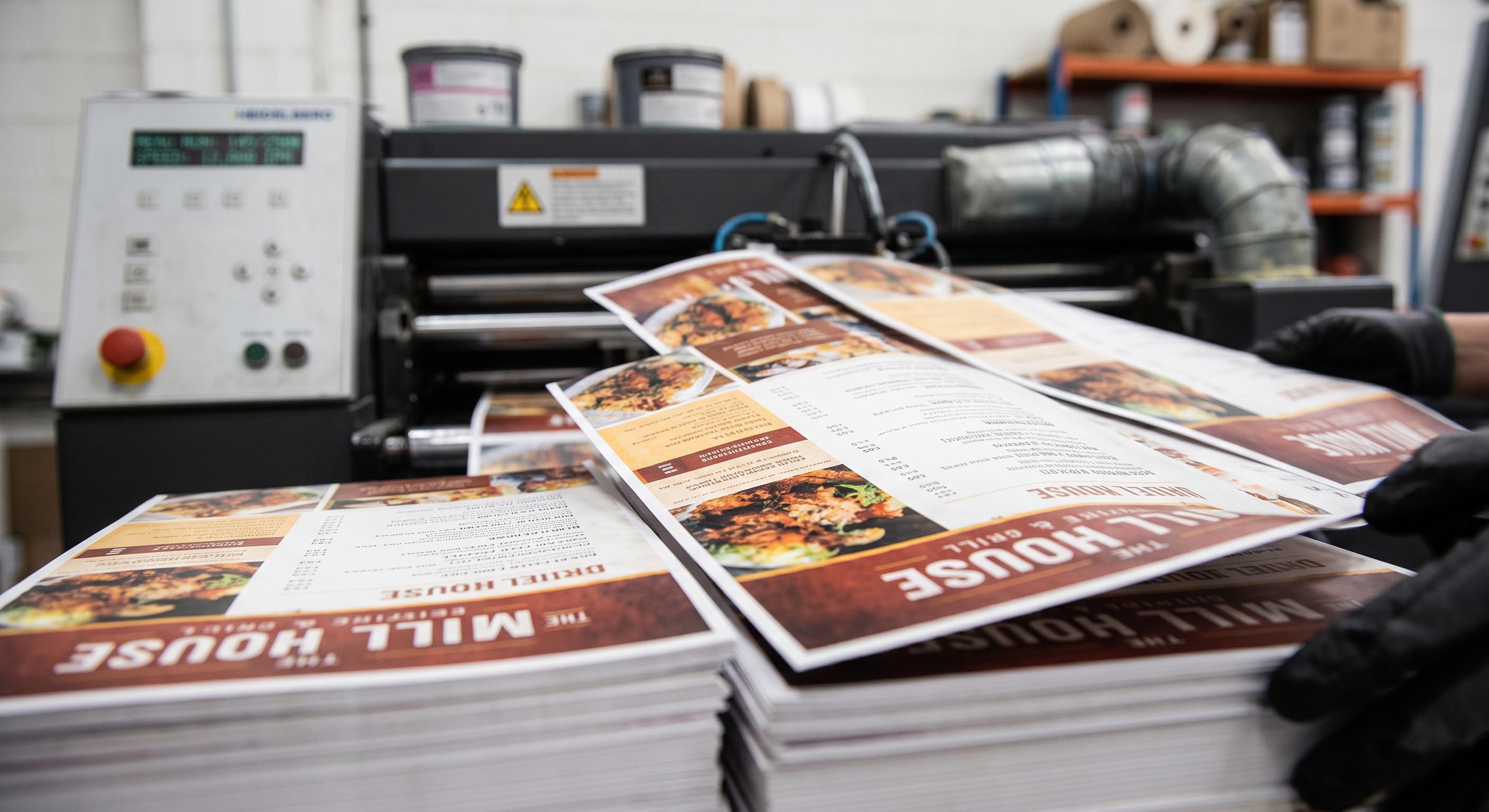
Your menu is your most-read piece of marketing. It's also the one that takes the most abuse: grease, moisture, constant handling, and the occasional spill. Yet most restaurant owners don't think about their menu boards and signage until something is visibly worn out, faded, or out of date.
If you're a restaurant owner in the Madison or Middleton area looking to print or upgrade your menu boards, wall signage, tabletop displays, or entrance graphics, this guide covers everything you need to know: which materials actually hold up in a restaurant environment, what formats work best for different spaces, what you should expect to pay, and what separates a quality local print shop from a generic online order.
The bottom line up front: the best restaurant signage combines the right material for the environment, a professional design that reinforces your brand, and a printer who understands the difference between a laminated poster and a rigid PVC board. Getting those three things right is what makes signage an asset rather than an afterthought.
Most restaurants need more signage than they realize. A full-service print shop will typically help you think through all of the touchpoints where printed materials are working for (or against) your brand.
Menu boards are the centerpiece of in-restaurant communication. They come in several formats depending on your space and service style:
Hanging displays: Suspended from the ceiling or mounted overhead, ideal for counter-service and fast-casual concepts
Wall-mounted boards: Fixed flat against the wall, great for permanent menus in dine-in settings
Tabletop menus: Printed inserts, tent cards, or rigid stands placed directly at each table
Dry-erase panels: Reusable boards for daily specials, seasonal items, or rotating selections
Beyond the menu itself, restaurants rely on printed signage throughout the space:
Hours of operation and entrance signs
Restroom and wayfinding signs
Health and safety notices
Promotional posters for seasonal specials or events
Window graphics that communicate your brand before a guest ever walks in
First impressions happen at the curb. Exterior signage, including banners, building signs, and window graphics, drives walk-in traffic and reinforces your brand from the street. For Madison-area restaurants, weather-resistant materials are non-negotiable given Wisconsin winters.
Key insight: A well-coordinated signage system, where materials, fonts, and colors are consistent from the exterior to the tabletop, creates a brand experience that customers notice even if they can't articulate why.
This is where most restaurant owners make their biggest mistake: choosing a material based on price alone, without considering the environment it will live in. A kitchen-adjacent menu board needs to survive heat, humidity, grease, and regular wiping down. A tabletop display needs to handle spills and daily handling. A window graphic needs to stand up to UV exposure and temperature swings.
Here is a breakdown of the most common materials used for restaurant signage and where each one performs best:
Rigid PVC Board
Acrylic
Aluminum Composite (Dibond)
Laminated Poster
Dry-Erase Panel
Not all wipeable surfaces are created equal. A standard laminated poster can handle light cleaning with a damp cloth but will degrade over time if exposed to heavy cleaning chemicals. Rigid PVC and acrylic hold up significantly better in high-contact zones like counter areas and kitchen-adjacent walls.
For busy restaurant environments, rigid PVC board, acrylic, and aluminum composite are the materials that consistently perform best. They withstand regular cleaning, moisture, and the kind of wear that comes with a high-traffic dining room.
For outdoor and window-facing applications, UV-curable inks and weather-resistant vinyl are the standard. Printing directly onto rigid substrates using flatbed UV printing technology locks the ink into the material rather than sitting on top of it, which dramatically extends the life of outdoor signage in climates like Wisconsin's.
Pricing for restaurant signage varies based on size, material, finish, and quantity. The ranges below reflect typical costs for professionally printed, production-quality signage, not the bargain-bin output you'd get from a big-box retailer.
Basic indoor menu boards and signage: Starting around $45 for standard indoor options
Premium or large-format custom displays: Pricing scales upward based on size, material, and custom finishes
Laminated tabletop menus and inserts: Among the most cost-effective options for high-turnover pieces that need regular updates
Exterior banners: Typically produced on weather-resistant vinyl; pricing depends on size and quantity
Several factors push signage costs higher:
Material upgrade: Moving from a laminated poster to rigid PVC or acrylic increases the per-unit cost but significantly extends the lifespan
Size: Large-format prints cost more per piece than standard-size items
Custom finishes: Soft-touch lamination, gloss UV coating, or specialty substrates add cost but elevate the perceived quality
Design work: If you don't have print-ready artwork, in-house design services add to the total but ensure the final product is production-ready and on-brand
Quantity: Ordering multiple pieces at once typically reduces the per-unit cost
A laminated poster that needs to be replaced every three months because it can't handle regular cleaning will cost more over a year than a rigid PVC board that lasts three years. When evaluating pricing, factor in the expected lifespan of the material in your specific environment. A good print shop will help you make that calculation honestly, not just push you toward the cheapest option.
One of the most common frustrations restaurant owners have with signage orders is timing. A new seasonal menu launches on a Tuesday, but the boards aren't ready until the following week. Getting ahead of this requires understanding how production timelines actually work.
For most restaurant signage, the standard production timeline is 2 to 3 business days following artwork approval. That means the clock starts when you sign off on the proof, not when you place the order.
The most common cause of delays is not the printer. It is artwork. Files that arrive in the wrong color format (RGB instead of CMYK), at low resolution, or without proper bleed and margins require extra preparation time before they can go to press. If your artwork isn't print-ready, build extra time into your timeline.
Rush and same-day printing options are available depending on current production volume. If you have a time-sensitive need, contact the shop directly to confirm availability before committing to a deadline. Rush orders may be subject to a fee.
Best practice for seasonal menu updates: Submit your artwork 5 to 7 business days before your launch date. This gives you buffer time for a proof review, any revisions, and production, without needing to pay rush fees.
If you don't have print-ready artwork, factor in design time as well. A full-service print shop with in-house design capabilities can take you from concept to finished signage, but that process takes longer than submitting a finished file.
One of the most common questions restaurant owners ask before placing a signage order: "Do I need to provide my own artwork?"
The short answer is no, not if you're working with a full-service print shop.
A true full-service provider handles the entire process in-house, from design through production. That means:
Design from scratch: No existing artwork? No problem. A designer can build your menu board layout, special poster, or window graphic from your brand assets (logo, fonts, colors) or help you develop them if you don't have a formal brand identity yet.
File preparation: If you have artwork that isn't quite print-ready, the team can adjust resolution, convert color profiles from RGB to CMYK, and add proper bleed and margins before going to press. These are the most common reasons jobs get delayed, and catching them early keeps your timeline intact.
Proofing: You review and approve a digital proof before anything is printed. This is your opportunity to catch errors, adjust copy, and confirm the layout before production starts.
No minimum order on small-format printing: A full-service local shop with no minimum order requirement lets you order exactly what you need, whether that's one replacement menu board or a complete signage refresh across your whole space. You're not forced to over-order to hit a quantity threshold.
Menus change. Prices go up. Seasonal items rotate. A print partner who can quickly turn around a design update and get new boards produced in 2 to 3 business days is far more valuable than an online vendor who requires you to upload a perfectly formatted file and wait a week for shipping.
The practical advantage of local: When something needs to change fast, you can walk in, talk to a designer, and have a proof in your hands the same day. That kind of responsiveness isn't available from an online print-on-demand service.
After working with restaurants across the Madison and Middleton area, a few ordering mistakes come up again and again. Knowing these in advance can save you time, money, and a reprint.
The most expensive mistake is ordering a material that isn't suited for where it will hang. A standard paper poster in a kitchen-adjacent area will warp and discolor within weeks. Always communicate where the sign will be installed, including whether it's near heat, moisture, or direct sunlight, before selecting a substrate.
Images that look sharp on a screen often fall apart when printed in large format. Print-quality artwork should be at least 300 DPI at the final output size, and color files should be set up in CMYK, not RGB. RGB is the color mode used for screens; CMYK is what commercial printers use. Submitting an RGB file doesn't always cause a visible problem, but it can shift colors in ways that don't match your brand. If you're working from a logo saved off a website (typically 72 DPI and RGB), it will not print cleanly. A good print shop will flag both issues during preflight, but catching them before you submit keeps your timeline on track.
Signage that tries to say everything says nothing. The most effective menu boards and promotional signs lead with one clear message: a featured item, a seasonal promotion, or a value offer. Crowded layouts with small text get ignored. If your sign requires someone to stand still and read for 30 seconds, it needs to be redesigned.
Typos in printed signage are expensive. Once a job goes to press, corrections require a reprint. Read every word on the proof, including hours, phone numbers, prices, and URLs, before approving. It is worth the extra 10 minutes.
Seasonal menu launches, grand openings, and events are predictable. The restaurants that get their signage right are the ones that plan 2 to 3 weeks ahead, not 2 to 3 days. Rush fees and compressed timelines increase stress and the chance of errors.
AlphaGraphics MIDDLETON is a full-service print and signage shop serving restaurants and food service businesses in the Middleton and Madison area. The team handles the complete production process in-house, including design, printing, and finishing, with no minimum order requirements and standard turnaround of 2 to 3 business days following artwork approval.
The restaurant printing and signage services at AlphaGraphics MIDDLETON include:
Menu boards: Hanging displays, wall-mounted boards, tabletop menus, and dry-erase panels
Large-format interior signage: Printed on rigid PVC, acrylic, aluminum composite, and other durable substrates
Laminated posters: Waterproof and wipeable options for high-contact areas
Window graphics: UV-resistant vinyl for storefronts and exterior-facing windows
Banners: Weather-resistant vinyl banners for outdoor promotions and events
Building and exterior signage: Durable options built for Wisconsin weather
You can also explore the full menu boards page and large-format printing options to see what's available.
Pricing for restaurant signage starts around $45 for basic indoor options and scales based on size, material, and finish. The best way to get an accurate quote is to describe your project, including the type of sign, where it will be installed, and whether you have existing artwork. The in-house team can advise on material selection, flag any artwork issues before production, and turn around a proof quickly.
Ready to upgrade your menu boards or refresh your restaurant signage? Contact AlphaGraphics MIDDLETON to discuss your project and get a quote tailored to your space.