
Direct Mail & Postcards
September 30, 2026
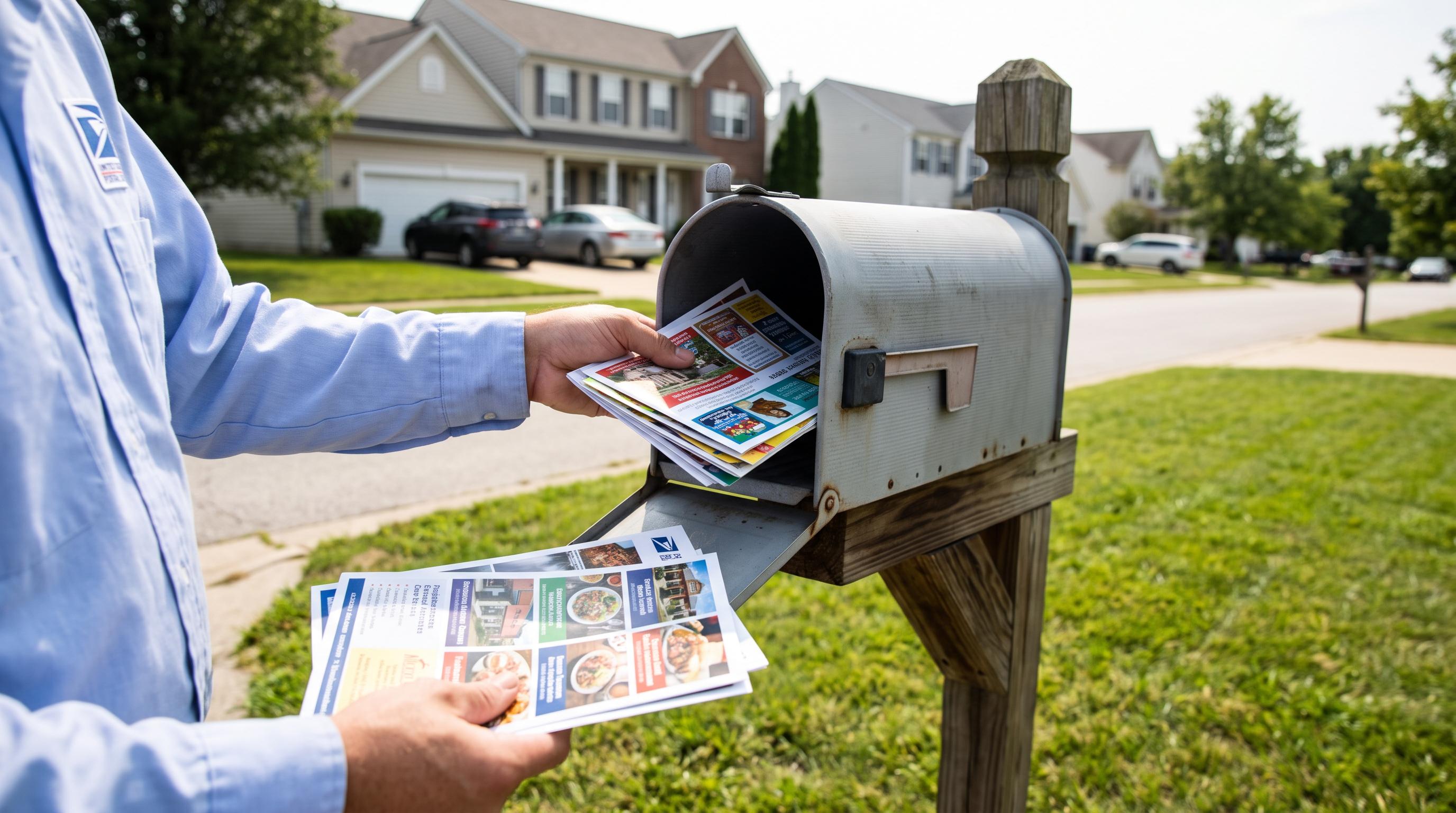
Local businesses in the Madison and Middleton area have two of the most cost-effective marketing tools available to them: Every Door Direct Mail (EDDM) postcards and professionally printed restaurant signage. Yet most owners either underestimate what these tools actually cost, overestimate the complexity of running them, or skip them entirely in favor of digital channels that deliver a fraction of the local reach.
This guide covers three questions that come up constantly at AlphaGraphics Middleton:
What does EDDM postcard printing actually cost? (Spoiler: less than most business owners assume)
What are the options for restaurant menu board printing? (Material choice matters more than most people realize)
How do you use EDDM as a real customer acquisition strategy? (Not just a one-time mailer, but a repeatable system)
Whether you're a restaurant owner planning a grand opening push, a home services company trying to saturate a neighborhood, or a retailer launching a seasonal promotion, this guide gives you the numbers and the strategy to make informed decisions.
Every Door Direct Mail costs less than most businesses expect, and significantly less than targeted direct mail. The reason: no mailing list to purchase, no individual addressing, and a discounted USPS postage rate that applies to every piece regardless of size.
Here's how the cost breaks down for a typical EDDM campaign.
Every EDDM campaign has three line items:
Postcard printing — the cost to produce the physical piece
USPS postage — currently $0.260 per piece as of mid-2026
Design — either in-house design fees or your own artwork preparation
The postage rate is the same for all EDDM-eligible sizes, which is one of the program's most underappreciated advantages. A 6.25" x 9" postcard and an 8.5" x 11" oversized flat cost the same $0.260 to mail. Going bigger costs nothing extra in postage.
At AlphaGraphics MIDDLETON, EDDM campaigns are handled entirely in-house: design, printing, addressing, bundling, and USPS drop-off. You don't need your own postal permit. Approximate all-in pricing:
200 Pieces (Minimum)
Starting at about $325
1,000 Pieces
About $450–$600
2,500 Pieces
About $700–$900
5,000 Pieces
About $1,500–$2,600
10,000 Pieces
About $2,800–$4,500
Per-piece cost typically ranges from $0.35 to $0.55 all-in, depending on postcard size, paper stock, and quantity. That's printing plus postage, not postage alone.
Several variables move the needle on your final cost:
Postcard size: Larger formats (8.5" x 11") cost more to print but carry the same postage rate. Larger pieces also have higher response rates, so the trade-off is often worth it.
Paper stock: AlphaGraphics MIDDLETON recommends 14 pt or 16 pt cardstock for EDDM postcards. This exceeds the USPS minimum thickness requirement and holds up well in mail handling. Thinner stock looks cheap and can affect deliverability.
Quantity: Per-piece cost drops as volume increases. A 5,000-piece run costs significantly less per card than a 1,000-piece run.
Design: If you provide print-ready artwork in the correct format (CMYK, with proper bleed and margins), design costs are minimal. If artwork needs to be created from scratch, expect additional design time.
The cost-per-lead advantage is real. According to USPS data, EDDM eliminates the two biggest cost barriers in traditional direct mail: the mailing list (typically 50–100 per thousand records) and individual addressing. The result is all-in campaign costs that run 40–50% lower than targeted mailings of equivalent reach.
Compare that to digital advertising, where cost-per-click in competitive local markets routinely runs 3–10 per click, with no guarantee the visitor converts. An EDDM campaign reaching 2,500 households for under $900 is a different category of investment entirely.
Key takeaway: For most Middleton and Madison area businesses, a well-executed EDDM campaign costs less per qualified local impression than any digital alternative. The math works especially well for businesses with broad appeal — restaurants, salons, gyms, home services — where nearly every household in a neighborhood is a potential customer.
A menu board is one of the highest-ROI investments a restaurant can make. It's working every hour the business is open, communicating prices, specials, and brand identity to every customer who walks through the door. Yet many restaurant owners treat it as an afterthought, printing on whatever is cheap and available, then wondering why the result looks amateurish six months later.
The material you choose determines how the board looks, how long it lasts, how easy it is to update, and whether it survives Wisconsin winters if it's mounted outdoors. Here's a breakdown of every practical option.
Menu Board Materials: The Full Comparison
Rigid PVC
Best for: Indoor permanent menus
Durability: High
Update frequency: Low (reprint to update)
Relative cost: Moderate
Acrylic
Best for: Fast casual, sit-down indoor
Durability: Very high
Update frequency: Low
Relative cost: Moderate-high
Aluminum Composite (Dibond)
Best for: Outdoor, drive-through
Durability: Excellent
Update frequency: Low
Relative cost: Moderate-high
Laminated Poster/Foam Board
Best for: Temporary, seasonal specials
Durability: Low
Update frequency: High (cheap to reprint)
Relative cost: Low
Magnetic Panel System
Best for: Frequently changing menus
Durability: High (system)
Update frequency: Very high
Relative cost: High upfront, low ongoing
Dry-Erase/Chalkboard Surface
Best for: Cafes, breweries, daily specials
Durability: High
Update frequency: Daily
Relative cost: Moderate
Rigid PVC and acrylic are the workhorses of indoor restaurant menu boards. Acrylic is slightly more premium: smooth, modern, easy to clean, and available in clear, frosted, or any color. Both materials hold UV-printed graphics for years without fading under indoor lighting. For a Middleton restaurant with a stable menu, either of these is the right long-term investment.
Aluminum composite (dibond) is the correct choice for anything outdoors. UV-cured inks on dibond hold up against direct sun for years; vinyl applied to cheaper substrates will fade within one Wisconsin summer of UV exposure. If you have a patio menu board, a drive-through panel, or an A-frame outside your entrance, dibond is worth the small premium.
Laminated posters are underrated for restaurants that rotate specials frequently. A laminated 24" x 36" poster printed on heavy stock costs a fraction of a rigid board and can be swapped out seasonally without reprinting the entire system. Many restaurants use a combination: permanent rigid boards for the core menu, laminated posters or inserts for weekly specials and limited-time offers.
Magnetic panel systems make sense for any restaurant changing menu items more than quarterly. Individual item panels or price strips swap out without replacing the entire board. The upfront cost is higher, but the ongoing update cost drops to near zero. AlphaGraphics MIDDLETON produces modular magnetic sign systems for restaurant clients across the Madison area.
Pricing varies significantly by size, material, and complexity. As a general reference:
Basic indoor single-panel menu board (rigid PVC or laminated): starting at approximately 45–150
Acrylic or aluminum menu board, standard sizes: approximately 150–500 per panel
Multi-panel systems with custom design: 500–2,000+
Magnetic interchangeable panel system: higher upfront, typically 800–2,500 for a complete system
For restaurant clients in Middleton and Madison area, AlphaGraphics MIDDLETON handles the full scope: design, material selection, printing, and finishing. The menu boards service page has more detail on available formats.
Standard menu board printing on acrylic, aluminum, or PVC typically takes 2–5 business days after artwork approval. If design work is needed from scratch, add 3–7 business days for design rounds. Rush production may be available depending on current production volume.
Design tip: For menu boards, file format matters. Vector-based files (PDF, EPS, AI) produce the sharpest output at any size. Raster images should be at least 150 DPI at final print size. RGB files must be converted to CMYK before printing, or colors will shift. AlphaGraphics MIDDLETON's design team handles file preparation and can flag issues before production begins.
A menu board doesn't exist in isolation. The most effective restaurant signage systems pair wall-mounted or hanging menu boards with window graphics, tabletop displays, and promotional banners that reinforce the same visual identity. AlphaGraphics MIDDLETON's restaurant solutions cover the full range, from grand opening signage packages to ongoing menu updates and seasonal promotional materials.
Most businesses treat EDDM like a lottery ticket: send one mailer, wait for the phone to ring, and decide the channel "doesn't work" when the results disappoint. That's not a strategy. It's a single data point with no context.
The businesses that consistently win with EDDM treat it as a repeatable acquisition system with three components: route selection, offer design, and campaign cadence. Get all three right, and EDDM becomes one of the most reliable local customer acquisition tools available.
Before a single postcard gets designed, you need to know which carrier routes you're targeting. This decision matters more than your headline, your design, or your offer.
The USPS EDDM Online Tool lets you search by ZIP code and view routes on a map with demographic overlays: median household income, average age, and household size. For most businesses, the right routes share two characteristics:
Proximity: Most customer conversions happen within a 5-mile radius of a business's location. Start with the routes closest to your storefront or service area.
Demographics: Match route demographics to your customer profile. A mid-range restaurant should target routes with household incomes above $60,000. A family-focused gym should prioritize routes with larger average household sizes.
AlphaGraphics MIDDLETON helps clients select routes using these factors, including household income, age, and route density. The goal is to identify the neighborhoods where your ideal customers already live, not just the ones that are convenient to mail to.
What to avoid: Don't select routes based on geography alone. A route that covers 800 households in a commercial district with few residences is a waste of budget. Filter to residential routes and suppress P.O. Box-heavy zones.
The most common EDDM design mistake is trying to say too much. A postcard that lists seven services, includes three phone numbers, and features a collage of stock photos will be ignored. A postcard with one bold offer, one clear call to action, and a dominant visual will get read.
The four elements of a high-performing EDDM postcard:
A headline readable in 3 seconds — your offer should be understood at arm's length, without effort. "20% Off Your First Visit" beats "Welcome to Our Neighborhood."
One strong visual — a real photo of your food, your space, or your team outperforms generic stock imagery. Authenticity builds trust faster than polish.
One clear call to action — visit, call, redeem, or scan a QR code. Pick one and make it obvious. Don't give recipients four ways to respond and hope they choose one.
Local relevance — mentioning the neighborhood by name ("Now serving Middleton families") creates an immediate connection that generic campaigns miss.
AlphaGraphics MIDDLETON's recommended postcard sizes for EDDM are 6.25" x 9", 6" x 11", and 8.5" x 11". The larger formats have higher response rates, and since postage is the same regardless of size, the incremental printing cost for a bigger card often pays for itself in improved results.
A single EDDM drop is an introduction. Two or three drops to the same routes is a campaign. The research is consistent on this point: direct mail response rates improve with repetition, and EDDM mailers are kept in households for an average of 17 days before being discarded.
The recommended cadence for most businesses:
2–4 campaigns per year to the same core routes builds compounding brand recognition
Vary the offer each cycle to give recipients a new reason to act
Track results using a dedicated phone number, QR code, or unique promo code so you know exactly which campaign drove which response
The businesses that treat EDDM as a quarterly or seasonal system, rather than a one-time experiment, see dramatically better results over time. The first mailing introduces your brand. The second reinforces it. By the third, you're the business neighbors think of when they need what you offer.
The numbers are compelling when the execution is solid. Consider a typical scenario for a Middleton-area business:
Postcards (6" x 9", 2,500 qty)
About $500–$650
USPS EDDM Postage (2,500 x $0.260)
$650
Design (with existing brand assets)
About $100–$200
Total Campaign Investment
About $1,250–$1,500
At a 2% response rate (the conservative benchmark for cold geographic audiences), that's 50 new inquiries. If 30% of those convert to customers, you've acquired 15 new customers. For any business where a customer's lifetime value exceeds $100, the campaign pays for itself on the first visit.
For restaurants specifically, the math is even more favorable. A neighborhood saturation campaign with a compelling offer (grand opening discount, new menu launch, limited-time special) can drive immediate foot traffic within days of delivery. EDDM delivery typically happens 1–4 days after the USPS drop-off, and AlphaGraphics MIDDLETON's total turnaround from artwork approval to mailbox delivery is estimated at 2–6 business days.
Even well-funded campaigns underperform when these errors are present:
Mailing too small an area: A 500-piece run covering two blocks is too small to generate meaningful data. Start with at least 1,000–2,500 pieces across multiple routes.
No trackable call to action: If you can't measure responses, you can't improve. A unique QR code or phone number takes five minutes to set up and transforms your campaign from a guess into a measurement.
Judging results from one mailing: Most businesses need two to three mailing cycles before drawing conclusions. One drop is a sample, not a verdict.
Weak follow-through: A mailer that drives someone to call, and that call goes to voicemail with no callback, wastes the entire marketing spend. EDDM drives the lead; your team has to close it.
The bottom line on EDDM strategy: Route selection, a single compelling offer, and consistent cadence are the three variables that determine results. Get those right, and EDDM consistently outperforms digital channels for local customer acquisition at a fraction of the cost per lead.
A 5,000-piece EDDM campaign at AlphaGraphics Middleton typically runs approximately 1,500–2,600 all-in, including printing and USPS postage. The range depends on postcard size, paper stock, and whether design work is included. Per-piece cost at this quantity generally falls between $0.30 and $0.52.
No. AlphaGraphics MIDDLETON can mail under its own permit. You do not need to obtain or pay for a separate USPS mailing permit. This is one of the key advantages of working with a full-service mail house rather than managing the USPS drop-off process yourself.
USPS requires a minimum of 200 pieces per carrier route for EDDM. AlphaGraphics MIDDLETON has no additional minimum above that requirement. A 200-piece campaign starts at approximately $325 including postage.
EDDM-eligible pieces must meet USPS size requirements: minimum 6.125" x 11" (for flats), and specific thickness requirements. Common sizes used at AlphaGraphics MIDDLETON are 6.25" x 9", 6" x 11", and 8.5" x 11". The postage rate is identical for all eligible sizes, so there's no postage penalty for going larger.
Aluminum composite (dibond) with UV-cured printing is the recommended material for any outdoor menu board application. It withstands direct sun, moisture, and temperature swings without fading or warping. Vinyl-faced foam board or standard laminated posters are not suitable for permanent outdoor use, especially in Wisconsin's climate.
Standard production on rigid menu boards (PVC, acrylic, aluminum) typically takes 2–5 business days after artwork approval. If design work is required from scratch, add 3–7 business days. Rush production may be available depending on current production volume.
Yes. AlphaGraphics MIDDLETON offers direct mail services including EDDM and targeted mailing, alongside a full range of restaurant and hospitality signage. Restaurant clients frequently run EDDM neighborhood campaigns alongside a menu board and window graphics refresh for a coordinated grand opening or rebranding effort.
AlphaGraphics MIDDLETON handles EDDM campaigns and restaurant signage printing from start to finish: design, production, and delivery. No minimums beyond USPS requirements. No postal permit needed. Local team that knows the Madison and Middleton area market.
Whether you're planning a neighborhood postcard campaign, replacing aging menu boards, or launching a grand opening with a full signage and direct mail package, contact AlphaGraphics MIDDLETON for a project quote. Turnaround from artwork approval to your customers' mailboxes is typically 2–6 business days for EDDM, and 2–5 business days for most signage projects.
Reach the direct mail services team or the restaurant signage team to discuss your project.