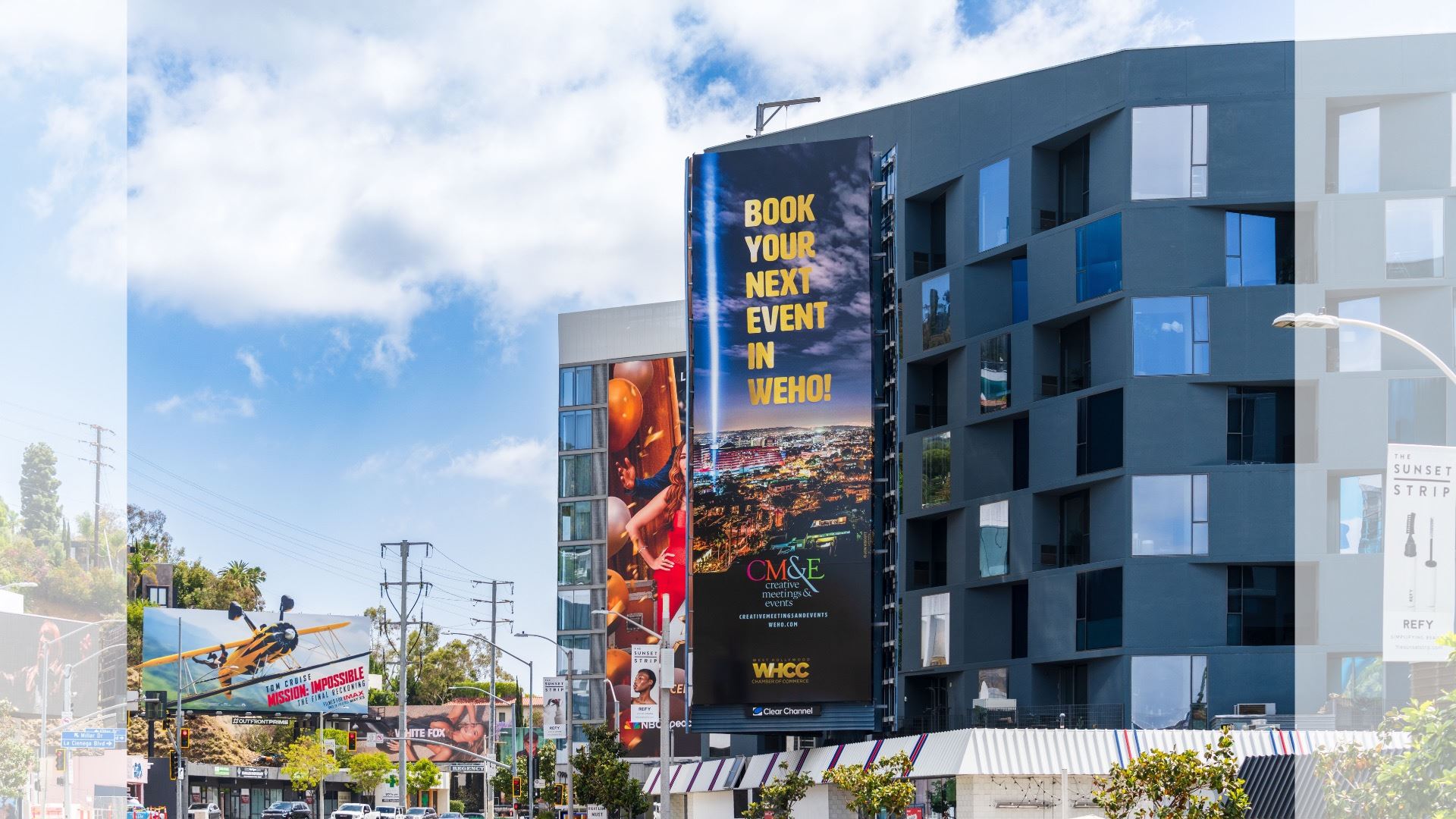
 Large format printing covers anything too big for a standard office printer. Posters, banners, yard signs, backlit graphics, floor plans, backdrops, wall murals, and vehicle graphics all fall under it. The category is broad enough that "I need something printed large" is the start of a conversation rather than an order.
Two decisions determine whether the finished piece looks professional: the material it prints on and the file you send. Most of the disappointing results we see trace back to one of those two, and both are easy to get right with a little planning. Here is what to know before you order large format printing in Orlando.
Start With Where the Piece Is Going
Substrate selection is driven by three questions: is it indoors or outdoors, how long does it need to last, and does it need to be rigid or flexible?
Short Term Outdoor
Yard signs, event directionals, real estate signage, and anything up for a few weeks. Coroplast is the standard choice here. It is corrugated plastic, lightweight, inexpensive, and takes a stake easily. It is not a long term material, and in Florida sun it will show its age faster than in most markets, but for its intended job it is hard to beat on cost. See coroplast signs.
Long Term Outdoor
Building signage, parking and regulatory signs, and anything that needs to look right in a year. Aluminum and aluminum composite panels are the durable options. They resist rust, hold up to sun and rain, and stay flat. The cost difference against coroplast is real, but so is the difference in how the piece looks after twelve months. See aluminum signs.
Flexible Outdoor
Banners for events, construction fencing, and building fronts. Scrim vinyl with hems and grommets is the workhorse. If the banner is going somewhere with real wind exposure, mesh vinyl lets air pass through instead of turning the banner into a sail, which reduces the chance of tearing out grommets or pulling down whatever it is attached to. See banner and mesh materials.
Indoor Display and Retail
Posters, framed prints, indoor banners, and trade show graphics. Indoor pieces do not need weather resistance, so the decision shifts to finish. Matte and satin finishes reduce glare under overhead lighting, which matters in convention halls, lobbies, and anywhere with strong ceiling lights. Gloss produces richer color and works well behind glass or in controlled lighting. See indoor banners and framed and fine art prints.
Technical and Architectural
Site plans, blueprints, and engineering drawings have their own requirements around line weight, scale accuracy, and paper stock. See blueprints and site plans.
Resolution: What Actually Matters at Scale
This is the most misunderstood part of large format, and the source of most reprints.
The 300 DPI standard people quote applies to material held in your hand. Large format graphics are viewed from farther away, and required resolution drops as viewing distance increases. A billboard printed at the resolution of a business card would be an enormous file for no visible benefit.
A practical way to think about it:
- Viewed from arm's length (small posters, tabletop signs): 150 to 300 DPI at final size
- Viewed from several feet (posters, retractable banners, trade show panels): 100 to 150 DPI at final size
- Viewed from across a room or a parking lot (large banners, building signage): 50 to 100 DPI at final size is often sufficient
The phrase that matters is at final size. A 300 DPI image is only 300 DPI at the dimensions it was created. Scale it up to eight feet wide and the effective resolution drops proportionally.
This is also why a logo pulled off a website almost never works for large format. A small web graphic scaled to banner size produces soft, pixelated edges no printer can fix. Vector files such as AI, EPS, or PDF avoid the problem entirely because they scale to any dimension without losing sharpness. If you have vector versions of your logo, send those.
A Short File Prep Checklist
Send files that meet these conditions and your job moves straight to production instead of coming back with questions.
- Build at final size, or a clean fraction of it. Half scale or quarter scale is fine if the file is set up proportionally. Just tell us which.
- Include bleed. Extend artwork past the trim edge so a small cutting variance does not leave a white sliver.
- Respect the safe zone. Keep text and logos well inside the trim. On grommeted banners, keep critical content away from the hem where grommets will punch through.
- Convert to CMYK and outline your fonts. RGB colors shift when converted for print, and unoutlined fonts substitute if we do not have them.
- Send vector where you have it. Especially logos and type.
- Flag exact brand colors. If a specific color has to match across pieces, tell us up front rather than after the first proof.
If your files are not print ready, that is a normal situation and not a problem. Our design team can prepare or rebuild artwork. It is simply better to know that at the start than to discover it the day before you need the piece.
Color Consistency Across Different Materials
One thing that surprises people running multi piece campaigns: the same file prints differently on different substrates. Fabric absorbs ink and reads slightly softer. Gloss vinyl reads more saturated. Uncoated paper reads flatter. A logo that looks perfect on a poster can look noticeably different on a fabric backdrop sitting next to it.
A print provider that produces all of your pieces can manage this across the set. Ordering the banner from one vendor, the posters from another, and the backdrop from a third is how a booth ends up with three versions of your brand blue on display at once. See backdrops and banners and posters for the pieces that most often need to match.
Frequently Asked Questions
What resolution do I need for a large banner?
Less than you probably think, as long as it is measured at final size. For a banner viewed from ten feet or more, 100 DPI at full size is generally sufficient. What matters more is starting from a high quality source rather than a small image scaled up.
What is the largest size you can print?
Large format equipment prints in wide rolls, and pieces beyond that width can be produced in panels and joined during installation. There is effectively no size limit for wall and building applications. Tell us the finished dimensions and we will tell you how it is best produced.
Can you print on rigid material as well as banner vinyl?
Yes. We print on coroplast, aluminum, acrylic, foam board, and other rigid substrates in addition to flexible banner and adhesive materials.
How long will an outdoor banner last in Florida?
It depends on exposure and material. A quality outdoor banner in a shaded or partially protected location lasts considerably longer than one in full southern sun. Tell us how long you need it up and we will recommend accordingly rather than defaulting to the cheapest option.
Send Us the Project
Whether it is a single poster or a full campaign across banners, signage, and displays, AlphaGraphics Orlando Central handles design, production, and finishing in house. We have served Orlando businesses for more than 35 years from 1315 North Mills Ave.
See our large format printing services, request a free quote, or call (407) 896-2294.