
Direct Mail & Postcards
October 30, 2026
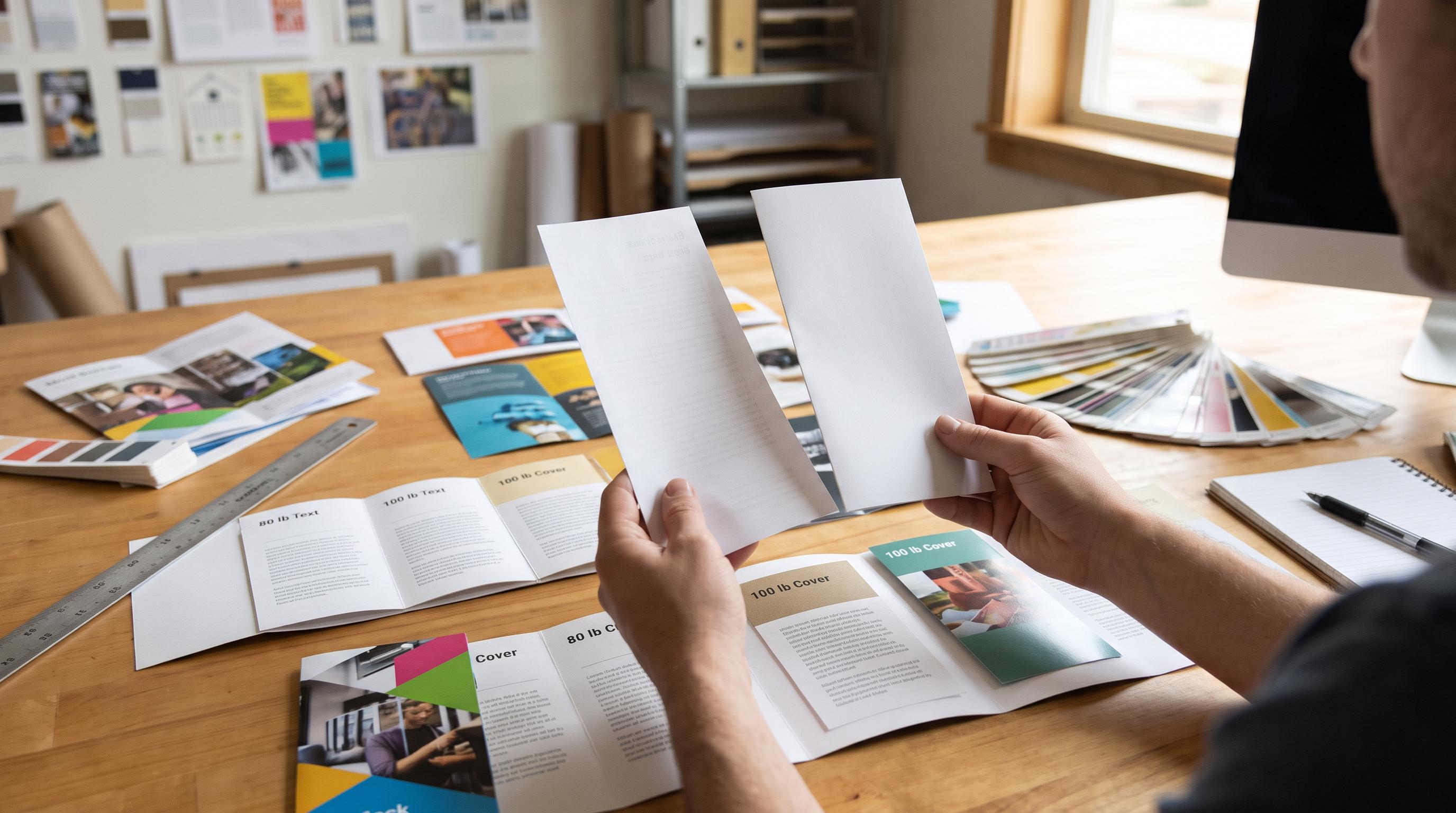
Three questions come up constantly at AlphaGraphics MIDDLETON: How do I run an EDDM campaign? Where do I find a reliable local printer? And what paper weight should I use for my brochures? They seem like separate questions, but they often arrive together, from the same business owner trying to get a direct mail campaign off the ground or a brochure into a prospect's hands.
This guide answers all three, in plain terms, with specific recommendations you can act on today.
What you'll learn: How to plan and launch an Every Door Direct Mail campaign from scratch, what to look for when choosing a nearby print shop, and how to match brochure paper weight to your actual use case.
Every Door Direct Mail (EDDM) is a USPS program that lets you deliver a printed piece to every address on a carrier route, without purchasing a mailing list. You pick the routes, print the mailers, and USPS handles delivery. For local businesses, it's one of the most cost-efficient ways to reach a defined neighborhood.
EDDM postage runs $0.260 per piece, and a typical 5,000-piece campaign in the Madison area costs $1,500 to $2,600 all in, including printing and postage.
Here is how to build a campaign that actually drives response.
Before you choose a route or design a postcard, decide what this campaign is trying to accomplish. Campaigns that try to do too much, announce a grand opening, promote three services, and build brand awareness simultaneously, underperform campaigns with a single focused goal.
Good EDDM objectives:
Drive foot traffic during a specific promotional window
Announce a new location or service area
Generate calls or form submissions for a specific service
Build name recognition in a neighborhood you're expanding into
Pick one. Your offer, your design, and your call to action all flow from that choice.
The USPS EDDM mapping tool lets you browse carrier routes and view household counts, average household income, and age data by route. Use this to make targeting decisions based on who lives there, not just how close the route is to your storefront.
Route selection factors that matter:
A roofing company in Middleton should prioritize routes with older housing stock and higher homeownership rates. A new restaurant should target routes within a two-mile radius of its location. Proximity matters, but demographic fit matters more.
EDDM pieces are flat mailers, not letter envelopes. They need to work at arm's length, in a stack of other mail, in under three seconds. That constraint should drive every design decision.
USPS size requirements for EDDM pieces:
Minimum size: 6.125" x 11"
Maximum size: 15" x 12"
Maximum thickness: 0.75"
Maximum weight: 3.3 oz
AlphaGraphics MIDDLETON recommends 6.25" x 9", 6" x 11", and 8.5" x 11" as the most practical sizes, balancing mailbox visibility with reduced paper waste.
Four design principles that drive EDDM response:
Headline first. Your offer needs to be readable in three seconds, from a distance. Large type, high contrast, no clutter.
One strong visual. A real photo of your product, space, or team outperforms stock imagery. People respond to authenticity.
One clear call to action. Visit, call, scan, or redeem. Pick one and make it impossible to miss.
Local relevance. Mentioning the neighborhood by name, "Now serving Middleton's west side," creates an immediate connection that generic campaigns miss.
Your mailer must include three elements to qualify for EDDM postage:
An EDDM indicia in the upper right corner (your printer handles this)
A "Postal Customer" recipient line in place of a name and address
Your business return address
Important: USPS requires a minimum of 200 pieces per route for EDDM. AlphaGraphics MIDDLETON has no minimum order requirement on our end, so you can run a small test campaign on a single route before scaling.
Plan your mail drop 3 to 5 business days before your promotion starts. Avoid weeks that include federal holidays, which can delay delivery. EDDM delivery from AlphaGraphics MIDDLETON typically takes 2 to 6 business days from artwork approval to mailbox delivery: 1 to 2 days for printing and mail preparation, then 1 to 4 days for USPS delivery.
Seasonal timing also matters. Restaurants see a strong response in late winter when people are tired of cooking at home. Home service businesses perform well in early spring before the busy season. Retailers benefit from campaigns timed to payday cycles and community events.
EDDM is trackable. Use at least one of these mechanisms on every campaign:
A unique promo code tied specifically to this mailer
A QR code linking to a dedicated landing page or booking form
A custom phone number that only appears on this piece
A route-specific offer so you can compare redemption rates by neighborhood
Businesses that run EDDM consistently, two to four campaigns per year on the same routes, compound the brand recognition effect over time. A single mailer builds awareness. A quarterly cadence builds trust.
Searching "printing services near me" returns a long list. The harder question is which shop is worth your time and budget. Not all print providers are equal, and the differences matter most when you're on a deadline or working on something that represents your brand.
Here is what separates a reliable local print partner from a vendor you'll regret using.
1. In-house production, not outsourcing
Many print shops are essentially brokers: they take your order, send it to a wholesale printer, and mark up the price. The problem is you lose control over turnaround time, quality consistency, and the ability to make last-minute changes. A shop with in-house presses can answer "can you rush this?" with a real yes or no, not a shrug.
Ask directly: "Do you print in-house or send it out?" The answer tells you a lot.
2. No-minimum flexibility
If you need 50 brochures for a meeting next week, a shop that requires a 500-piece minimum is not your partner. Look for a printer that can handle short runs without penalizing you for the quantity. This is especially important for small businesses testing a new design or running a niche campaign.
AlphaGraphics MIDDLETON has no minimum order requirement for small-format printing, which means you can order exactly what you need.
3. In-house design capability
Printing requires print-ready files: correct color mode (CMYK, not RGB), proper bleed and margins, and the right resolution. If you don't have a designer or a print-ready file, you need a shop that can help you get there. A shop with in-house design capability can catch problems before they become expensive reprints.
4. Full-service mailing
If your goal is direct mail, a print shop that only prints is only half the solution. Look for a shop that also handles addressing, USPS preparation, and drop-off. A full-service mail house eliminates the handoff risk between vendors and typically gets your piece in the mail faster.
5. Transparent turnaround communication
A reliable printer tells you upfront how long things take, what causes delays, and what happens if you need something faster. Vague answers like "it depends" without specifics are a warning sign. Good shops have standard production timelines and clear rush policies.
Before placing an order with any print shop, ask these:
What is your standard turnaround for [your specific product]?
Do you offer rush or same-day options, and what do they cost?
Can you handle the full mailing process, including USPS drop-off?
Do I need to provide print-ready files, or can you help with design?
Is there a minimum order quantity?
Can I see samples of similar work?
A shop that answers these confidently, with specifics, is worth your business. A shop that hedges or redirects is not.
Online print vendors offer low prices on commodity jobs. But for anything with a deadline, a specific material requirement, or a design that needs review, local wins on almost every dimension that matters.
Local print shop vs. online printer:
The math changes when you factor in shipping costs, reprint risk, and the value of getting it right the first time.
Paper weight is one of the most common sticking points in a print project, and it's also one of the most consequential. The wrong choice means a mailer that gets bent in transit, a brochure that feels cheap in someone's hand, or a tri-fold that cracks at the crease.
The right choice depends entirely on what your brochure is doing and where it's going.
The single most useful question to ask yourself: Will this piece be mailed, handed out, or displayed? That answer alone narrows your options significantly.
U.S. printers use three measurement systems, and they all describe the same physical property, weight and thickness:
lb (pound weight): The most common U.S. standard. A 20 lb bond is copy paper. Brochures typically run 60 to 100 lb text, or heavier cardstock.
pt (point thickness): Used for cardstock. 14 pt and 16 pt are the standard for mailers and premium flat pieces. Higher point = thicker, stiffer card.
gsm (grams per square meter): The metric standard. 130 to 170 gsm covers most folded brochure applications; 350+ gsm is premium cardstock territory.
The short version: the higher the number, the heavier and thicker the paper. But weight alone does not tell the whole story. A 100 lb gloss text and a 100 lb matte text are technically the same weight but feel completely different in hand. Finish is the other half of the equation.
Folded brochures (tri-fold, bi-fold, z-fold)
Use text-weight paper, not cardstock. Cardstock is rigid and does not fold cleanly without scoring. For a standard tri-fold, 80 to 100 lb text (130 to 170 gsm) is the right range. It folds cleanly, stacks easily, and feels noticeably more substantial than copy paper.
80 lb text: Good for high-volume informational handouts where cost per piece matters
100 lb text: The sweet spot for most professional folded brochures; substantial feel, folds cleanly
100 lb text with gloss or matte coating: Adds durability and polish; the right choice for anything customer-facing
Direct mail and EDDM mailers
Mail goes through sorting machines, bundling, and weather exposure before it reaches a mailbox. Lightweight paper does not survive the journey intact. For mailers, use cardstock.
14 pt cardstock: The standard for most EDDM postcards and flat mailers; meets USPS minimum thickness requirements with room to spare
16 pt cardstock: Worth the upgrade for a premium in-mailbox feel; noticeably stiffer and more substantial
Premium leave-behinds and sales collateral
A leave-behind that sits on a prospect's desk after a meeting needs to hold its own every time someone picks it up. This is where heavier stock earns its cost.
350+ gsm cardstock with soft-touch or satin finish: Real presence in hand; pair with soft-touch laminate for a genuinely tactile piece that prospects keep rather than discard
Lobby and rack brochures
Brochures in a display rack need to look sharp but do not need to survive the mail. A mid-weight option is the practical choice.
80 to 100 lb text with gloss or matte coating: Gloss makes colors pop; matte reads more sophisticated and is easier on the eyes under fluorescent lighting
Quick-reference paper weight chart:
When in doubt, go heavier rather than lighter. The cost difference between 80 lb and 100 lb text is small. The impression difference is not.
Many businesses order folded brochures on cardstock because it sounds more premium. It is not the right call. Cardstock folds poorly without scoring, and unscored folds on heavy stock crack at the crease, which looks worse than a lighter paper that folds cleanly. If your piece folds, use text weight. If it lays flat, cardstock is the better choice.
For a deeper look at paper weight options across different print applications, see AlphaGraphics MIDDLETON's brochure paper weight guide.
Whether you are planning your first EDDM campaign, looking for a local print shop that can handle the full project, or trying to figure out which paper stock works best for your brochure, AlphaGraphics MIDDLETON offers all three under one roof.
What we handle in-house:
Every Door Direct Mail (EDDM) printing and USPS preparation
Full-service direct mail, including targeted mailing lists, addressing, and drop-off
Brochures and booklets in any size, stock, and finish
In-house design and artwork preparation; no print-ready file required
No minimum order for small-format printing
Standard turnaround is 2 to 3 business days after artwork approval. Rush options may be available depending on production volume.
Contact AlphaGraphics MIDDLETON to get a quote, ask about paper samples, or talk through your campaign before you commit to anything.