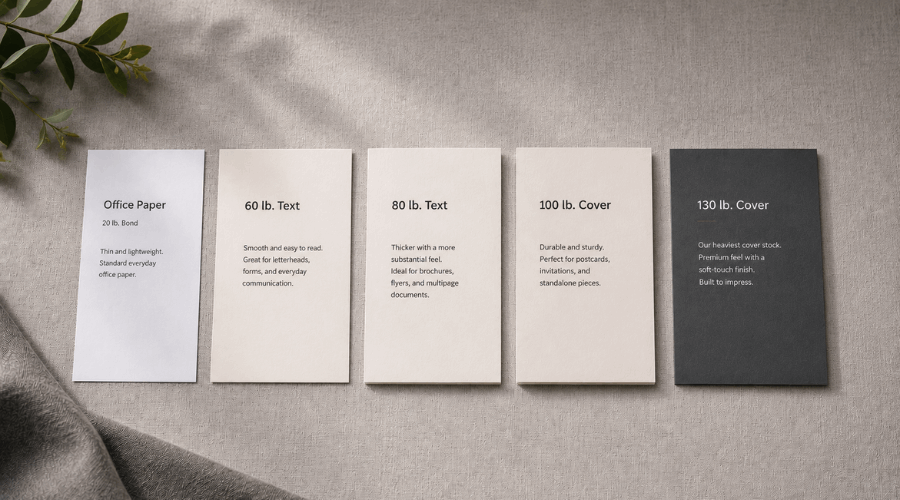
Heavier Paper Feels More Valuable
There is documented psychological research showing that customers assign more credibility, more care, and more value to brands that print on premium stock — before reading a single word.
The phenomenon is called weight-as-quality bias. A heavier business card, a thicker brochure, a substantial postcard signals that the brand behind it took the work seriously. A flimsy one signals the opposite.
The cost difference between standard and premium paper is usually 10 to 25 percent. The perception difference is much larger. Understanding paper weight — what the numbers mean, how text and cover stock differ, and which weight goes with which project — is one of the highest-leverage decisions in print.
What Paper Weight Actually Measures
Paper weight in the U.S. is measured in pounds (lb). Internationally and increasingly in U.S. design specs, you can see it measured in grams per square meter (gsm).
The pound measurement is the historically confusing part: it refers to the weight of 500 sheets of the paper, cut to a standard size before trimming. The standard size differs between text-weight and cover-weight categories, which is why 100 lb text and 100 lb cover are not the same thickness.
The gsm measurement is simpler and consistent: it is the weight of one square meter of the paper, regardless of category. Higher gsm = thicker, heavier paper.
When in doubt, ask for the gsm. It is the unambiguous spec.
Text Weight vs. Cover Weight
This is the most confusing part of paper specs for non-print buyers.
Text weight papers are designed for interior pages — book pages, magazine interiors, brochure inserts, letterhead. They are thinner and more flexible so they fold and bend cleanly.
Cover weight papers are designed for covers, postcards, business cards, marketing pieces. They are thicker and more rigid so they hold their shape.
A 100 lb text-weight sheet is much thinner than a 100 lb cover-weight sheet, even though they share a number. Cover-weight paper at the same numerical weight is always heavier and sturdier than text-weight paper.
A quick test: text weight feels like a sturdy letterhead. Cover weight feels like a postcard or business card.
Paper Weight Quick Reference
|
Weight
|
gsm
|
Best For
|
|
20–24 lb bond
|
75–90
|
Office paper, internal documents
|
|
28–32 lb bond
|
105–120
|
Resumes, proposals, premium letterhead
|
|
60–80 lb text
|
89–118
|
Book interiors, booklet pages, brochures
|
|
100 lb text
|
148
|
Premium magazine interiors, art books
|
|
80–100 lb cover
|
216–270
|
Brochure covers, postcards, marketing materials
|
|
110–130 lb cover
|
298–352
|
Business cards, invitations, premium pieces
|
|
140 lb cover and up
|
378+
|
Hang tags, packaging, hardcover binding
|
Office and Everyday Papers (20 to 32 lb Bond)
This is your everyday printer paper. 20 lb is standard office copy paper. 24 lb is a noticeable step up — better texture, more presence, appropriate for business correspondence going to external recipients. 28 to 32 lb sits between paper and cardstock, and is the right weight for resumes, proposals, and presentations that need to feel intentional.
If a piece is going to live in a printer tray or a manila folder, 20 to 24 lb is right. If it is going to a client’s desk, step up to 28 to 32 lb.
Text Weight Papers (60 to 100 lb Text)
This is the workhorse range for professional printing. Flexible enough to fold, thick enough to feel substantial, prints color beautifully.
-
60 to 70 lb text: Book interiors, high-volume catalogs, lower-cost brochures.
-
80 lb text: The standard premium choice for brochure interiors, corporate booklets, magazine interiors.
-
100 lb text: Top of the text-weight range — premium magazines, art books, high-end brochures where paper quality is part of the product.
For double-sided printing with heavy ink coverage, do not go below 70 lb text. Anything thinner risks ink show-through.
Cover Weight Papers (80 to 130 lb Cover)
The most commonly used range for marketing materials that need to feel substantial.
-
80 lb cover: The standard for self-cover brochures and booklet covers. Sturdy enough to protect interior pages, flexible enough to handle easily.
-
90 to 100 lb cover: The standard for postcards, direct mail pieces, and premium booklet covers.
-
110 to 120 lb cover: Heavyweight business cards, premium invitations, announcement cards.
-
130 lb cover: The top of the standard cover-stock range. Used for luxury business cards, premium packaging inserts, and high-end retail materials.
For business cards specifically, 100 lb cover and up is the minimum that signals professionalism. 130 lb with a soft-touch laminate or letterpress finish is the premium tier.
Specialty Heavy Papers (140 lb and Up)
At 140 lb cover and beyond, the paper crosses into board stock. These weights are used for:
-
Hang tags and retail packaging
-
Hardcover book binding (the cover board, not the dust jacket)
-
High-end pocket folders
-
Greeting cards in the premium tier
-
Mounting board for large-format prints
How to Choose: Four Questions
For any print project, four questions narrow the right paper weight quickly:
1. How will it be used? A piece handled repeatedly, mailed, or carried in a bag needs more durability. A piece displayed in a rack or read once and filed can use lighter stock.
2. Who is the audience? A high-end clientele expects premium materials. A high-volume audience is fine with cost-effective stock that still looks professional.
3. How much ink coverage does the design have? Full bleeds with heavy color or photography need thicker paper to prevent show-through. Light or text-only pieces can use lighter stock.
4. What is the budget? Heavier paper costs more in both material and shipping weight. Premium is worth it when the piece needs to feel like it cost something. It is overkill when function is the priority.
Paper Weight by Project Type
A practical match-the-weight-to-the-piece reference:
-
Flyers: 70 to 100 lb text
-
Brochures (interior): 70 to 100 lb text
-
Brochures (self-cover): 80 to 100 lb cover
-
Booklet interiors: 60 to 80 lb text
-
Booklet covers: 80 to 100 lb cover
-
Magazines: 80 lb text interior, 100 lb cover
-
Business cards: 100 lb cover minimum, 130 lb cover for premium
-
Postcards (mailed): 100 lb cover (postal regulations require 7 pt minimum)
-
Photo books: 100 lb text interior, 120 lb cover
-
Books and manuals: 60 to 70 lb text interior
-
Invitations: 110 lb cover and up
-
Hang tags and luggage tags: 140 lb cover and up
Paper Weight and Customer Perception
This is the part that does not show up on a spec sheet. Heavier paper communicates intentionality. When a customer picks up a piece on premium stock, the brand behind it gets credit for caring about details before a single word is read.
The reverse is also true. A logo that has been carefully designed, printed on flimsy stock, loses credibility on contact. The cheapest part of the printed piece is doing the loudest signaling.
For small businesses especially, paper weight is the quiet lever that punches above the rest of the marketing budget.
Frequently Asked Questions
Is 100 lb paper thicker than 80 lb paper? Yes — but only within the same category. 100 lb cover is thicker than 80 lb cover. 100 lb text is thicker than 80 lb text. But 100 lb text is thinner than 100 lb cover. The number is meaningful only inside one category (text or cover); compare across categories using gsm.
What is the best paper weight for business cards? 100 lb cover (270 gsm) is the standard minimum. 130 lb cover (352 gsm) is the premium tier and is the most common choice for high-end professional cards. Heavier cards above 130 lb feel luxurious but may not fit standard card-printing equipment, so confirm with your printer before specifying.
Can I mix paper weights in one project? Yes, and for booklets and catalogs it is the standard approach. A heavier cover stock with a lighter interior text paper is a common combination — for example, 100 lb cover on the outside with 80 lb text on the inside. This gives the piece a premium feel without driving up cost on every interior page.
What paper weight is best for double-sided printing? 70 lb text and above handles double-sided printing well. Below that, ink from one side can show through to the other, especially with heavy color or dark backgrounds. If the design is image-heavy, 80 lb text or higher is safer.
Does paper weight affect mailing costs? Yes. Heavier paper adds weight to the mail piece, which can push it into a higher postage tier. For large direct mail campaigns, factor paper weight into budget early. A premium feel is often worth the postage difference, but the math matters at scale.
What is the difference between paper weight and paper thickness? Paper weight measures mass (pounds or grams per square meter). Paper thickness measures caliper (the actual physical thickness, usually in points or mils). They correlate but are not identical — a high-bulk paper can be thicker than a denser paper at the same weight. For most buying decisions, paper weight is the relevant spec.