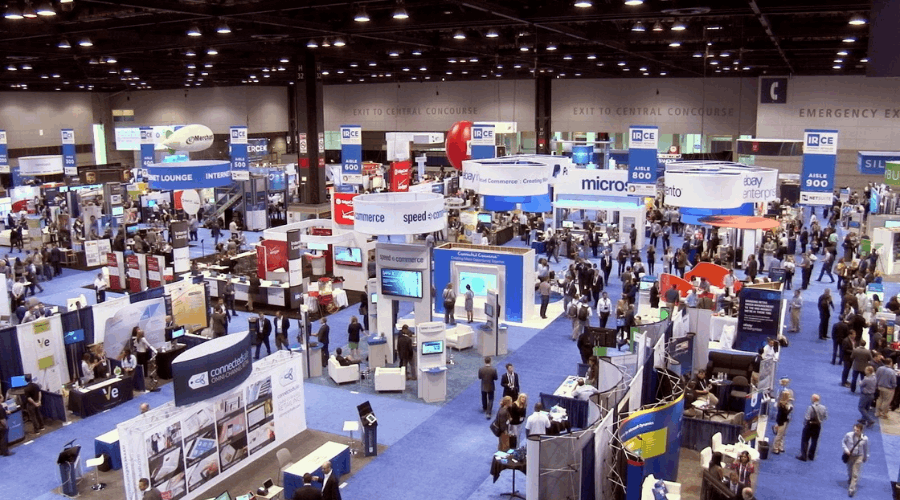
What Makes Attendees Stop
Trade show attendees walk past roughly 90 percent of booths without breaking stride. Eye-tracking research on trade show floor behavior consistently shows attendees scan for 1 to 3 seconds per booth before deciding to engage or move on.
The booths that win that 3-second decision share five physical elements: a single clear message visible from 20 feet, vertical height that breaks the horizontal table line, something tactile worth keeping, consistent branding across every surface, and intentional lighting.
Everything else — the demo, the giveaway, the conversation — is downstream of those five elements. Without them, the booth never gets the chance.
This is the print stack that delivers them.
The Booth Display Stack
The booth display is the first signal an attendee sees from across the aisle. It does three jobs: it identifies you, it gives one reason to stop, and it creates a backdrop that holds up in photos.
Retractable banner stand — the workhorse of trade show print. 33 by 80 inch is the most common size; it fits in a standard travel case, sets up in under a minute, and gives you eye-level branded real estate.
Pop-up backdrop — a curved or straight tension-fabric wall that creates a branded 8 by 8 ft or 10 by 10 ft backdrop. Best for booths that will be photographed (sponsor mentions, social posts, video interviews).
Branded table cover — a fitted or stretch cover that turns a generic 6 or 8 foot conference table into branded real estate. Front-printed only is fine for back-of-booth tables; full-sided printing for tables at the edge of the booth.
Hanging sign or ceiling banner — overhead branding visible from anywhere on the floor. Mostly for larger 20 by 20 ft or larger booths. Worth the investment if your booth is in a corner or back row.
Why Pocket Folders Still Outperform Tablets and QR Codes
The most common mistake at modern trade shows: replacing printed handouts with a “scan this QR code for our deck” sign. The data on this is brutal — fewer than 8 percent of attendees who scan a booth QR code follow through on the linked content within a week. Most never open it.
A printed pocket folder, by contrast, has a kept rate above 60 percent — it goes home in the bag, sits on a desk, and gets opened by both the attendee and (often) a colleague who didn’t attend.
A trade show pocket folder should contain:
-
A one-page capabilities sheet — clear, scannable, your top-line value proposition
-
A specific case study or proof point — one customer, one outcome, one number
-
A pricing or “starting at” sheet — gives the prospect something to take to their procurement team
-
A business card slot — your card is right there when they reach for it
-
Optional: a printed coupon or post-show offer with a deadline
Pocket folders, 9 by 12, full color, with business card slits and stitched spine.
The Handout Tier — Brochures, Rack Cards, and One-Sheets
Pocket folders are for serious leads. For everyone else, you need a lighter handout that delivers value in a single read.
Tri-fold brochure — the standard. Six panels of content, easy to scan, fits in a back pocket. Best for product or service overviews.
Rack card — 4 by 9 inches, printed both sides, sturdy enough to survive a tote bag. Best for single-product pieces or event-specific offers.
One-sheet sell sheet — 8.5 by 11, full color, on heavier stock (100 lb cover or above) so it doesn’t crease. Best for technical products or B2B services where buyers need specs.
Quantity to order: roughly 50 percent of expected booth visitors, plus 20 percent overage. A booth expecting 400 visitors should print 200 pocket folders and 250 handouts.
Giveaways That Actually Get Kept
Trade show giveaways have a brutal kept-vs-thrown-away ratio. Most pens, stress balls, and tchotchkes go in the hotel trash by Friday. The ones that survive the trip home share three traits: they are useful, they are branded subtly enough to be used in public, and they are tied to a story.
What works in 2026:
-
Branded notebooks (large or pocket) on premium paper — kept for months
-
Reusable water bottles — used daily if quality is good
-
USB-C cables or wall plugs in branded sleeves — used at every airport
-
Branded socks — surprisingly high kept rate and conversation-starter on the flight home
-
A printed pocket guide (10 to 20 pages, saddle-stitched, on 80 lb cover) on a topic relevant to your audience — combines the giveaway and the content in one piece
What does not work in 2026: pens, stress balls, fidget toys, plastic novelty items, anything that says “TRADESHOW 2024” - stop bringing outdated materials just because you have them.
Business Cards: The Highest-ROI Print at the Show
Most attendees finish a 3-day show with a stack of business cards and almost no memory of which conversation went with which card. The card that gets remembered is the one that feels different in the hand.
For trade show use specifically, consider:
-
Premium 130 lb cover stock with a soft-touch laminate — feels luxurious, costs slightly more than standard cards
-
A back-of-card differentiator — a single specific claim, an outcome stat, a memorable visual
-
A clear write-on space — many attendees scribble a context note (“met Tuesday, talked about Q3 launch”) and your card needs to allow that
The ROI math is simple: one closed deal from a remembered card pays for the entire show’s worth of cards 10x over.
Pre-Show Checklist — What to Order, When
A workable trade show print timeline:
-
8 weeks before: Decide booth strategy. Order or refresh booth display elements (banner stand, backdrop, table cover). Booth-display production is the longest lead time, often 3 to 4 weeks.
-
6 weeks before: Design and approve handouts (pocket folder, brochures, rack cards). Order giveaways.
-
4 weeks before: Final approvals on handouts. Print and ship to the show venue or to your local AlphaGraphics Center near the show city.
-
2 weeks before: Print buffer reorders. Confirm shipping. Print business cards for everyone working the booth.
-
Week of show: Ship-to-venue arrives. Carry critical pieces (business cards, top-tier handouts) in personal luggage.
After the Show — The Follow-Up Mailer Nobody Sends
Roughly 3 percent of B2B trade show exhibitors send a printed follow-up to leads after the show. The other 97 percent send an email — and most of those emails get filtered out as cold outreach.
A printed follow-up mailer sent 5 to 7 days after the show, referencing the specific conversation at the booth, has a response rate roughly 8 to 10 times the rate of the equivalent follow-up email.
The mailer is simple: a personalized note card, a single relevant piece (a case study, a one-pager), and a hand-signed signature line.
Almost no competitor does this. It is the cheapest competitive edge available in B2B trade show marketing.
Frequently Asked Questions
What print materials do I need for a trade show booth? A complete booth requires six to eight types of printed materials at minimum: a retractable banner stand, a table cover, a pocket folder with insert materials, a brochure or rack card, business cards, name badges for booth staff, a giveaway item, and (for larger booths) a pop-up backdrop or hanging sign.
Can AlphaGraphics ship printed materials directly to the trade show venue? Yes. Most AG Centers handle ship-to-venue logistics, including drop-shipping booth display elements to the official trade show advance warehouse before show open. Plan for an additional 5 to 7 days of lead time for advance-warehouse delivery.
What size should my trade show banner be? The most common and versatile size is a 33 by 80 inch retractable banner stand. This fits in a standard travel case, displays at eye level, and works in any booth size from 6 to 20 feet wide. For larger booths or hero positioning, consider a 47 inch or 60 inch wide stand.
Should I include a QR code on my trade show printed materials? Yes, but as a supplement to printed content, not a replacement. Use the QR code to drive attendees to a specific landing page (a calendar booking, a product demo signup, a case study download). Do not use a QR code that points to your homepage — the conversion rate is near zero.