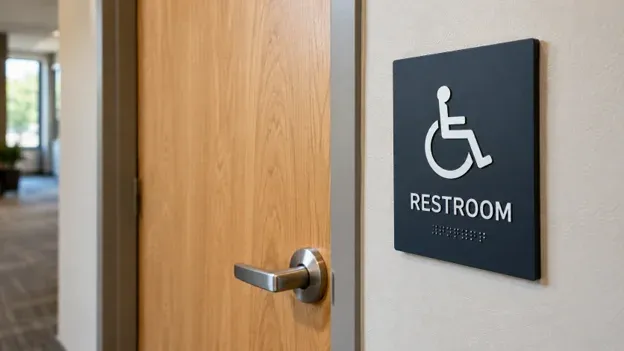
ADA signage requirements are federal standards under the Americans with Disabilities Act that dictate how certain signs in public and commercial buildings must be designed and installed. The rules cover tactile (raised) lettering, Grade 2 Braille, font style, color contrast, non-glare finishes, and mounting height. They apply to any business that serves the public, regardless of size, and noncompliance can lead to lawsuits, DOJ complaints, and fines starting at $75,000.
Most business owners assume their signs are compliant because they look professional. That's not how it works. Looking good and meeting ADA standards are two completely different things. A beautifully designed restroom sign in a script font with no braille and no raised lettering fails compliance on at least three counts, no matter how nice it looks on the wall.
This guide explains which signs must comply, what the technical requirements are, and how to check whether your current signage passes or needs replacement.
Who Has to Comply (And What Happens If You Don't)
Every business, nonprofit, and government building that's open to the public must comply with ADA signage requirements. It doesn't matter if your building is brand new or 100 years old. It doesn't matter if you're a one-person office or a 500-employee operation. If people come through your doors, your signage needs to meet the standard.
The regulatory document you're dealing with is the 2010 ADA Standards for Accessible Design. It's federal law, not a suggestion, and it applies uniformly across all 50 states. Some states, California and New York in particular, add additional requirements on top of the federal baseline, so if you operate in those states, you may need to go further than what this guide covers.
Here's what most business owners don't realize about enforcement: you don't get a warning letter first. Private citizens, not the government, file ADA compliance lawsuits, and they've been increasing every year. A single complaint about inaccessible signage can trigger a lawsuit that could make you responsible for legal fees, remediation costs, and potential damages. Federal penalties are $75,000 for a first violation and up to $150,000 for subsequent ones.
Nobody is trying to scare you into buying signs. But the financial risk of noncompliance is real, and fixing it after a complaint is far more expensive than getting it right the first time.
Which Signs Need to Be ADA Compliant
This is where most confusion lives. Not every sign in your building needs braille and raised lettering. The ADA distinguishes between different types of signs, and the requirements vary depending on what the sign identifies.
Signs that require full ADA compliance (tactile text, braille, contrast, proper mounting):
Permanent room identification signs. Restrooms, offices, conference rooms, break rooms, storage rooms, and any room with a permanent, unchanging purpose. If the room has a name or number, it needs a compliant sign.
Exits and exit routes. Exit signs and directional signs pointing toward exits must meet ADA standards.
Stairwell and floor level identifiers. Every stairwell landing needs a sign identifying the floor level. These must include tactile characters and braille.
Accessible facility markers. Accessible restrooms, entrances, parking, and elevators. These need the International Symbol of Accessibility and must meet all ADA design standards.
Signs that need to meet visual standards but NOT tactile/braille requirements:
Directional and informational signs. "Lobby this way" or "Elevator around the corner" type signage needs to be readable (proper contrast, appropriate font size based on viewing distance) but doesn't require raised text or braille as long as it's not identifying a specific permanent room.
Overhead signs. Signs mounted above doorways or suspended from ceilings follow different sizing rules based on viewing distance but generally don't need tactile elements because they're out of reach.
Signs that are exempt from ADA requirements:
Temporary signs. Anything displayed for seven days or less (event notices, temporary hours changes) is exempt.
Building names and logos. Your company name on the outside of the building and your logo in the lobby are not room identification signs and don't need braille or tactile text.
Menus, directories, and informational displays. These are considered changeable content and are exempt from tactile requirements, though they should still be readable (good contrast, appropriate sizing).
Knowing which signs fall into which category can save you from either spending money on compliance features you don't actually need or, worse, skipping compliance on signs that require it.
The Technical Requirements Explained in Plain English
The ADA specifications get very precise. Here's what your compliant signs actually need.
Raised (tactile) characters. Letters and numbers on permanent room identification signs must be raised at least 1/32 inch from the background surface. All tactile characters must be uppercase. This isn't a style choice. It's required because uppercase raised letters are easier to read by touch.
Character height. Tactile characters must be between 5/8 inch and 2 inches tall. If they're too small, they can't be read by touch. Too large and they're harder to trace with a finger.
Font. Sans serif fonts only. Think Arial, Helvetica, Verdana, or Montserrat. No script fonts, no decorative fonts, no italics, no oblique styles. The letterforms need to be simple and distinguishable by touch. This is one of the most common violations because business owners want their signage to match their brand font, and their brand font is almost always a decorative serif or script that doesn't comply.
Grade 2 Braille. Every sign with tactile text must also include Grade 2 (contracted) Braille positioned directly below the corresponding text. Not Grade 1. Grade 2 is the standard for public signage. Braille dots must be domed (not flat) and spaced at least 3/8 inch from any raised text above them.
Color contrast. The text and background must have a high contrast ratio, generally 70% or greater. Dark text on a light background or light text on a dark background. Both work. The finish must be non-glare (matte or satin), because glossy surfaces create reflections that make signs harder to read for people with low vision.
Pictograms. When pictograms are used (like the accessibility symbol or a restroom icon), they must be in a 6-inch minimum height field. Any text describing the pictogram goes below it, not inside the pictogram field.
Mounting Height and Placement Rules
Where you install the sign matters as much as how you design it. A perfectly designed ADA sign mounted in the wrong spot is noncompliant.
Wall-mounted room identification signs must be installed on the latch side of the door (the side with the handle, not the hinges). The baseline of the lowest tactile character must be at least 48 inches above the finished floor. The baseline of the highest tactile character must be no more than 60 inches above the floor. This 48- to 60-inch range ensures the sign is readable by touch for both standing individuals and wheelchair users.
Never mount ADA signs on the door itself. When the door is open, the sign disappears. It must be on the adjacent wall where it's always visible and accessible.
Clear floor space. Keep an 18 x 18 inch clear floor space in front of the sign so a person in a wheelchair can approach close enough to read it by touch.
Double door entries. If the room has double doors with no wall space between them, the sign goes to the right of the right-hand door (when facing the doors from outside the room).
Overhead and directional signs follow different rules. Character size depends on viewing distance. For every foot of viewing distance, the minimum character height increases proportionally. Your sign provider can calculate the correct sizing based on your specific hallway widths and mounting heights.
How to Audit Your Current Signage
You don't need to hire a consultant to do a basic compliance check. Walk through your building with this checklist to catch the most common problems.
Start at your entrance. Is there a sign indicating the accessible entrance? If your main entrance is accessible, it may not need a separate sign, but if it isn't, you must have directional signage pointing to the accessible entrance.
Check every permanent room. Check restrooms, offices, break rooms, conference rooms, storage, and mechanical rooms. Each one needs a sign with raised uppercase characters, Grade 2 Braille, high contrast, non-glare finish, and proper mounting (latch side, 48 to 60 inches).
Check your restrooms specifically. Accessible restroom stalls need identification. If the restroom is accessible, the entrance sign must include the International Symbol of Accessibility.
Check stairwells. Each landing needs a floor level identifier with tactile characters and braille.
Check exits. Exit signage must be visible and compliant with both ADA and local fire code requirements.
Check mounting locations. Are signs on the latch side of the door? Are they within the 48 to 60 inch height range? Is there clear floor space for approach? Are any signs mounted on the door itself (a common violation)?
Check fonts and finishes. Are any signs using script, decorative, or italic fonts? Are any surfaces glossy instead of matte?
If you find issues, that's actually good news. You found them before someone else did. Now you can fix them on your own timeline and budget instead of in response to a complaint.
What Compliant Signage Typically Costs
ADA-compliant signs aren't as expensive as most people assume, especially compared to the risk of a lawsuit.
Individual ADA room signs (restroom, office, conference room) typically run $25 to $75 per sign depending on materials, size, and customization. Basic acrylic or photopolymer signs are on the lower end. Custom designs with specific colors, wood-look finishes, or brushed metal aesthetics cost more.
A full building signage package for a small to midsize office, retail, or restaurant space usually runs $500 to $2,500 depending on how many rooms and areas need signage. Larger commercial buildings, medical offices, and multi-floor facilities can run $3,000 to $10,000 or more.
That includes design, fabrication with proper tactile text and braille, and the signs themselves. Installation is sometimes included, sometimes billed separately.
Compare that to the cost of a single ADA lawsuit: legal fees starting at $5,000 to $10,000, even if you settle quickly, plus remediation costs and potential federal penalties. The math is straightforward.
If you're building out a new space or renovating, including ADA-compliant signage from the start is far cheaper than retrofitting later. Your sign partner can spec everything during the design phase so the signs are ready when the space opens.
Mistakes We See Business Owners Make
After producing ADA signage for businesses across every industry, certain errors come up over and over.
Using decorative or brand fonts on room signs. Your brand identity matters, but ADA signs aren't the place for a custom serif or script typeface. Tactile characters must be sans serif, uppercase, and simple. You can absolutely use your brand colors and materials to make the signs look cohesive with your space. You just can't use your brand font if it doesn't comply.
Mounting signs on doors. This is one of the most common violations we see. It makes sense intuitively because the sign is right where the room is. But when the door opens, the sign goes with it. ADA requires wall mounting on the latch side so the sign is always in the same predictable location.
Skipping braille or using the wrong grade. Some business owners order "ADA signs" online that have raised text but no braille, or that use Grade 1 (uncontracted) braille instead of Grade 2. Both are noncompliant. Every permanent room sign needs Grade 2 Braille positioned correctly below the tactile text.
Forgetting stairwells. People remember restrooms and conference rooms. They almost always forget that every stairwell landing needs a floor level identifier. It's one of the most frequently missed requirements.
Assuming old signs are grandfathered in. They're not. If your building is open to the public, your signage must meet current ADA standards regardless of when you installed it. "We've had these signs since 2005" is not a defense.
Not accounting for renovations. When you remodel a space and change room functions, update the signage to reflect the new room purposes. A conference room that becomes a storage room still needs a compliant sign identifying its new function.
FAQs
Do all of my business signs need to be ADA compliant?
No. Only signs identifying permanent rooms and spaces (restrooms, offices, exits, stairwells, accessible facilities) require full ADA compliance with tactile text, braille, contrast, and proper mounting. Directional signs need to meet visual readability standards but don't require tactile elements. Temporary signs (7 days or less), building logos, menus, and changeable displays are generally exempt.
What fonts are ADA compliant?
Sans serif fonts only. Common compliant choices include Arial, Helvetica, Verdana, Optima, and Montserrat. Tactile text must not use script, italic, decorative, or highly stylized fonts. Characters must be uppercase on all tactile signs.
Where exactly should ADA signs be mounted?
On the latch side of the door (the side with the door handle), not on the door itself. The baseline of the lowest tactile character must be between 48 and 60 inches above the finished floor. There must be an 18 x 18 inch clear floor space in front of the sign for wheelchair access.
How much does it cost to make my business ADA compliant with signage?
Individual room signs run $25 to $75 each. A full signage package for a small to midsize business typically costs $500 to $2,500. Larger or multi-floor buildings can run $3,000 to $10,000+. These costs are modest compared to the $75,000+ in potential penalties and legal fees from a noncompliance lawsuit.
What are the penalties for not having ADA compliant signs?
Federal penalties start at $75,000 for a first violation and up to $150,000 for subsequent ones. More commonly, private citizens file ADA lawsuits, which can result in settlement costs of $5,000 to $25,000+ plus attorney fees and required remediation. ADA lawsuits have been increasing year over year, and signage is one of the most frequently cited violations.
Can I just order ADA signs online or do I need a professional?
You can find ADA signs online, but quality and compliance vary significantly. The safest approach is to work with a sign company experienced in ADA requirements that can verify the tactile text, braille grade, contrast ratio, character sizing, and mounting specifications meet current standards. One detail can make the sign noncompliant, even if it looks right.
Does South Carolina have additional ADA signage requirements beyond federal law?
South Carolina primarily follows the federal 2010 ADA Standards for Accessible Design. However, local building codes and fire codes may have additional requirements for exit signage and emergency wayfinding. If your business is in a historic district (relevant for many Charleston businesses), there may be additional design review considerations when adding signage to historic structures. Check with your local building department or ask your sign provider.
Getting This Right Isn't Hard. It Just Requires Attention.
ADA signage compliance isn't complicated once you understand which signs need it and what the specifications are. The requirements are specific, but they're not unreasonable. Raised text, braille, sans serif fonts, proper contrast, correct mounting height. It's a defined checklist, and a qualified sign partner can handle every detail from design through installation.
The real risk isn't in the complexity. It's assuming you're already compliant when you might not be. A 15-minute walkthrough of your building with the checklist above will tell you where you stand. If anything needs fixing, doing it proactively costs a fraction of what it costs after someone files a complaint.
If you're not sure where your signage stands, reach out. We'll take a look and tell you exactly what needs attention.