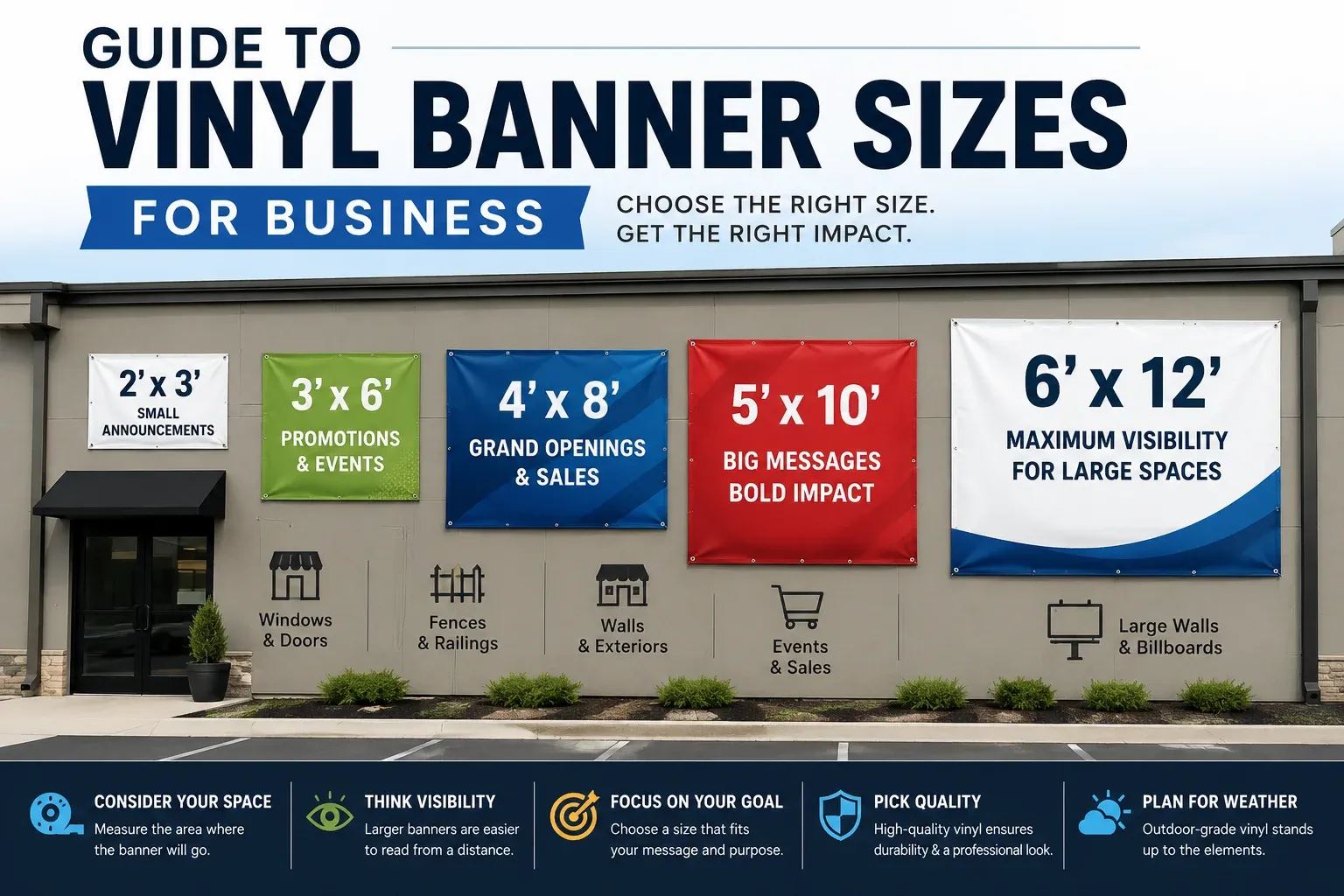
Picking a banner size sounds simple until you stand in front of the wall, fence, or storefront where it's going to be. Too small and it gets lost. Too big and it looks awkward, costs more than it should, and won't even fit the space you had in mind.
Here's the short answer most people are looking for. The most common vinyl banner sizes for business are 2' x 4' ft, 3' x 6' ft, and 4' x 8' ft. The 3 ft by 6 ft is the everyday workhorse for small businesses. The 4 ft by 8 ft is the size you go up to when you need it readable from across a parking lot or down a street. Anything bigger than that gets into building wraps and outdoor event signage.
That covers about 80 percent of orders. The other 20 percent is where people make expensive mistakes. The rest of this blog walks through every common size, when to use it, how mounting and viewing distance affect the answer, and the small details (hems, grommets, mesh vs. solid) that decide whether your banner lasts six weeks or six years.
Why Banner Size Actually Matters
Three things change when you change the size.
First, readability. There's a rule in the sign industry that says one inch of letter height for every ten feet of viewing distance. So if people are going to read your banner from 50 feet away, your main text needs to be at least 5 inches tall. That sets a minimum size before you start thinking about anything else.
Second, attention. A banner that's the right size for the space looks professional. A banner that's clearly too small for the wall it's hanging on looks like an afterthought. Customers notice that, even if they don't say it out loud.
Third, cost. Vinyl banner pricing scales with square footage. A 3-by-6 banner is 18 square feet. A 4-by-8 is 32 square feet, almost double the material. Going bigger isn't always wrong, but it's worth knowing what you're paying for.
Small Banners
Small banners run from about 2 ft by 4 ft up to 3 ft by 5 ft. These are for close viewing, where people are within about 15 feet of the banner.
Where they fit:
-
Tabletop displays at trade shows
-
Behind a registration or check-in table
-
Hung in a retail store window
-
Inside a 10 by 10 booth
-
Above a sale rack or promo display
A 2 ft by 4 ft banner is great for putting on the front of a draped table. A 3 ft by 5 ft is a step up that gives you more design room without taking over the booth.
The problem here is that people use small banners for outdoor advertising. A 2 ft by 4 ft banner on a fence facing a road is going to disappear. Save the small ones for indoor or close-up use.
Medium Banners
Medium banners cover 3 ft by 6 ft and 4 ft by 6 ft. This is the most popular size range for businesses, and for good reason. They're big enough to read from across a parking lot, small enough to handle without a crew, and they fit on most fences, walls, and standard mounting setups.
The 3 ft by 6 ft is a strong choice for:
-
Grand opening signs
-
Event banners
-
Sale and seasonal promotions
-
Real estate "Coming Soon" or "Now Leasing"
-
Sponsorship banners on a fence
The 4 ft by 6 ft gives you a more square shape, which works better when you have a logo and a tagline that need balanced space. It's also a common pick for trade show backdrops and step-and-repeat photo banners.
If you're ordering your first business banner and don't know which size to choose, start here. A 3 ft by 6 ft handles 80 percent of small business needs.
Large Banners
Large banners run from 4 ft by 8 ft up to about 6 ft by 10 ft. This is where you go when the banner has to do real work. Outdoor visibility, drive-by traffic, the side of a building, a tall fence facing a busy intersection.
Common uses:
-
Building facade banners for storefronts
-
Construction site fence wraps
-
Roadside advertising along a property line
-
Outdoor event main stage backdrops
-
Grand opening on a high-visibility wall
A 4 ft by 8 ft banner is the most ordered "big" banner because it fits a standard 8 ft sheet of plywood and most outdoor mounting frames. If you're going past that size, you're usually getting into custom territory, and that means custom hardware and probably custom hanging.
Extra-Large and Building Wraps
Anything bigger than 6 ft by 10 ft is what most printers call extra-large or large format. We're talking 8 ft by 20 ft, 10 ft by 30 ft, building wraps, scaffolding banners, stadium-side advertising. These are jobs where the banner has to compete with everything else in a busy outdoor scene.
A few things change at this size. Material switches almost always to mesh vinyl so the wind passes through. Mounting needs real engineering, not just zip ties. And the design needs to be simpler, because drivers are unlikely to read three lines of small text while driving.
If you think you need something this big, talk to your printer first. The wrong material at this scale becomes a sail in the first thunderstorm.
Indoor vs Outdoor
The same banner size doesn't always work for both. A few quick differences worth knowing.
Indoor banners can be smaller because the viewing distance is shorter. Lighting is consistent, so colors look the way they look on screen. Wind isn't a factor, so you don't need mesh material or reinforced hems. Standard 13 oz vinyl is fine for almost any indoor use.
Outdoor banners need to be bigger to read from a distance. They face sun, rain, and wind. Material should be 13 oz vinyl at a minimum, with hemmed edges and grommets every two to three feet. If the banner is going to be exposed to wind or facing a busy road, mesh vinyl is the smart move.
Florida sun and salt air, in particular, will fade a cheap banner in one summer. Pay for UV-resistant inks and a proper outdoor-grade vinyl, and you'll get years out of it instead of months.
The Distance Rule
Here's the rule again because it matters more than the size chart. One inch of letter height for every ten feet of viewing distance.
|
Viewing distance
|
Minimum letter height
|
|
10 feet
|
1 inch
|
|
25 feet
|
3 inches
|
|
50 feet
|
5 inches
|
|
100 feet
|
10 inches
|
|
200 feet
|
20 inches
|
Once you know how far away your readers will be, the minimum letter height tells you the minimum banner size. A banner that needs 10-inch letters can't fit a strong headline on a 2 ft by 4 ft. The math just doesn't work.
Mounting Changes the Size You Need
Most articles skip this, and they shouldn't. How you hang the banner affects the size you should order.
Grommets: the most common option. Metal rings are punched into the corners and along the edges every 24 to 36 inches. You order the banner in the size you want, and the printer adds grommets. Order the same size as the space you measured.
Pole pockets: sleeves on the top and bottom edges that slide over a pole or rod. If you order a banner with pole pockets, the printable area is smaller than the cut size. A 3 ft by 6 ft banner with 3-inch pole pockets has only about 5 ft 6 in of vertical printed area. Order an inch or two larger than your space if you're using pole pockets.
Rope hems: a rope sewn into the edge for tying off without grommets. Common on construction site banners and outdoor sports fences. Add about an inch on each side for the hem.
Wind-rated mounting: for windy locations, banners need bungee cords or zip ties through the grommets, not rope. The grommets need to be reinforced. Ask the printer for "wind-rated" finishing if it's going somewhere exposed.
If you don't tell the printer how you're hanging it, they'll usually default to standard grommets every 24 inches, and that's fine for most jobs. But if you're using pole pockets or doing a building wrap, mention it before you order.
Mesh or Solid Vinyl
Solid vinyl is what most people picture. A flat, full-color sheet blocks the wind and blocks the view through it.
Mesh vinyl has tiny holes in the material. About 30 to 50 percent of the surface is open. That sounds like it would hurt the print, but from a normal viewing distance, you can't tell the difference. The reason mesh exists is wind. A solid vinyl banner on a chain link fence in a 30 mph wind acts like a sail. It either rips, pulls the fence down, or ends up in the next county.
Use mesh when:
-
The banner is on a fence facing an open space
-
It's mounted high on a building
-
It's near the coast or in a wind-prone area
-
It's going on a construction site fence
Use solid when:
-
The banner is indoors
-
It's mounted flat against a wall
-
You need maximum color saturation
-
You want it to block the view behind it (like construction screening on a low fence)
Common Mistakes That Waste Money
A few patterns we see repeatedly.
Ordering too small for outdoor use. A 2 ft by 4 ft on a road-facing fence is invisible. If it's facing traffic, start with a 3 ft by 6 ft area and go up from there.
Ignoring the aspect ratio. A logo that's basically square doesn't look right on a 2 ft by 8 ft banner. Match the banner shape to the design, not the other way around.
Skipping hems and grommets to save a few dollars. A banner without proper hems will tear at the corners within a few weeks. The cost difference is usually under ten dollars. Always pay it.
Putting too much text on the banner. A banner is not a brochure. Headline, one supporting line, logo, contact info. That's it. If you need to say more, use a flyer.
Forgetting bleed. Vinyl banners need about a quarter-inch bleed on every side. If your design has important text or logo edges right up against the cut line, they'll get trimmed. The printer should handle this if you give them a print-ready file, but if you're designing yourself, build in the bleed.
Cheap material outdoors. A 9 oz banner is fine indoors. Outdoors, it doesn't last. Use 13 oz minimum, 15 oz for harsh conditions.
Before You Order
Walk through this list before you place the order. Saves a lot of headaches.
-
Where exactly is the banner going? Measure the actual space.
-
Indoor or outdoor?
-
How far away will most people read it from?
-
What's the minimum letter height based on that distance?
-
How are you mounting it? Grommets, pole pockets, ropes, frame?
-
Is the location windy or exposed? If yes, consider mesh.
-
Is the banner one-time use, or do you need it to last a year or more?
-
Do you need it printed on one side or both?
-
Do you have a print-ready file, or do you need design help?
-
What's the deadline? Rush printing usually adds 25 to 50 percent.
If you can answer all ten, the order goes smoothly. If you can't, that's where it pays to call the printer and walk through it before they put anything on the press.
Frequently Asked Questions
What's the most popular vinyl banner size for businesses?
3 ft by 6 ft. It's big enough to read from across a parking lot, small enough to hang almost anywhere, and it works for grand openings, sales, events, real estate, and most general business use. If you're not sure what size to order, this is the safe pick.
What size banner do I need for a grand opening?
For most storefronts, a 4 ft by 8 ft is the right size. It's visible from the street, it fills the space above or beside an entrance, and it photographs well for social media. If you have a smaller frontage or you're hanging inside, a 3 ft by 6 ft works fine.
Indoor or outdoor vinyl banner: what's the difference?
Indoor banners can be smaller and lighter (9 to 10 oz) and don't need UV-resistant inks or reinforced hems. Outdoor banners should be 13 oz minimum, with hemmed edges, grommets, UV-resistant inks, and mesh material if they're exposed to wind. The same design and size will last way longer outdoors with the right material.
How big do letters need to be on a banner?
One inch of letter height for every ten feet of viewing distance. Reading from 50 feet, your main text should be at least 5 inches tall. From 100 feet, at least 10 inches. Build the headline first, then size the banner to fit it.
Can vinyl banners be reused?
Yes. With proper care, a 13-oz vinyl banner can last three to five years outdoors and even longer indoors. Roll it loosely (don't fold it) when storing, keep it dry, and avoid stacking heavy things on top. Avoid creases. A creased banner usually can't be saved.
How long does it take to print a vinyl banner?
Standard turnaround is two to five business days for most printers, depending on size and finishing. Rush printing can drop that to 24 hours.. If you have an event coming up, order at least a week ahead so you have time to review the proof and reorder if anything's off.
Need Custom Vinyl Banners? We Can Help
AlphaGraphics Tampa on Hillsborough has been printing custom vinyl banners for Tampa businesses for years. Trade show banners, grand opening signs, building wraps, fence banners, retractables, indoor and outdoor, every size from 2 ft by 4 ft up to building-wrap scale. Florida weather is rough on signage, and we know which materials and finishes actually hold up here.
If you want help choosing the right size for your space or design, our team can walk you through it. Browse our custom banners and posters, indoor banners, large format printing, and banner stands and pop-ups, or request a quote and we'll get you a price the same day.