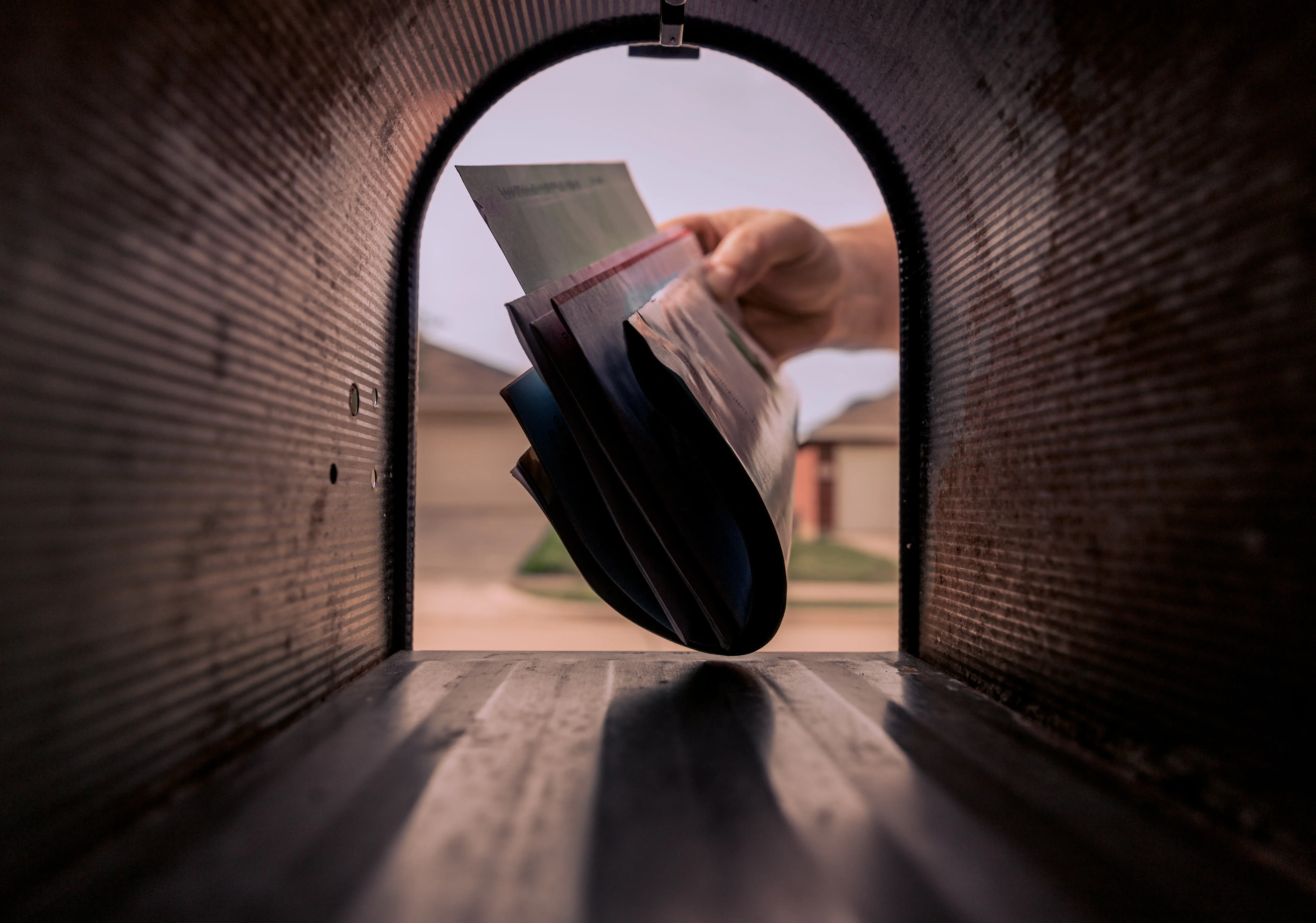
EDDM (Every Door Direct Mail) is a USPS program that lets you send postcards to every home and business on specific postal carrier routes without buying a mailing list. You pick the neighborhoods, design your postcard, and the postal service delivers it to every mailbox on those routes. Postage runs $0.26 per piece as of July 2026, making it one of the cheapest ways to get a physical marketing piece into someone's hands.
If your business depends on customers who live or work within a few miles of your location, you should understand EDDM. It's not new, but small businesses that would benefit most from it use it far less than they should. Restaurants, dental offices, salons, gyms, home service companies, retail shops. These businesses thrive on local foot traffic, and EDDM was built for them.
Here's how it works, what it costs, and why it still outperforms a lot of digital marketing for local businesses.
What Is EDDM and How Is It Different From Regular Direct Mail?
Traditional direct mail requires a mailing list. You either buy one from a data broker or build your own from customer records. Then you pay higher postage rates, need a bulk mail permit, and often hire someone to manage the list, remove duplicates, and handle returned mail. It works great for targeted campaigns where you know exactly who you want to reach, but it's expensive and complicated for a small business that just wants to reach the neighborhood.
EDDM strips all of that out. No mailing list. No permit (for the Retail version). No individual addresses. You select carrier routes through the USPS EDDM mapping tool, choose which routes match your target area, and your postcards go to every deliverable address on those routes. The mail carrier handles the rest.
Think of it this way: traditional direct mail is a rifle. EDDM is a shotgun. If you're trying to build awareness across entire neighborhoods rather than reaching specific individuals, saturation coverage is exactly what you want.
How an EDDM Campaign Works Step by Step
The process is simpler than most people expect. Here's what a typical campaign looks like from start to finish.
Pick your target area. Use the USPS online tool to search by ZIP code and see all available carrier routes. Each route shows you the number of residential and business addresses, plus demographic data like average household income, age range, and household size. You pick the routes that match your ideal customer base.
Most local businesses start with the routes closest to their location and work outward. A restaurant might target every route within a 3-mile radius. A dental office might focus on routes in higher-income neighborhoods. A home services company might saturate an entire zip code.
Design your postcard. Your postcard needs to meet USPS size requirements to qualify for EDDM rates. The piece must exceed at least one of these minimums: 6.125 inches tall, 11.5 inches long, or 0.25 inches thick. Most businesses go with a 6.5 x 9 or 8.5 x 11 postcard because the larger size stands out in the mailbox.
The design should lead with one clear offer, include your business name and contact information, and have a strong call to action. We'll get into what makes a postcard actually work later in this guide.
Print. Your postcards need to be printed on card stock that meets postal requirements. This isn't a home printer job. Professional postcard printing ensures the stock weight, dimensions, and print quality all meet the standard.
Bundle and prepare. EDDM mailings must be bundled in groups of 50 or 100 with USPS facing slips that identify the carrier route and piece count for each bundle. This is the most tedious part of the process if you're doing it yourself.
Drop off at the post office. You deliver your bundled postcards to the local post office that serves the zip codes you're targeting. EDDM Retail allows up to 5,000 pieces per zip code per day. If your campaign is larger, you either spread it across multiple days or use the EDDM BMEU option, which requires a permit but removes the daily cap.
Delivery. The mail carrier delivers your postcard along with the regular mail on their route. Typical delivery takes 7 to 14 days from drop-off, though timing can vary.
What It Costs: A Real Budget Breakdown
Let's talk actual dollars because vague claims about "affordability" don't help anyone plan a real campaign.
USPS postage: $0.26 per piece (EDDM Retail rate as of July 2026). This is the same regardless of postcard size, so a bigger, more impactful postcard costs the same to mail as a smaller one.
Printing: $0.08 to $0.22 per piece depending on quantity, size, paper stock, and finishing. Larger orders significantly reduce the per-piece cost.
Design: $150 to $500 if you need professional design from scratch. If you already have brand assets and know what you want, design costs drop. Many print and marketing partners include design in the package.
Mail preparation and bundling: $0.02 to $0.05 per piece if you're using a service. Free if you do it yourself (but budget the time).
Here's what real campaigns actually cost all in:
A 1,000-piece campaign runs roughly $400 to $550 total. That's 1,000 homes and businesses receiving your postcard for about 40 to 55 cents each.
A 5,000-piece campaign runs roughly $1,700 to $2,200. Your per-piece cost drops because printing gets cheaper at volume.
A 10,000-piece campaign runs roughly $3,200 to $4,300. At this scale, you're saturating multiple zip codes, and your cost per impression is lower than most digital advertising.
Compare that to a Facebook ad campaign. You might spend $1,500 to $2,000 and reach 10,000 people in your area, but those impressions scroll by in a fraction of a second. An EDDM postcard sits on someone's kitchen counter. They pick it up, read it, maybe stick it on the fridge if the offer is good. That's a fundamentally different kind of attention.
Why This Works Better Than You'd Expect
Physical mail has something digital ads lost long ago: attention.
The average American gets dozens of marketing emails a day. They see hundreds of digital ads. Most of it gets ignored, scrolled past, or blocked entirely. But they get maybe a handful of direct mail pieces per week, and studies consistently show that people read most of their physical mail, even if it's unsolicited.
Postcard response rates typically range from 1% to 5%, depending on the offer and the design. That might sound low until you compare it to email marketing (0.5% to 2% click-through) or display ads (0.1% average click-through rate). And EDDM response rates tend to be on the higher end because you're reaching people in the immediate area who could actually walk into your business.
There's also a trust factor. A printed postcard from a local business feels different than a pop-up ad on a website. It feels tangible and local. People are more likely to try a restaurant, book a service, or visit a store when they can hold the marketing piece in their hands.
For businesses that rely on local foot traffic, that combination of attention, trust, and proximity is hard to beat at any price.
Which Businesses Get the Best Results
EDDM works for almost any local business, but certain categories consistently see the strongest response rates.
Restaurants and food service. "Grand opening" postcards, seasonal menus, "buy one get one" offers, and catering promotions all perform well. People eat near where they live. A well-timed postcard with a compelling food offer is one of the highest-converting EDDM campaigns you can run.
Dental and medical practices. "New patient specials" and "accepting new patients" postcards targeted to neighborhoods near the office are a proven strategy. One dental practice case study showed 340 phone calls from a single 3-neighborhood EDDM drop.
Home services. HVAC, plumbing, roofing, landscaping, pest control. These businesses serve a defined radius, and their customers almost always search locally. A postcard that lands right before summer ("AC tune-up special") or right before hurricane season hits home for Tampa area residents.
Salons and beauty. First visit discounts, seasonal promotions, and new service announcements. These businesses thrive on repeat local customers, and EDDM builds that initial awareness.
Fitness and gyms. "Join this month" offers, new facility announcements, class schedules. People join gyms near their home or office. EDDM reaches exactly that audience.
Retail shops. Grand openings, clearance events, holiday promotions. Especially effective for new businesses that need to quickly introduce themselves to the surrounding neighborhood.
What Makes a Postcard People Actually Respond To
Your postcard has about three seconds to earn attention. That's how long it takes someone to glance at it before deciding whether to read further or drop it in the recycling. Those three seconds are everything.
Lead with one clear offer. Not three. Not five. One. "20% off your first visit." "$50 off AC service." "Free consultation." The offer should be the first thing someone sees.
Make the headline impossible to ignore. Your headline does the heavy lifting. It should state the benefit or the offer in plain language. "Your Neighbors Are Already Saving on Their Electric Bills" works better than "Premium Energy Solutions for Your Home."
Use one strong image. A photo of your actual location, your team, or your product beats clip art every time. Real photos build trust. If you're a restaurant, show the food. If you're a dental office, show smiling real people, not stock photos of models.
Include a clear call to action. What exactly should someone do next? Call this number. Visit this website. Scan this QR code. Bring this postcard in for your discount. Make it obvious and make it one thing, not four.
Add a deadline. "Valid through [date]" creates urgency. Without a deadline, people set the postcard aside and forget about it. With one, they act, or they lose the offer.
Don't forget the basics. Business name, address, phone number, website, hours. You'd be surprised how many postcards leave off critical contact information.
Why Working With a Print and Mail Partner Matters
You can technically do an EDDM campaign entirely on your own. Select routes on the USPS website, design the postcard in Canva, print it at home, bundle it in groups of 50 with facing slips, and drive it to the post office yourself.
In practice, almost nobody does it that way more than once. The bundling alone is tedious enough to make you question your life choices. If anything is wrong with your dimensions, stock weight, or bundle prep, the post office will reject the entire mailing, and you're back to square one.
Working with a full-service print and mail partner means someone handles everything: route selection strategy, postcard design, professional printing on USPS-compliant stock, proper bundling with facing slips, and delivery to the post office. You approve the design and the routes. They handle everything else.
The cost difference between DIY and full service is usually $0.03 to $0.05 per piece for the mail preparation. On a 5,000-piece campaign, that's $150 to $250 to have someone else handle the part of the process that takes the most time and creates the most room for error. For most business owners, that tradeoff is obvious.
EDDM vs Digital Advertising: Where Your Money Goes Further
This isn't an either/or conversation. Smart local businesses use both. But the comparison is worth making because most business owners have been told that digital is always the better investment, and that's not always true for local marketing.
Cost per thousand impressions (CPM). EDDM at $0.26 postage means $260 per 1,000 impressions. Facebook and Instagram ads for local businesses typically run $8 to $15 CPM, so $8 to $15 per 1,000 impressions. On raw CPM, digital wins by a wide margin.
But CPM doesn't tell the whole story. A digital impression is someone scrolling past your ad in 0.3 seconds. An EDDM impression is a physical postcard someone holds for 5 to 30 seconds. The depth of attention isn't comparable.
Response rates. EDDM postcards: 1% to 5%. Facebook ads: 0.5% to 1.5% click-through rate. Google Ads (local): 3% to 5% click-through rate but at a significantly higher cost per click for competitive local categories.
Ad fatigue and blocking. Roughly 40% of internet users use ad blockers. Nobody blocks their mailbox. Your EDDM postcard gets delivered and seen, period.
The smart combination. Send an EDDM campaign to a neighborhood, then run retargeting ads on Facebook and Instagram to that same zip code with matching visuals and offers. The person sees your postcard on Tuesday, then sees your ad on Thursday. That repetition across channels builds recognition faster than either channel alone.
FAQs
What does EDDM stand for?
Every Door Direct Mail. It's a USPS program that lets businesses send marketing mail to every address on selected carrier routes without a mailing list or bulk mail permit.
How much does an EDDM campaign cost?
USPS postage is $0.26 per piece as of July 2026. Including printing and mail prep, most campaigns run $0.40 to $0.55 per piece all in. A 5,000-piece campaign typically costs $1,700 to $2,200 total. Design is additional if you don't have an existing layout.
What size postcard do I need for EDDM?
Your mail piece must exceed at least one USPS minimum: 6.125 inches tall, 11.5 inches long, or 0.25 inches thick. Most businesses use 6.5 x 9 or 8.5 x 11 postcards. Standard 4 x 6 postcards don't qualify for EDDM rates.
How many pieces do I need to send?
EDDM Retail requires a minimum of 200 pieces per zip code per mailing. The maximum is 5,000 pieces per zip code per day. If your campaign exceeds 5,000, you can spread across multiple days or use the EDDM BMEU option, which requires a permit but has no daily cap.
How long does delivery take?
Typical EDDM delivery is 7 to 14 business days from post office drop-off. Timing can vary by location and postal volume. For time-sensitive promotions, build in at least two to three weeks of lead time before the offer starts.
Can I target specific demographics with EDDM?
You can't target individual households, but you can select carrier routes based on demographic data including average household income, average age, and household size. The USPS EDDM mapping tool shows this data for every route, so you can focus your campaign on the neighborhoods most likely to respond.
Is EDDM worth it for a small business?
For local businesses that serve customers within a defined area, yes. At $0.40 to $0.55 per piece all in, it's one of the most affordable ways to put your business in front of every household in your target neighborhoods. Restaurants, dental offices, home service companies, and retail shops consistently see strong results from EDDM when the offer is compelling, and the routes are chosen strategically.
Your Next Customers Live Down the Street
EDDM isn't complicated. It's a straightforward way to put your business in front of every home and business in the neighborhoods that matter most to you. The postage is cheap, the process is simple with the right partner, and the results are measurable.
If you've been dumping your entire marketing budget into digital ads and wondering why local foot traffic isn't growing, a single EDDM campaign might change your perspective on what's possible.
Talk to our team about planning your first (or next) EDDM campaign. We handle design, printing, mail prep, and post office delivery so you can focus on what happens when those new customers walk through your door.