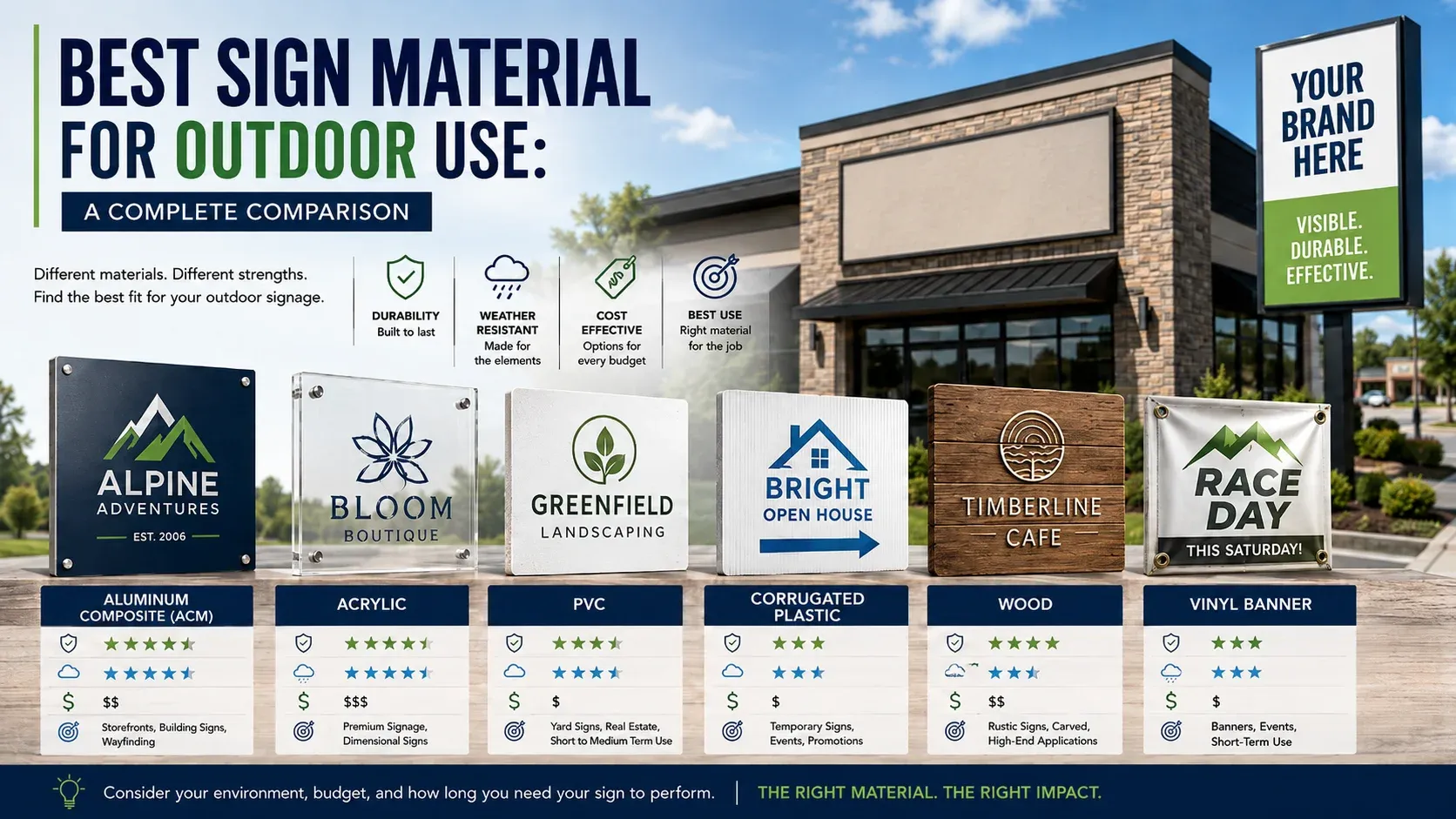
The outdoor sign question is the one we get most often from new clients. Some version of "which material should I use?" or "what's going to hold up?" or "I've had three signs fail in five years, what am I doing wrong?"
That last question is the most useful one because it usually points to the real issue. Most failed outdoor signs in Crystal Lake, and the broader Chicago area, do not fail because someone chose the wrong substrate. They fail because someone underestimated how Illinois weather affects signs that are not built for it. Freeze-thaw cycles. Road salt blown off Route 14 every winter. Humidity off the lakes in summer. UV exposure during the months when the sun actually shows up. Wind gusts that hit 50 mph in March storms.
Pick the right material for that environment, and you get a sign that lasts 10 to 15 years. Pick wrong, and you replace it every 18 months while wondering what happened.
This guide walks through every common outdoor sign material we work with at our Crystal Lake shop, what each one actually holds up to, and how to make the right call for your specific situation. If you want to skip ahead, the signs page has the full list of what we offer.
What Outdoor Signs Actually Have to Survive
Before getting into materials, it helps to understand what the sign is actually fighting. Outdoor signs in Crystal Lake face a brutal combination of seasonal stressors.
UV radiation. The sun degrades almost everything over time. Plastics get brittle. Inks fade. Adhesives release. Some materials handle UV beautifully for 15 years. Others lose half their color in two summers.
Temperature swings. A January morning at -5°F followed by an afternoon at 25°F creates expansion and contraction cycles that crack rigid substrates and pop adhesives. Summer days at 95°F do the opposite. Materials that are not engineered for this range will fail predictably.
Freeze-thaw moisture cycles. Any water that enters a substrate or becomes trapped behind a printed surface freezes, expands, and causes delamination. This is the most underrated failure mode in cold-climate outdoor signage. PVC and certain composite panels handle it well. Others do not.
Road salt and de-icing chemicals. Anyone with a sign within 50 feet of a road in Illinois deals with salt spray for four to five months a year. Salt corrodes mounting hardware, eats certain coatings, and stains finishes if not cleaned off.
Wind. Crystal Lake regularly sees 30 to 40 mph wind gusts in spring and fall, with peaks above 50. Sign substrate matters here, but the mounting matters more. We've seen perfectly good aluminum signs destroyed in a single storm because of cheap brackets.
Humidity. Lake-effect humidity in summer is harder on materials than dry heat. Vinyl, in particular, behaves very differently in humid conditions than in dry ones.
Now let's get into the materials themselves.
Aluminum
The gold standard for permanent outdoor signage and the material we recommend most often for storefronts, monument signs, parking lot signs, and any sign that needs to last over 10 years.
Why it works in Illinois weather: Aluminum does not rust. It expands and contracts predictably with temperature swings. It handles freeze-thaw cycles without delaminating. UV exposure barely affects the metal itself, though the print or paint layer on top still needs UV-stable inks. Road salt does not eat aluminum the way it eats steel.
Realistic lifespan: 10-15 years for standard panel signs. Properly mounted aluminum monument signs in our area routinely last 20 years or more.
Best applications:
-
Permanent storefront signs
-
Monument signs at office parks and business entries
-
Parking lot signs and wayfinding
-
Pole and panel signs
-
Real estate brokerage signs that need to outlast multiple listings
Limitations: Aluminum on its own is just a substrate. The print, vinyl wrap, or paint layer on top is what fails first. Cheap solvent-printed graphics on quality aluminum will fade in 3 to 5 years. UV-cured inks on the same substrate hold color for 10+ years.
What to spend extra on: Mounting hardware. Stainless steel or galvanized fasteners with proper anchors are non-negotiable for any aluminum sign in this region. Standard zinc-plated hardware will rust through in 3 winters.
We make many aluminum signs for clients across McHenry County, particularly for storefront installations and pole signs along Northwest Highway.
Aluminum Composite Material (Dibond and ACM)
Aluminum composite panels are made of two thin sheets of aluminum bonded to a polyethylene core. The brand name Dibond is the most common, but other ACM panels work the same way. This material has become the default for printed outdoor signs because of its flatness, lightweight construction, and good weather resistance.
Why it works in Illinois weather: ACM resists warping during temperature swings better than solid aluminum because its core layer absorbs some of the expansion. The flat surface holds large printed graphics without the rippling you sometimes get on heavier metals. Both sides can be printed, useful for two-sided signs at intersections or driveways.
Realistic lifespan: 5 to 8 years for standard printed dibond signs in Illinois weather. Some manufacturers claim longer lifespans, but in our experience, the print layer on the surface usually starts to show wear before the panel does.
Best applications:
-
Large printed outdoor signs (3+ feet)
-
Real estate panel signs
-
Yard signs that need to last more than one season
-
Construction and development signage
-
Wayfinding sign panels
-
Mid-term promotional signs
Limitations: The polyethylene core can swell if water gets in through cut edges that were not properly sealed. This is a real failure mode we see on signs that are cut poorly or have edges left raw. Always seal the cut edges or use proper edge banding.
We use ACM panels for a significant portion of the building signage we do, particularly for clients who want a flat, printed sign that looks professional and lasts longer than a couple of years.
Acrylic (Plexiglass)
Acrylic, a clear plastic that comes in many colors and finishes, gives a clean, modern, often premium look. Used heavily for backlit channel letters, building identification, and dimensional signs.
Why it works in Illinois weather: High-quality cast acrylic is UV stable and won't yellow significantly in outdoor use. Holds its shape across the temperature range we see in northern Illinois. Doesn't rust or corrode.
Realistic lifespan: 7 to 10 years for properly engineered outdoor acrylic signs. Backlit acrylic faces in channel letters often need replacement around years 8 to 10, as the front faces dull from accumulated UV exposure.
Best applications:
-
Backlit channel letters
-
Premium building identification
-
Office park entry signs
-
Backlit cabinet sign faces
-
Dimensional letters and logos
Limitations: Acrylic can crack under impact, especially in extreme cold when it becomes more brittle. A car bumper into an acrylic sign in February will shatter it. Cheap extruded acrylic (cheaper than cast) yellows faster and is more prone to crazing in temperature cycles. Spending more on cast acrylic is worth it.
For backlit applications, we use acrylic faces paired with LED illumination, which we plan into the design through our backlit graphics service. We make many acrylic signs for office and retail clients in the Crystal Lake area.
PVC and Sintra
Rigid PVC (also sold under brand names like Sintra) is a plastic sheet that comes in various thicknesses and provides a middle-ground option between coroplast and aluminum composite.
Why it works in Illinois weather: PVC handles humidity well, doesn't rust, and resists most of what the outdoors can throw at it. The trade-off is UV degradation. Standard PVC will become brittle and start to crack after a few years of direct sun exposure.
Realistic lifespan: 2 to 4 years in full sun, 4 to 6 years in shaded or partially protected locations.
Best applications:
-
Semi-permanent signs that need to last a few years
-
Shaded entry signs
-
Patient room signs (when outdoors)
-
Letters and logos for indoor-outdoor transitions
-
Cost-effective outdoor signs where a 15-year lifespan is overkill
Limitations: Direct sun in unshaded locations dramatically shortens PVC lifespan. Will warp slightly in extreme heat (above 95°F or so) but bounces back. Becomes brittle in deep cold and can crack on impact.
We use rigid PVC for magnetic graphics substrates and for many short- to mid-term outdoor signs where aluminum is more material than the project requires.
Vinyl Banners and Mesh
Flexible vinyl banners are the answer for short-term outdoor signs, event signage, construction site advertising, and seasonal promotions. Heavier weight vinyl (13 oz or 18 oz) lasts longer than thin promotional banner stock.
Why it works in Illinois weather: Modern banner vinyl is engineered for outdoor exposure. UV-stable inks on a quality vinyl substrate will hold color for 1 to 3 years, depending on the grade. Mesh banners (which have small openings to let wind through) work better than solid vinyl in wind-prone locations because they reduce sail effect on the mounting points.
Realistic lifespan: 1-2 years for 13-oz banner vinyl outdoors. Up to 3-4 years for premium 18 oz vinyl with proper grommets and tension mounting.
Best applications:
Limitations: Vinyl will fail at the grommets first if it's flapping in the wind. Tension mounting, hemmed edges, and proper grommet placement (at least every 24 inches) dramatically extend lifespan. Wind tears destroy more banners than UV does.
We make a lot of vinyl signs and banners for short-term promotional needs, as well as banner and mesh products for higher-wind locations.
Coroplast (Corrugated Plastic)
Lightweight corrugated plastic, the same material political yard signs are made of. The most affordable outdoor sign substrate available.
Why it works in Illinois weather: Coroplast is waterproof, rust- and rot-resistant, and withstands most short-term outdoor exposure just fine. The corrugated structure gives it rigidity without weight.
Realistic lifespan: 6 to 12 months for typical outdoor use. With proper UV-stable inks and lamination, it can stretch to 18 months, but that's the upper limit.
Best applications:
-
Real estate yard signs
-
Political campaign signs
-
Open house and event signs
-
Garage sale and short-term promotional signs
-
Construction permit display signs
-
Trade show curbside signage
Limitations: Not a long-term outdoor solution. Will fade and become brittle, and the fluting can fill with water in heavy rain if not properly designed. The H-frame mounting wire poking through the flutes is the most common failure point.
Coroplast signs make sense when the right answer is short-term and low-cost, not when permanence matters.
Wood (HDU and Real Wood)
High-Density Urethane (HDU) is a foam-like material engineered to look like carved wood. Real wood signs still exist but are less common in commercial outdoor signage.
Why HDU works in Illinois weather: HDU is completely impervious to moisture, doesn't rot or crack, and holds paint exceptionally well. It can be carved, sandblasted, and routed into dimensional shapes that real wood can't sustain outdoors over time.
Realistic lifespan: 10 to 20 years for HDU signs with quality finish coats.
Best applications:
-
Carved business and property signs
-
Historic district storefront signs
-
High-end neighborhood entry signs
-
Custom carved logos and lettering
-
Park and recreational area signs
Limitations: Cost is significantly higher than printed substrates. The aesthetic is specifically the carved/dimensional look. Not a fit for businesses wanting a modern flat-printed sign.
Real wood (cedar, redwood, etc.) requires significant ongoing maintenance to survive Illinois winters. Most commercial applications that look like wood are now HDU.
The Real Failure Point: Inks, Laminates, and Mounting
This is the part nobody talks about. The sign substrate is rarely the first to fail. The print layer, the lamination, and the mounting hardware almost always go on before the substrate.
Inks and printing. UV-cured inks on a quality substrate will outlast solvent inks by years. Latex inks are in between. The price difference between cheap and quality printing is significant, but on a 10-year sign, it makes the difference between needing replacement at year 4 and year 10. We use UV-cured ink technology for outdoor printing because the results are dramatically more durable.
Laminates. A clear UV-protective laminate over printed graphics extends color life by years. Polymeric and cast laminates outperform monomeric. Cast laminates are the right call for any outdoor sign with a lifespan target over 5 years.
Mounting hardware. The bolts, brackets, and anchors are what kill more signs in Illinois weather than anything else. Galvanized steel rusts in 3 winters. Stainless steel keeps going for 15 years. Aluminum hardware paired with aluminum signs eliminates galvanic corrosion. Specifying the right hardware may cost 10% more upfront and double the practical sign lifespan.
Installation. Wrong fasteners, wrong wall anchors, inadequate sealing around penetrations. These cause water intrusion that destroys substrates from the inside. Proper installation by people who know what they're doing matters as much as the materials.
Cost-Per-Year: The Math That Actually Matters
A cheap sign that lasts 2 years and a quality sign that lasts 12 years are not actually different prices when you calculate them per year of service. They are often closer than the upfront sticker price suggests.
Here's a rough example for a 4x6 foot outdoor business sign:
-
Coroplast with solvent ink graphics: $200 upfront. 12-month lifespan. Cost per year: $200.
-
PVC with UV-cured ink: $400 upfront. 3-year lifespan. Cost per year: $133.
-
Dibond ACM with UV-cured ink and cast laminate: $700 upfront. 7-year lifespan. Cost per year: $100.
-
Aluminum panel with UV-cured ink, cast laminate, and stainless mounting: $1,200 upfront. 12-year lifespan. Cost per year: $100.
The cheap option is the most expensive option per year, not the least. This is the calculation that catches most first-time outdoor sign buyers off guard.
Illinois-Specific Considerations
A few things specific to Crystal Lake and the broader Chicago metro area that affect material selection.
Sign permits and wind load. McHenry County and many local municipalities have wind load requirements for permitted signs. Larger-format signs (typically anything over 32 square feet) require engineered drawings demonstrating that the sign can withstand a specified wind speed. This affects both substrate choice and mounting design. We handle the permit process for clients on most installations.
Snow load on top-mounted signs. Signs with horizontal top surfaces accumulate snow and ice. The weight matters more than people realize. A 4-foot-wide horizontal panel can hold 50+ pounds of accumulated snow and ice in a bad winter. Mounting hardware needs to support this.
Salt damage zones. Signs within 100 feet of major roads (Route 14, Route 31, IL-176) deal with significantly more salt spray than signs in residential areas. Mounting hardware specification matters even more in those zones.
Backlit signs in winter. LED-illuminated signs work fine in Illinois cold, but the gaskets and seals that keep moisture out of the cabinet are critical. We've replaced more channel letter electronics than we'd like to admit due to water intrusion caused by inadequate gaskets.
How to Pick: A Decision Framework
If you take nothing else from this post, take this. Ask yourself three questions in this order.
1. How long does this sign need to last?
-
Less than 1 year: Coroplast or vinyl banner
-
1 to 3 years: PVC, premium vinyl banner, or short-term ACM
-
3 to 7 years: ACM/Dibond with quality inks and laminate
-
7 to 15 years: Aluminum panel with full UV-cured print system
-
15+ years: HDU carved sign or aluminum monument sign
2. Where exactly will it be installed?
-
Full sun, exposed: Move up one tier from where you'd otherwise land
-
Wind-prone location: Mesh banner if temporary, aluminum if permanent
-
Near major road: Specify upgraded mounting and consider salt-rated coatings
-
Backlit/illuminated: Cast acrylic or aluminum cabinet with quality LED
3. How much budget do you have for this sign? If the answer is "as little as possible," be honest about whether you're really making a sign or just making a temporary placeholder. The cheapest material that will actually last as long as you need it to is the right answer. The cheapest material period is rarely the right answer.
Frequently Asked Questions
What is the most durable material for outdoor signs?
Aluminum is the most durable common outdoor sign material, with realistic lifespans of 10 to 15 years and often longer for properly engineered monument signs. HDU (high-density urethane) for carved dimensional signs can last 15 to 20 years. Both significantly outperform plastic-based materials for permanent outdoor signage.
What is the best material for outdoor signs that need to last long-term?
For long-term outdoor signs (10+ years), aluminum is the standard choice. Pair it with UV-cured ink graphics, a cast UV-protective laminate, and stainless steel mounting hardware for maximum lifespan. For carved dimensional signs, HDU is the equivalent material.
Are aluminum signs better than PVC for outdoor use?
Yes, for any sign meant to last more than a few years. Aluminum doesn't degrade in UV exposure, won't crack in extreme cold, and holds up to road salt and humidity. PVC is more affordable upfront but typically needs replacement every 2 to 4 years in Illinois weather. Aluminum is the better long-term value.
How long do outdoor vinyl banners last?
13 oz banner vinyl typically lasts 1 to 2 years outdoors. Premium 18 oz vinyl with proper hemming and grommet placement can last 2 to 4 years. Wind tears at mounting points cause more failures than UV does, so quality mounting matters as much as vinyl grade.
What outdoor sign material handles cold weather best?
Aluminum, ACM/Dibond, and HDU all handle Illinois cold without issues. Acrylic becomes more brittle in deep cold and is more vulnerable to impact damage. PVC and coroplast can crack when frozen and struck by impact. For cold-climate permanent signage, aluminum is the safest specification.
What is the cheapest outdoor sign material?
Coroplast (corrugated plastic) is the cheapest substrate at typically $15 to $40 per yard sign. Vinyl banners are similarly affordable for larger format short-term needs. Both are appropriate for sub-1-year outdoor use but not for permanent signs.
How do I keep outdoor signs from fading?
Use UV-cured inks rather than solvent or low-grade printing. Apply a cast UV-protective laminate over the printed surface. Choose substrates that don't degrade in UV (aluminum, HDU, cast acrylic). For colored substrates, choose colored aluminum or pigmented PVC rather than painted finishes that can fade.
Should I use dibond or aluminum for my outdoor sign?
For flat printed signs up to about 4x8 feet, dibond ACM is usually the right choice because of its weight, flatness, and cost. For larger signs, signs requiring structural rigidity, or signs needing a 10+ year lifespan, solid aluminum panels are the better specification. Many monument and pole signs use aluminum framing with ACM panels for the printed surface.
Do I need a permit for an outdoor business sign in Crystal Lake?
Most permanent exterior business signs require a permit from the City of Crystal Lake or your specific municipality. Requirements vary by sign type, size, and location. We help clients through the permit process on most commercial installations.
Get a Quote
If you're planning a new outdoor sign, replacing one that failed, or trying to figure out the right material for a specific application, the next step is a real conversation about your project, location, and timeline.
We design, print, fabricate, and install outdoor signs for businesses throughout Crystal Lake, Lake in the Hills, Algonquin, Cary, McHenry, Woodstock, and the surrounding McHenry County area.
AlphaGraphics Crystal Lake 6294 Northwest Hwy (Rt 14) Crystal Lake, IL 60014 (815) 444-9971 Monday through Friday, 8 AM to 5 PM