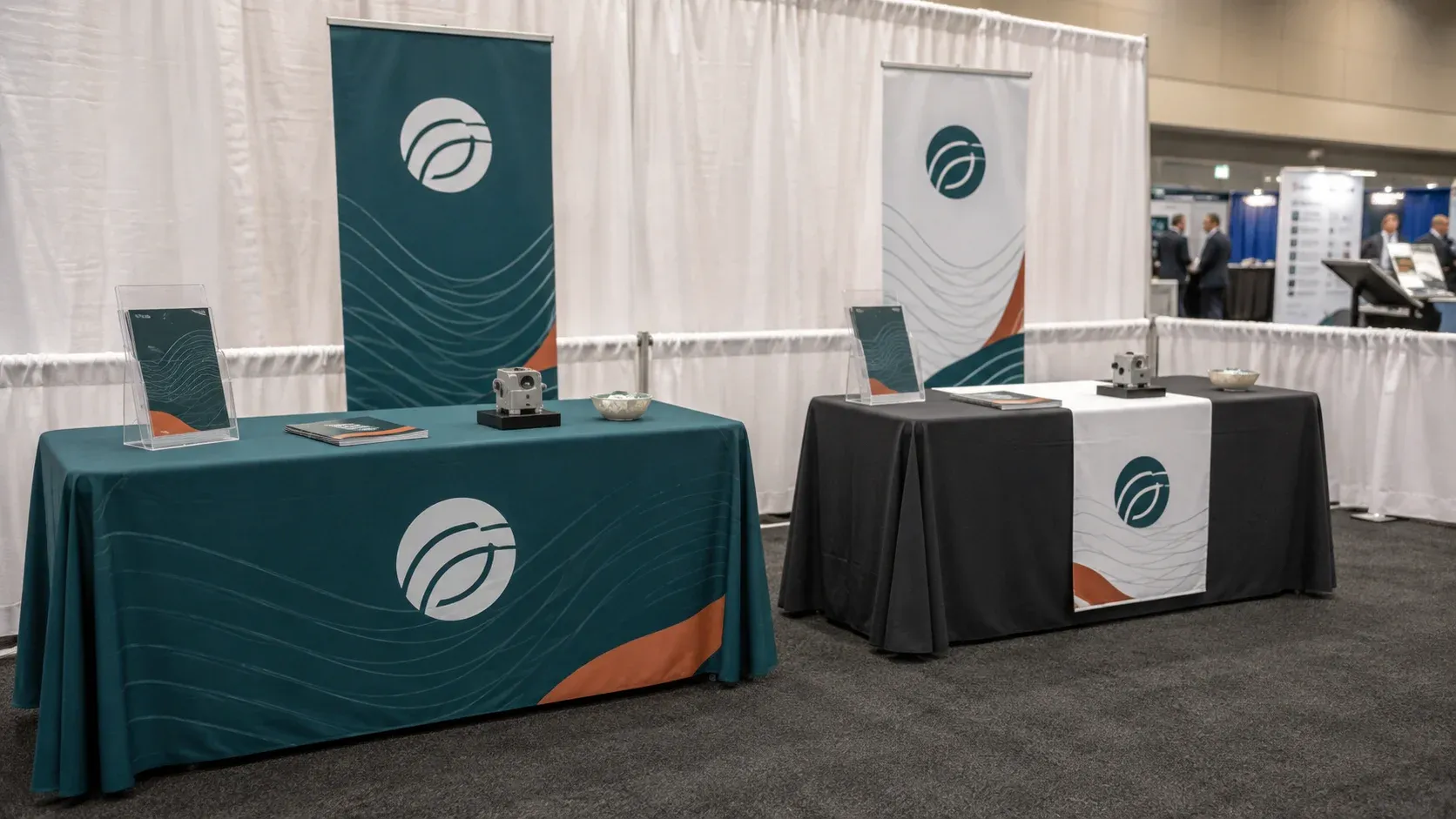
A table throw covers most or all of an event table, giving you a large, unified branding surface. A table runner is a narrower printed panel that sits over a separate tablecloth and usually centers your logo on the front of the table.
The better choice depends on how your booth will be used:
-
Choose a table throw when you want maximum coverage, a complete standalone display, and a clean way to conceal supplies beneath the table.
-
Choose a table runner when you already own a plain tablecloth, need a compact display, or want to change campaigns without replacing the entire table covering.
-
Use both when you want the coverage of a full cloth with a replaceable branded layer for departments, sponsors, products, or seasonal messaging.
If you are still deciding, AlphaGraphics on Hillsborough offers custom table throws and table runners in Tampa, including printed, fitted, stretch, convertible, and round options.
Table Throw vs. Table Runner: Quick Comparison
|
Factor
|
Table Throw
|
Table Runner
|
|
Coverage
|
Covers the top and most or all visible sides
|
Covers a narrower section across the top and front
|
|
Separate tablecloth needed?
|
No
|
Usually yes for a finished, full-coverage setup
|
|
Branding space
|
Larger; can support a logo, background graphics, patterns, and side branding
|
Smaller; best for a logo and one short message
|
|
Conceals under-table storage?
|
Yes, if the selected style reaches the floor on the visible sides
|
The runner alone does not; the plain cloth underneath may
|
|
Flexibility across table sizes
|
Depends on the style; fitted and stretch covers are size-specific
|
Generally more flexible when paired with different plain cloths
|
|
Setup
|
One main piece
|
Runner plus a separate tablecloth
|
|
Portability
|
More fabric to pack
|
Runner alone is compact, but remember to include the undercloth
|
|
Cost pattern
|
Higher custom-print cost, but no separate cloth is required
|
Usually lower for the printed piece; total cost rises if you also need a quality tablecloth
|
|
Updating the message
|
Requires a new throw or a layered runner
|
Easier to replace the runner and reuse the cloth
|
|
Best fit
|
Trade shows, conferences, product launches, registration tables
|
Job fairs, sponsorships, recurring programs, community events, multi-brand setups
|
What Is a Custom Table Throw?
A custom table throw is a fabric cover designed to drape over or fit around an event table. Because the design can continue across a large surface, a throw turns an ordinary folding table into a more complete branded display.
The familiar six-foot and eight-foot folding tables are common at expos, conferences, recruiting events, and vendor fairs, but they are not universal. Table depth, height, shape, and the number of visible sides can vary. Measure the actual table whenever possible, rather than ordering by length alone.
Common table-throw styles
Draped or loose throws fall naturally over the table. They create a traditional presentation and are often the most forgiving when the table dimensions vary slightly. A loose throw can shift or bunch if it isn't positioned carefully, so check the booth after setup.
Fitted throws are made for specific table dimensions and create straight corners and a structured silhouette. They look tidy and stay aligned, but the fit is less flexible if the venue changes the table size.
Stretch throws use a fitted fabric that pulls toward the table legs or frame. They create a modern, sculpted look and resist loose folds, but they require the correct table size and shape.
Convertible throws adapt to selected common table widths. They can be useful when your event schedule includes more than one table size, but confirm the exact product specifications before ordering.
Open-back and full-back options change access and coverage. An open back lets booth staff reach boxes and literature stored under the table. A full back provides complete coverage when people may walk behind the display. Some fitted and stretch styles may offer a zipper or another access point.
AlphaGraphics on Hillsborough also lists round covers, fitted covers, stretch covers, and runners among its table-cover options.
What Is a Custom Table Runner?
A custom table runner is a narrower piece of printed fabric positioned across the table and centered on the audience-facing side. It normally sits over a solid-color tablecloth that provides the remaining coverage.
Runners are available in different widths and lengths. No single size works for every display, so avoid assuming a runner will always be 24 inches wide or will automatically reach the floor. Review the product template and decide how much fabric should show on the top, front, and back.
The runner’s main advantage is modularity. A business can keep one black, white, or brand-color tablecloth and change the runner for:
-
Different departments or locations
-
Seasonal campaigns
-
New products or services
-
Sponsors and partner events
-
Recruiting versus sales events
-
Short-term offers that may change next year
Because the branded panel is smaller, runners work best with a focused design. A clear logo and one concise line usually communicate more effectively than several messages competing for attention.
Which Option Creates More Visual Impact?
A full table throw usually makes the stronger impression when the table is a major part of the booth. The larger color field can unify the setup and make the brand recognizable from the front and, depending on the artwork, from the sides.
A runner creates a more concentrated focal point. Its impact depends heavily on the contrast between the runner and the plain cloth underneath. A light runner over a dark cloth—or the reverse—can make the logo stand out without printing the entire cover.
Neither option should carry every detail about the business. Event attendees often view the table while walking or while others stand in front of it. Treat the table covering as an identification tool, then use a backdrop, banner stand, brochures, or a QR code for the next layer of information.
For a broader booth plan, explore AlphaGraphics' exhibits and display options in Hillsborough or read the center’s guide to high-impact trade show print materials in Tampa.
When Should You Choose a Table Throw?
A table throw is usually the better choice when:
-
The table is one of the main visual elements in your booth
-
Attendees may approach from the front or sides
-
You need to conceal boxes, bags, literature, or equipment beneath the table
-
You want one piece that can be placed quickly without a separate cloth
-
Your brand colors or patterns need a larger visual surface
-
You use a consistent table size at most events
-
The display needs to look complete even without a large backdrop
For trade shows and corporate events, a fitted or stretch cover can support a more structured booth design. A draped or convertible option may be more practical when table dimensions change from event to event.
When Should You Choose a Table Runner?
A table runner may be the better fit when:
-
You already own clean, floor-length tablecloths
-
You need the custom-printed portion to pack into a small bag
-
The venue provides tables but cannot confirm every dimension in advance
-
The table is against a wall and only the front matters
-
Multiple teams share the same event kit
-
A sponsor, campaign, product, or program name changes frequently
-
You want to refresh the branded layer without replacing the full covering
A runner is not automatically the “budget” option. If you also need to purchase, transport, and maintain a professional plain cloth, compare the total setup cost with the price of a complete printed throw.
Can You Layer a Runner Over a Table Throw?
Yes. Layering can combine the coverage of a full throw with the flexibility of a runner. This approach works especially well when:
-
The base throw uses a solid or subtle brand color
-
The runner carries a campaign, division, sponsor, or event-specific message
-
Several teams need to share one base display
-
You want high contrast around the logo
Keep the layers visually simple. If the base throw already contains a large logo, pattern, and tagline, adding a second printed piece can make the table look busy. It may be better to use a solid base with the detailed branding on the runner.
Also confirm how the runner will stay centered. Tabletop products, literature, attendee contact, and airflow can cause a loose runner to shift. The right clips or fastening method depends on the table, cloth, and venue rules.
How Much Do Table Throws and Runners Cost?
A table runner normally has a lower custom-print price because it uses less printed fabric. A complete throw generally costs more, particularly for larger tables, fitted construction, stretch fabric, full-color coverage, or printing on several panels.
However, published national price ranges can be misleading. Your quote may depend on:
-
Table size and shape
-
Runner width and length
-
Draped, fitted, stretch, convertible, or round construction
-
Open-back, full-back, or zippered access
-
Single-color, multicolor, or full-color artwork
-
Quantity
-
Artwork preparation or design assistance
-
Proofing, production, and delivery deadline
-
Whether a separate tablecloth is needed
Instead of comparing only the first purchase price, consider the complete event kit and how often the message will change. A runner may save money for rotating campaigns, while a full throw may offer better value when you reuse the same brand setup repeatedly.
How to Design a Table Cover That Reads Clearly
1. Lead with one visual priority
For most organizations, that priority is the logo. A short descriptor or website can follow, but avoid turning the front panel into a brochure.
2. Design for the visible area
Place the most important information on the audience-facing panel, not only on the tabletop. Displays, laptops, samples, and literature may cover the top once the event begins.
3. Account for people standing in front of the table
Booth staff, chairs, and attendees will block parts of the design. Keep the logo large enough to remain recognizable and avoid placing critical text too low or near a fold.
4. Use strong contrast
The logo should separate clearly from the background. For layered displays, the runner and base cloth should contrast without fighting the brand palette.
5. Start with the best logo file available
Vector artwork such as an editable PDF, EPS, or AI file generally scales more cleanly than a screenshot or logo copied from a website. If you do not have the ideal format, send the best original file you have so the design team can evaluate it.
6. Coordinate the full booth
The table cover, banner stand, backdrop, printed collateral, and promotional items should feel like one system. If a large backdrop already explains the offer, keep the table simple. If the table is the only branded element, give it a stronger visual role.
If you plan to add a banner, AlphaGraphics' Hillsborough business banner size guide can help you choose a format that complements the table instead of competing with it.
What Should You Confirm Before Ordering?
Use this checklist before approving a table throw or runner:
-
What are the table’s exact length, depth, and height?
-
Is the table rectangular, round, counter-height, or an unusual shape?
-
Which sides will attendees see?
-
Do booth staff need access to storage from the back?
-
Will the venue provide a plain tablecloth, and what color and drop length will it have?
-
Does the venue require flame-retardant material or documentation?
-
Will the same cover be used with more than one table size?
-
What objects will sit on the tabletop and potentially cover the design?
-
Does the artwork match the exact template for the selected product?
-
When must the finished display arrive, including time for proof approval?
This information helps the print team recommend the right construction instead of guessing from a photo or a generic “six-foot table” description.
How Do You Care for a Printed Table Cover?
AlphaGraphics on Hillsborough lists its table throws as machine washable, durable, and reusable. Care instructions can still differ by fabric, print method, and construction, so follow the label or product-specific instructions provided with your order.
As a general practice:
-
Clean spills before long-term storage
-
Store the fabric completely dry
-
Keep it away from sharp booth hardware
-
Avoid placing heavy objects on the folded logo area
-
Address wrinkles only with a method approved for that fabric
-
Inspect the cover before each event so there is time to clean or replace it
If a venue requires proof of flame resistance, request the appropriate documentation for the exact product rather than assuming every fabric meets the same standard.
The Bottom Line
A table throw is the stronger all-in-one choice for complete coverage, larger branding, and concealed storage. A table runner is the more flexible choice when you already have a plain cloth or expect the message, department, or sponsor to change.
Before choosing, consider the entire setup: table dimensions, visible sides, under-table storage, existing linens, booth graphics, travel needs, and how often the artwork will be updated. The best display is not simply the one with more fabric. It is the one that fits how your team actually works at an event.
Custom Table Throws and Runners in Tampa
AlphaGraphics on Hillsborough helps Tampa-area businesses plan coordinated materials for trade shows, job fairs, conferences, networking events, storefront displays, and community events. The team can review your table measurements, artwork, brand colors, event setup, and deadline before recommending a runner, draped throw, fitted cover, stretch cover, or another display option.
Request a quote from AlphaGraphics on Hillsborough or call (813) 875-7083 to discuss your next event display.
Frequently Asked Questions
Is a table throw the same as a tablecloth?
The terms are sometimes used interchangeably, but a custom table throw usually refers to a branded event cover designed for a particular display table. It may be draped, fitted, stretch, convertible, open-back, or full-back.
Does a table runner need a tablecloth underneath?
Usually, yes. A plain tablecloth gives the table a complete, finished appearance and may conceal the legs and storage area. You can use a runner alone for a deliberately minimal setup, but it will not provide full coverage.
Which is better for a trade show: a table throw or a runner?
A table throw is generally better when the table is central to the booth and needs to look complete from several angles. A runner can be better when the booth already has strong backdrop graphics, when table dimensions vary, or when the branded message changes often.
Will one table throw fit both a six-foot and an eight-foot table?
Most fitted and stretch covers are made for one specific table size. Some draped or convertible products can accommodate more than one width. Confirm the measurements and product specifications before ordering.
Can a table runner hide boxes under the table?
The runner itself usually cannot. A floor-length plain tablecloth beneath it can conceal the legs and stored items. Confirm the cloth’s drop length before relying on it for storage coverage.
Are custom table throws machine washable?
Many polyester event covers are machine washable, and AlphaGraphics on Hillsborough lists its table throws as machine washable. Always follow the care instructions for the exact fabric and print method rather than applying one washing routine to every product.
What artwork file should I provide?
A vector logo file such as an editable PDF, EPS, or AI file is generally preferred for large-format printing. High-resolution raster files may also work. Send the original artwork whenever possible, and have the printer check it against the final product template before production.
How early should I order a table throw or runner?
Turnaround depends on the product, quantity, artwork, proof approval, and delivery requirements. Begin as early as possible and include your event date when requesting a quote. Do not schedule around production time alone; allow time to review the proof and receive the finished display before travel or booth setup.