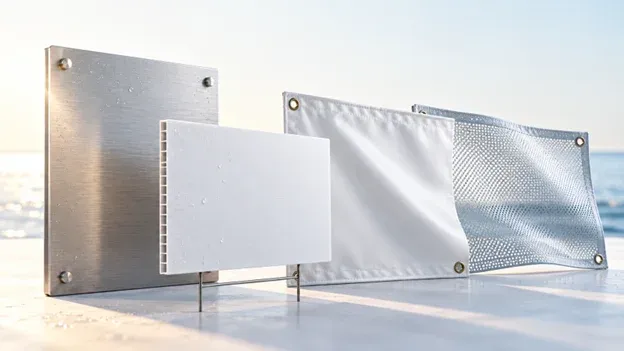
The short answer: The best material for outdoor signs in Tampa Bay depends on whether the sign is permanent, temporary, sheltered, or exposed. For most long-term rigid panels, start with aluminum or aluminum composite. Choose Coroplast for short-term yard, event, and directional signs. Use solid vinyl for temporary banners in protected locations and consider mesh for larger, more exposed banners. For windows, panels and vehicles, choose an outdoor-rated adhesive vinyl and a compatible protective laminate when needed.
A roadside panel along Hillsborough Avenue faces a different environment than a banner on a fence near Clearwater or a window graphic beneath an awning. The material, finish, and mounting method should match the actual site.
Why Tampa Bay Weather Changes the Decision
Outdoor signs in Tampa Bay contend with several conditions at once:
-
Sun and heat: At Tampa International Airport, normal daily high temperatures range from 90.2°F to 91.2°F from June through September. Direct sun can make a sign's surface even hotter.
-
Rain and humidity: The area's normal annual rainfall is 49.48 inches, with 30.24 inches—about 61%—falling from June through September, based on 1991–2020 Tampa climate normals. Separate humidity normals report annual averages of 86% at the morning observation and 58% in the afternoon.
-
Wind and salt exposure: Wind puts pressure on panels, banners, and mounting points. Closer to the Gulf or Tampa Bay, salt air also makes compatible, corrosion-resistant hardware especially important.
Before comparing materials, ask three questions: How long will the sign remain installed? How exposed is the location? Does the message need a rigid panel, a flexible banner, or a graphic applied to another surface?
If you are still deciding which types of signs your property needs, see our guide to 10 business signs every Tampa storefront should consider.
Outdoor Sign Materials at a Glance
|
Material
|
Best use
|
Main advantage
|
Watch for
|
|
Aluminum or aluminum composite
|
Longer-term property, parking and directional panels
|
Rigid, lightweight and resistant to rust
|
Correct thickness, frame and hardware
|
|
Coroplast
|
Short-term yard, event and temporary directional signs
|
Light, portable and economical
|
Bending or loose stakes in exposed wind
|
|
Expanded PVC foam board
|
Smooth panels in sheltered applications
|
Clean, polished presentation
|
Product rating, heat and panel size
|
|
Acrylic or polycarbonate
|
Dimensional or illuminated sign components
|
Refined appearance and fabrication options
|
Expansion, impact needs and attachment
|
|
Solid vinyl banner
|
Temporary promotions in protected locations
|
Dense color and easy storage
|
Greater wind pressure
|
|
Mesh banner
|
Large fence graphics in more exposed locations
|
Allows some airflow
|
Lower opacity; still requires a storm plan
|
|
Adhesive vinyl
|
Windows, panels, equipment and vehicles
|
Flexible and vivid
|
Film, surface, sun and laminate compatibility
|
Not sure which row fits your project? Send AlphaGraphics Northwest Tampa a site photo, approximate dimensions, and how long the sign needs to remain installed. Those three details eliminate many poor material choices early.
1. Aluminum: A Strong Choice for Longer-Term Rigid Signs
For most long-term rigid exterior panels, start with aluminum or aluminum composite. Both are lightweight for their rigidity and don't rust like untreated steel can. They are commonly used for property identification, parking, directional, and post-and-panel signs.
A large panel on an exposed wall has different structural demands than a small parking sign, so panel construction, thickness, frame, and attachment points must work together. At salt-air-exposed sites, mutually compatible, corrosion-resistant hardware is especially important.
Explore aluminum sign options from AlphaGraphics Northwest Tampa.
2. Coroplast: Practical for Short-Term and Portable Signage
Corrugated plastic, often referred to as Coroplast, is moisture-resistant, lightweight, and easy to transport. It is a practical choice for short-term yard signs, events, open houses, hiring campaigns and temporary directions.
Its outdoor performance still depends on the print system, UV exposure, panel size, stakes, and mounting. Larger panels present more surface area to the wind, so don't treat Coroplast as a premium long-term panel. Bring temporary signs inside before dangerous weather arrives.
See Coroplast sign options for yard, event and temporary business signage.
3. Specialty Plastics: Best for Sheltered or Designed Applications
Expanded PVC foam board provides a smooth print surface and may suit selected sheltered exterior displays. Avoid using it as a generic substitute for aluminum: product grade, thickness, panel size, heat exposure, and mounting all affect whether it fits the job.
Acrylic and polycarbonate are more often used for dimensional elements, directories, or illuminated sign faces. They offer a refined appearance, but they are not interchangeable. Specify impact needs, light transmission, thermal movement, and the attachment method as part of the sign's design. Ask which exact product is rated for your installation.
4. Solid Vinyl or Mesh: Which Banner Works Better Outside?
Solid vinyl works well for temporary promotions where dense color and image detail matter. In an exposed location, however, a solid banner can behave like a sail.
Mesh allows some air to pass through, making it a useful starting point for larger fence graphics or routine wind exposure. The tradeoff is lower opacity and less visual density. The actual reduction in wind pressure depends on the mesh's open area, banner size, mounting, nearby obstructions, and site conditions; mesh has no universal wind rating.
Choose based on the site:
Neither material is hurricane-proof. Compare banner and mesh materials, and use our business banner size guide when planning proportions and viewing distance.
5. Adhesive Vinyl: Match the Film to the Surface
Outdoor adhesive vinyl is used for storefront windows, sign panels, equipment, and vehicle graphics. Choose the film for the surface shape and condition, intended duration, preparation requirements, and sun orientation. Pair it with a compatible overlaminate when the application calls for added protection.
Avoid a universal lifespan claim. The same graphic can age differently on a shaded north-facing window and a dark, west-facing exterior panel. A site photo and an honest description of the desired use lead to a better recommendation.
Learn more about vinyl sign and graphic options.
For application ideas, explore 12 practical ways Tampa businesses can use window graphics.
Match the Material to the Tampa Bay Use Case
Use these as practical starting points:
-
Roadside property sign in Northwest Tampa: Start with aluminum or aluminum composite, then specify the frame and attachments for the size and site.
-
Exposed construction or athletic-field fence: Consider mesh, confirm site rules, and create an early-removal plan for severe weather.
-
Weekend event or festival: Use portable Coroplast directions and temporary banners, with someone assigned to retrieve them as conditions change.
-
Gulf-facing, bayfront or otherwise salt-air-exposed site: Specify mutually compatible, corrosion-resistant frames, fasteners and mounting components.
These are not engineering specifications. Size, placement and mounting can change the recommendation.
Prepare Temporary Signs Before Severe Weather
No portable sign, flag, banner or lightweight panel should be assumed safe in tropical-storm or hurricane conditions. The Florida Division of Emergency Management warns that signs and other unsecured outdoor items can become dangerous flying debris.
Before hazardous weather arrives:
-
Bring in A-frames, flags, portable stands, and temporary yard signs.
-
Remove temporary banners early, according to the sign provider's removal plan, before winds make the work unsafe.
-
Follow official emergency guidance and never climb or attempt removal during an active storm.
Mesh can reduce wind pressure compared with solid vinyl, but it does not eliminate wind load and should never be treated as storm protection.
Do You Need a Sign Permit in Tampa?
Permit requirements depend on the sign type, size, location, attachment, and jurisdiction. A Tampa mailing address does not necessarily mean the site is within Tampa city limits.
For installations inside Tampa city limits, the City's commercial sign permit information lists review items that can include a site plan, elevations, sign specifications, area calculations, design wind loads, and attachment or foundation details. Sites in unincorporated Hillsborough County, Pinellas County, or another municipality follow that jurisdiction's rules. Also check landlord or shopping-center criteria and obtain property-owner approval.
What to Consider Before Ordering an Outdoor Sign
A weather-ready sign is a complete system: substrate, print, finish, edges, hardware, structure, and installation. Two signs made from the same panel can perform differently because their exposure and mounting are different.
For a more useful recommendation and quote, send:
-
A clear photo of the installation area and its surroundings
-
Approximate sign dimensions
-
How long the sign needs to remain in service
-
The wall, window, fence, posts, or other mounting surface
-
Whether the site is sheltered, wind-exposed, or affected by salt air
-
The direction the sign faces and how much direct sun it receives
-
Typical viewing distance and whether viewers are walking or driving
-
Whether the sign will be permanent, temporary, moved, or stored for reuse
-
Known landlord, property-management, or permit requirements
Ask how the recommended substrate, outdoor print method, protective finish and hardware work together. Follow the manufacturer's cleaning guidance, and inspect exterior signs periodically from the ground for loose hardware, damaged edges, or failing attachments.
Frequently Asked Questions
What is the best material for outdoor signs in Florida?
For many longer-term rigid sign panels, aluminum is a strong starting point because it is lightweight, stable, and rust-resistant. The best choice still depends on size, exposure, mounting, appearance, and required service period. Temporary yard signs, banners, window graphics, and illuminated signs each call for a different material system.
Is vinyl or mesh better for an outdoor banner?
Solid vinyl provides denser color and suits smaller or protected temporary banners. Mesh allows some airflow and can be a better starting point for large, exposed fence graphics. Both require suitable mounting and an early-removal plan before severe weather.
How can I keep an outdoor sign from fading?
Start with materials, inks, and finishes intended for outdoor use. Consider direct-sun exposure, use a compatible protective laminate when appropriate, and follow the manufacturer's cleaning guidance. The complete specification and location—not one product label—determine how the sign ages.
How long will an outdoor sign last in Tampa Bay?
There is no accurate universal lifespan. Material, ink, finish, sun direction, salt exposure, structural design, installation, and maintenance all play a role. Ask for warranty information tied to the specific products recommended for your site.
Does every business sign in Tampa require a permit?
No single rule applies to every sign. Confirm current requirements with the jurisdiction that governs the installation address, then check landlord or property-management criteria before production and installation.
Choose a Sign for the Location, Not Just the Material Name
The best choice is not one “Florida-proof” material. It is a sign system matched to the message, location, exposure, mounting method, and intended duration.
Send AlphaGraphics Northwest Tampa a site photo, approximate size, and how long the sign needs to remain installed. We will help you compare material, finishing, and mounting options so your business can be seen, remembered, and chosen.
Start your outdoor sign project with AlphaGraphics Northwest Tampa.